

In October 2025, the CNI, with the annual publication of the report on the qualification exam relating to the professions of Engineers and Architects, reported a collapse in qualifications, generating subsequent different interpretations on the real reasons for this.
The numbers
The graphs represented by the CNI report identify, for engineers, the trend of those qualified from 1996 to 2024 (last 26 years), while, for architects, the two lines respectively indicate participants and those qualified for the exam from 2003 to 2024 (last 21 years).
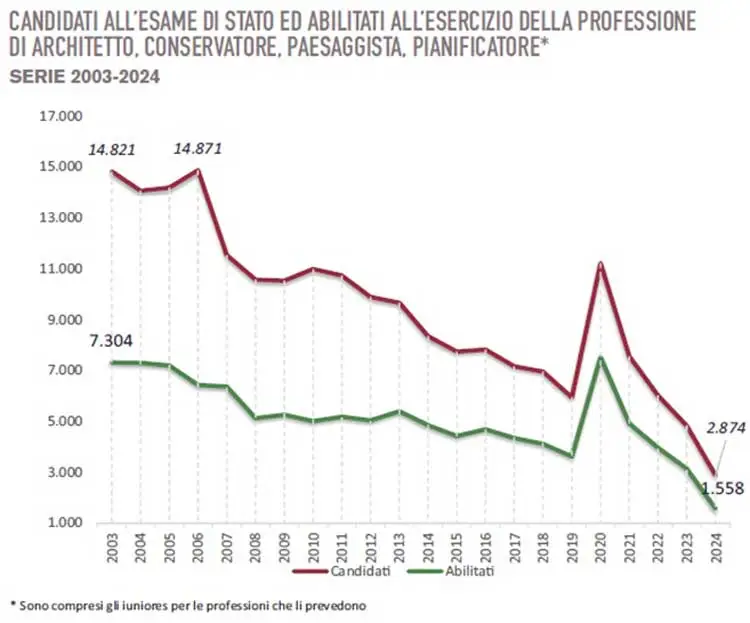
Well, looking only at the overlapping data, it is highlighted that an actual decline in qualifications is a constant for both professions starting from 2003, the year the 3+2 university reform became fully operational, until 2019, except for a slight increase in 2006.
Only the years of the pandemic, i.e. 2020 and 2021, saw a reversal of trend, with a significant growth in participants and qualifications, only to return to an increasingly marked decline between 2023 and 2024, the latter year with a hybrid and intermediate exam method compared to the legislative dictate, which was then restored in 2025.
If these are the numbers, let’s now analyze the actual causes, trying to link this to specific events linked to universities and the profession.
The causes of the decline in qualifications
First of all, the system of three-year and specialist degrees, introduced by Ministerial Decree 509/99 and the subsequent Presidential Decree 328/2001 which profoundly reformed first the university and then, consequently, the structure of the orders. The reforms mentioned attempted to modify the university system with specific consequences also on the labor market, the result of which was that – as stated by Riccardo Ruggeri on Saffron – “Schools and universities tend to promote everyone with a qualification which, if it is true that it should provide privileged access to work, is today light years away from the value of degrees over 60 years ago and therefore from that role as the heart, lungs and brain of society itself, which universities and professions have represented, for better or for worse, for many centuries of Western civilisation.”.
And the numbers in the tables referred to speak clearly in this sense: first school and university education, and the subsequent reform of orders, divided into sections and sectors, with in parallel the reform of state exams characterized by an increase in tests, seems to be the primary cause of this disaffection.
This is confirmed precisely by the increase in qualified people between 2020 and 2022, linked exclusively to an exam facilitated by the single remote oral test, which eliminated the problem of having to carry out a project theme, a report and a general culture theme.
Furthermore, the reasons for this temporary increase, analyzing the characteristics of those who attended the preparation courses I organized in that period, are evident to me. In many cases they were old graduates already employed in the world of work in various capacities, without any particular need for qualification, and therefore not previously willing to take on the considerable burdens for the preparation required for the exam with the multiple tests introduced by Presidential Decree 328/2001, but who, faced with a facilitated exam, in a period of closures and limitations, took advantage of this to close a circle and obtain the qualification.
So, perhaps, the issue of disaffection towards the freelance profession and qualifications should be sought elsewhere. First of all, in schools, which have no longer provided adequate training for decades, something that has been denounced several times even at university level, but which has, until now, seen absolutely no interventions to modify this declining trend. The same consumerist society seems to have removed the ability to resist the stress given by a meritocratic training system, and therefore there is a decrease in performance demands, to which is added, as a further danger, also the indiscriminate use of technology and AI, which certainly do not help in training mental faculties, generating an increasingly lower performance level.
And let’s not forget, moreover, the 0 growth linked to the birth rate. If you don’t have children, how can you expect the numbers of potential new graduates and qualifications to grow?
Going on to analyze aspects more specifically linked to the profession, some legislative measures always linked to the market certainly did not help, such as the elimination of minimum tariffs, which, together with an increasingly suffocating and often incomprehensible bureaucracy. at least in construction and urban planning – generate notable disaffection with certain professions.
And perhaps, the very fact that there are too many technicians linked to civil construction where skills overlap – that is, architects sec. AB, civil environmental engineers sec. AB, surveyors and graduate surveyors, experts, etc. – has generated a shift towards more profitable and satisfying professions, because if we combine the number of members of provincial orders and colleges of the aforementioned professions, compared to the actual number of the population, we would probably find ourselves having a technician with an extended family.
Therefore, if the technical professions, in the face of commitment and ability, no longer guarantee the setting in motion of the social elevator of the past, without therefore adequate satisfaction in both economic and professional terms, why should there be growth trends in these professions?
>> If you want to receive news like this directly on your smartphone, subscribe to our new Telegram channel!