

In contemporary thermotechnical design, vapor migration represents one of the most delicate aspects in evaluating the behavior of the building envelope, in particular in internal thermal insulation interventions. Unlike an external insulation system, in which the load-bearing wall remains close to the temperature of the internal environment, internal insulation radically modifies the thermal regime of the existing structure. The wall cools during the winter season and the dew point tends to move inside the insulation.
In this context, hygrothermal verification plays a fundamental role. The calculation method adopted becomes a determining element for the durability of the intervention: an incomplete evaluation of the vapor migration phenomena can lead, over time, to interstitial condensation and consequent degradation of the materials, even in the presence of apparently thermally correct stratigraphy.
>> Are you interested in articles like this? Receive them directly
Regulatory framework and legislative obligations
The Italian regulatory framework, defined by the Ministerial Decree 06/26/2015 (“Minimum Requirements”), imposes the obligation to carry out hygrothermal checks for all structures subject to intervention that delimit the air-conditioned volume towards the outside, both in newly constructed buildings and in redevelopment interventions.
There are two checks required: the first concerns the absence of risk of mold formation on the internal surfaces, the second the absence of interstitial condensation within the stratigraphy. In the latter case, the legislation requires that any accumulations of humidity evaporate completely within the annual cycle and do not exceed the maximum quantities permitted for the different materials.
Mold and condensation: because the time factor is central
In the hygrothermal verification of opaque structures it is essential to correctly distinguish between interstitial condensation and mold development, since they are different phenomena, governed by different physical mechanisms and time scales.
Interstitial condensation is the formation of liquid water within the stratigraphy when the vapor pressure exceeds the saturation pressure at a specific layer. It is a phenomenon that can occur even in the absence of visible signs and which depends on the thermo-hygrometric balance between the materials that make up the wall.
The development of mold, however, does not require the presence of liquid water. It is linked to the maintenance over time of high relative humidity conditions in the innermost layers or near the internal surfaces of the structure. It is therefore a cumulative phenomenon, strongly dependent on the duration of the critical conditions.
This distinction highlights a key point: a test that only analyzes an average or instantaneous condition is not able to describe whether humidity tends to progressively accumulate in the stratigraphy or whether, on the contrary, it is eliminated over time. The time factor therefore becomes central in the assessment of hygrothermal risk.
Glaser’s method and its application limits
The Glaser method, regulated by UNI EN ISO 13788, is a stationary calculation model. It performs calculations based only on the average monthly external temperatures and as a physical principle analyzes the stratigraphy by modeling only the diffusion of water vapor. The principle of the method consists in comparing the vapor pressure with the saturation pressure along the stratigraphy, identifying any condensation zones.
The method does not consider a series of relevant physical phenomena, including the transport of liquid water by capillarity, the hygroscopic capacity of the materials, solar radiation, driving rain and the variation of the physical properties of the materials as a function of the moisture content. Furthermore, the analysis is conducted in steady state (monthly average values), without evaluating the real temporal evolution of the phenomena.
Dynamic hygrothermal simulation: a paradigm shift
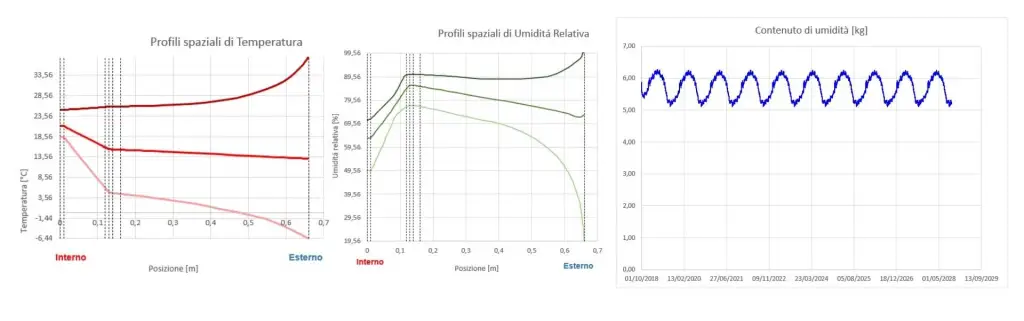
The dynamic hygrothermal simulation, regulated by UNI EN ISO 15026, overcomes the limits of the stationary model by introducing an hourly analysis of the flows of heat, liquid water and steam within the stratigraphy for 365 days a year. This approach allows us to consider the real evolution of external and internal climatic conditions, including solar radiation, driving rain, latent heat and the variation of material properties as a function of the variation in thermo-hygrometric conditions.
The real added value of dynamic verification lies in the possibility of evaluating the hygrometric balance over time. We do not limit ourselves to checking whether condensation forms for a single given average monthly value, but we analyze whether the humidity accumulated during the winter season is actually disposed of in the most favorable periods, bringing the stratigraphy back to dry equilibrium conditions at the end of the annual cycle.
This aspect is fundamental for the durability of the interventions: a stratigraphy that accumulates humidity year after year is destined to deteriorate over time.
Diffusion and convection: the role of air tightness
A further element that makes a purely stationary evaluation insufficient is the distinction between vapor diffusion and convection. Diffusion is a slow phenomenon, governed by the vapor pressure gradient and the permeability of the materials. Convection, on the other hand, is linked to air movements driven by temperature gradients that pass through discontinuities or imperfections in the air sealing layer.
Convection can transport quantities of humidity within the stratigraphy that are enormously higher than diffusion; any discontinuities in the air tightness can completely compromise the hypotheses underlying a calculation whether it is merely stationary or dynamic.
Conclusions
Addressing vapor migration in internal insulation based exclusively on stationary checks means adopting a simplified representation of complex physical phenomena. Dynamic hygrothermal simulation is the most coherent tool for evaluating the real behavior of stratigraphies over time.
Only through a dynamic analysis is it possible to understand whether humidity tends to accumulate or whether it is actually disposed of during the annual cycle, guaranteeing the durability of the redevelopment interventions. In this sense, dynamic checks do not represent an advanced option, but the natural point of arrival of an informed design of the building envelope.