
Production network: 12 plants between Brescia and Mantua
Concrete Italia is based in Brescia and has a network of 12 concrete plants, distributed between the provinces of Brescia (9 sites) and Mantua (Ponti sul Mincio, Cavriana and Mantua).
The presence of both dry and pre-mixer systems allows us to guarantee flexible and qualitatively constant production, adaptable to different construction site needs. The operational model is based on an average radius of approximately 30 km per plant: a choice that allows us to optimize logistics, reduce transport distances and ensure continuity of supplies.
Two complementary markets: infrastructure and widespread construction
Concrete Italia’s activity develops in two complementary areas. On the one hand, large infrastructure works, which require production capacity, organization and operational continuity; on the other, the widespread market, which includes residential, industrial and urban construction, where speed and proximity to the customer are crucial.
This dual presence allows the company to adapt processes and services to different scales of intervention, maintaining industrial coherence and reliability.
The production model is based on an integrated supply chain rooted in the territory, also supported by the Heidelberg Materials cement plant in Rezzato–Mazzano (BS), one of the most advanced plants in Europe. This rooting allows us to reduce logistical impacts, guarantee continuity in supply and develop a stable relationship with the local production system, in which infrastructures and buildings become a development lever for the territory.
Sustainability of materials and reduction of CO₂
Sustainability represents a structural element of production. Concrete Italia has progressively oriented its choices towards the use of cements with a lower environmental impact and more efficient management of resources.
In the last two years, approximately 90% of production has been made with low CO₂ emission cements, in particular the CEM III slag type. This step made it possible to obtain an estimated reduction in emissions of approximately 12% in 2025 compared to 2024, without compromising the technical performance of the concrete.
At the same time, the company has steadily integrated the use of artificial and recycled aggregates (MPS, secondary raw materials) deriving from blast furnace slag and selective demolition. In the last two years, approximately 25,000 tonnes of artificial and recycled aggregates have been used in concrete mixes, with a consequent reduction in the use of natural aggregates and a concrete contribution to the principles of sustainability and circular economy.
The integration between low-emission cements and recycled aggregates now allows approximately 90% of production to comply with the Minimum Environmental Criteria (CAM), anticipating regulatory and market demands.
Operation in large works
In the infrastructure sector, Concrete Italia operates as a concrete supplier capable of integrating into complex construction sites, guaranteeing production continuity, logistical coordination, compliance with deadlines and supplies even on extended shifts, up to 24 hours a day. To support this operation, Concrete Italia uses dedicated staff and a fleet of vehicles sized to easily support concentrated supplies and volume peaks.
Among the main works carried out:
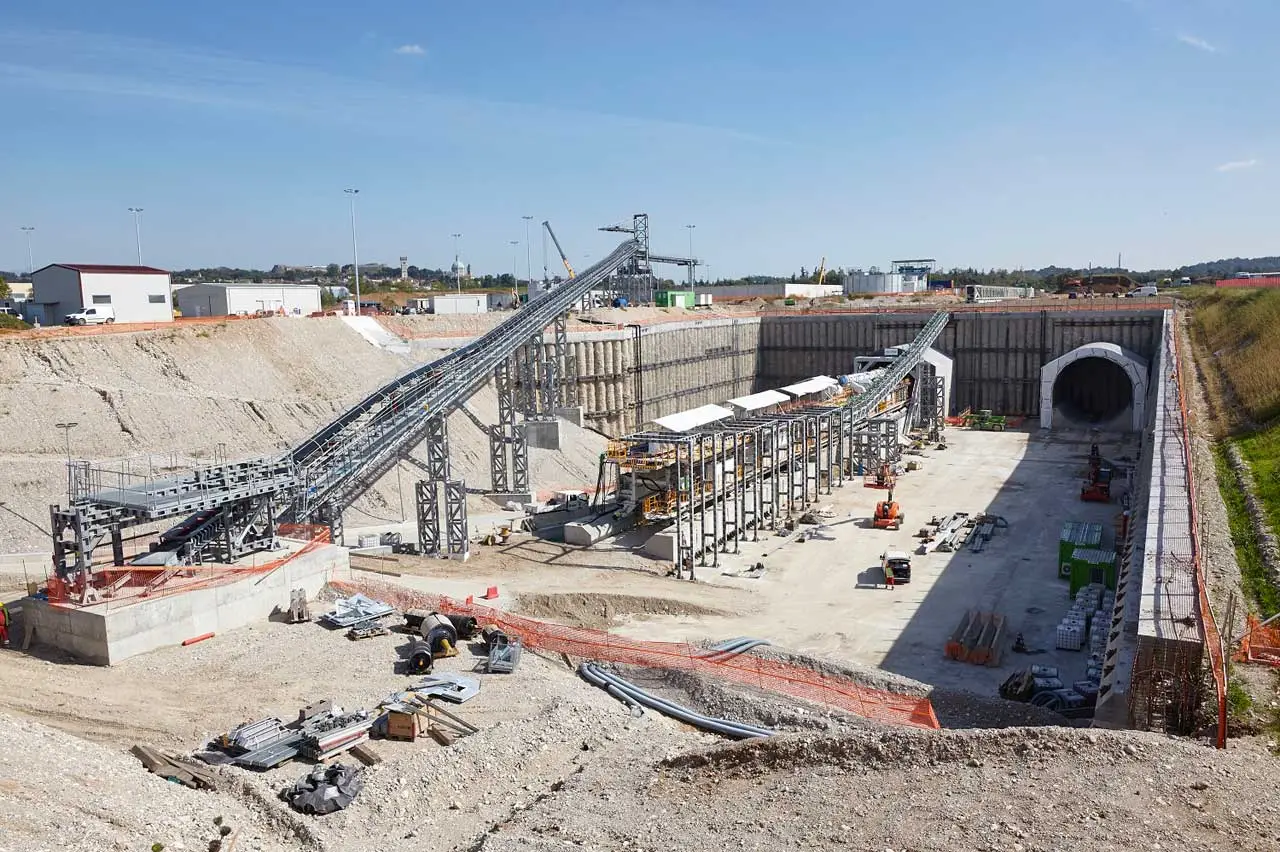
- Brescia–Verona High Speed Line (CEPAV Due), with overall supplies of the order of 500,000 m³ of concrete through multiple plants along the route;
- Railway doubling of the Piadena–Mantua section, with continuous support for a multi-year development site.
The widespread market: construction, logistics and urbanization
Alongside large works, Concrete Italia is active in the widespread market, supplying concrete for civil construction, industrial warehouses, logistics and urbanization works. In this context, the collaboration with Ibuild Italia – a Heidelberg Materials company specialized in concrete flooring – allows us to combine the supply of material with integrated solutions for flooring and horizontal structures.
The most significant interventions include airport infrastructure with approximately 40,000 m³ of concrete, a 12,000 m³ BREEAM “Very Good” certified logistics hub in Ospitaletto (BS), a hotel structure in Torri del Benaco (Formaggioni Group) and new production offices in Brescia (Leonessa Hub Scarl), built using products in line with CAM requirements.
Concrete Italy: a model of industrial development
Concrete Italia represents a concrete business model capable of combining industrial scale, territorial proximity and sustainability. The experience gained in large infrastructures coexists with a structured presence in the widespread market, where reliability, flexibility and knowledge of the local context become decisive factors. This is accompanied by a concrete commitment to reducing the environmental impact of materials, through technological choices regarding cements and aggregates. What emerges is an industrial approach oriented towards continuity over time, in which innovation, sustainability, attention to safety and territory are integrated components of a single development strategy.
For further information
concreteitalia.it
heidelbergmaterials.it