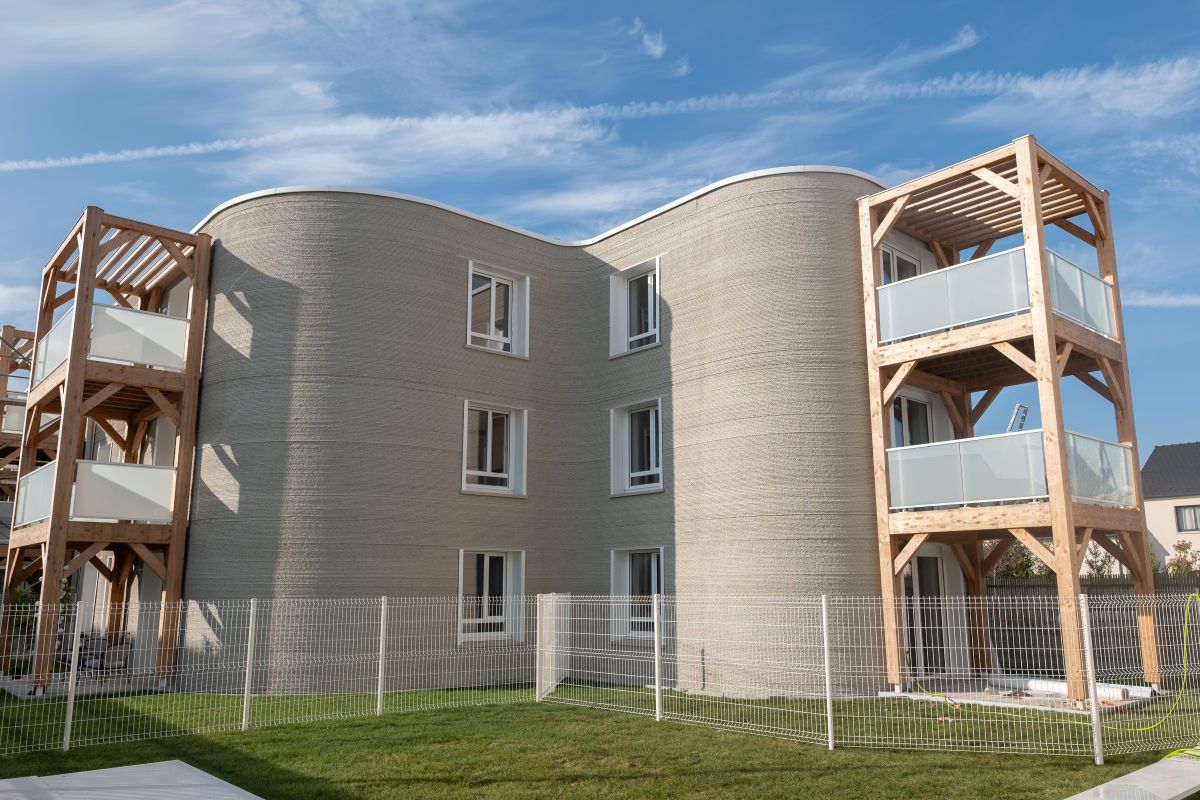
With ViliaSprint², Plurial Novilia is delivering the first French collective building whose entire structure is printed in 3D concrete on site. A large-scale demonstration of the promises of additive manufacturing.
Publi-Information 


This is a first in France. In Bezannes, near Reims, a collective building whose entire structure was printed in 3D concrete directly on site has just been delivered. A concrete step forward for a process set to transform the building sector.
A first in France on the scale of a collective building
In Bezannes (Marne), Plurial Novilia reaches a milestone. THE social landlord inaugurates ViliaSprint2a building of 12 social housing units in which all of the load-bearing walls – facades and partitions – have been produced by 3D concrete printing directly on site.
With 800 m2 habitable distributed over three levels (R+2), the operation also stands out as the largest building of its type in Europe. Delivered in just 12 months (TCE, excluding infrastructure), the program takes place in a context of a slowdown in new construction and a persistent labor shortage, particularly in structural work.
A technology now operational
After an initial experiment in 2022 on individual homes, Plurial Novilia is moving to the next level. THE construction site relies on a COBOD BOD2 robotic gantrydeployed by PERI 3D Construction, capable of extruding layer after layer of specific concrete to form load-bearing walls.
Developed by Holcim (ECOPact low carbon range), this printable concrete, reinforced with macrofibersshows a reduction of at least 30% in CO emissions2 compared to traditional concrete.
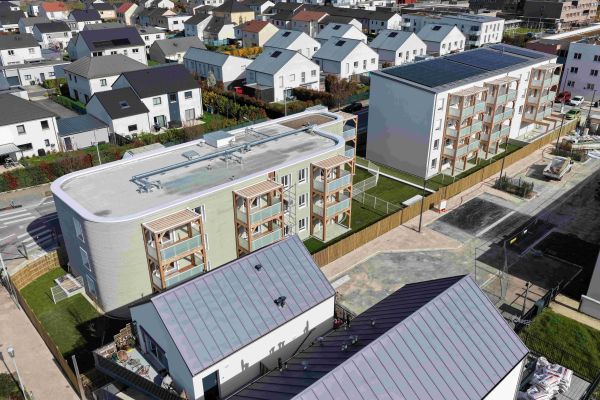
Started in March 2025, the printing phase was completed in 34 actual days – compared to 50 initially planned – thanks to optimization of the phasing and prefabrication of the slabs, limiting the robot’s movements. © Plural Novilia
Concrete gains on the construction site
Beyond technical performance, the process transforms the organization of work. Three operators are enough to control printing, compared to six in the traditional method. Strenuous tasks are reduced, postures improved, the risks of musculoskeletal disorders and accidents reduced.
The material resources are also reduced: robot and scaffolding partly replace formwork and footbridges. Result: a quieter, safer site and less dependent on labor which has become scarce.
Towards the industrialization of 3D printing in construction
Designed as a demonstrator, the project aims to test the viability of the process on the scale of collective housing. On the same plot, a second almost identical building was built in the traditional way in order to compare performances. Two observations emerge:
– the deadlines for the structure phase are halved;
– On-site manufacturing also makes it possible to reduce waste by half (from 10% to 5%) as well as to limit transport, concrete being produced and transformed directly on site.
L’3D printing also opens up new architectural possibilities. Curved shapes, complex geometries, optimization of volumes: so many levers that make it possible to reduce concrete consumption by around 10%.
A response to the challenges of the sector
The project is part of a global approach to sustainable construction. Designed by HOBO Architecture, it integrates biosourced and geo-sourced materials (perlite, wood), 500 m2 photovoltaic panels and a gas hybrid heat pump, enough to approach 60% energy autonomy, in accordance with the requirements of RE2020.
If the cost remains higher today – around +30%, for a total investment of 4.5 million euros – it is mainly linked to the R&D phases as well as the approval procedures. It is expected to decrease with the increase in power of the process. In fact, Plurial Novilia is already preparing a new program of around 40 housing unitsmixing individual and collective. The goal is to accelerate production rates – up to four times faster – and achieve a level of competitiveness comparable to traditional construction.
Plural Novilia