
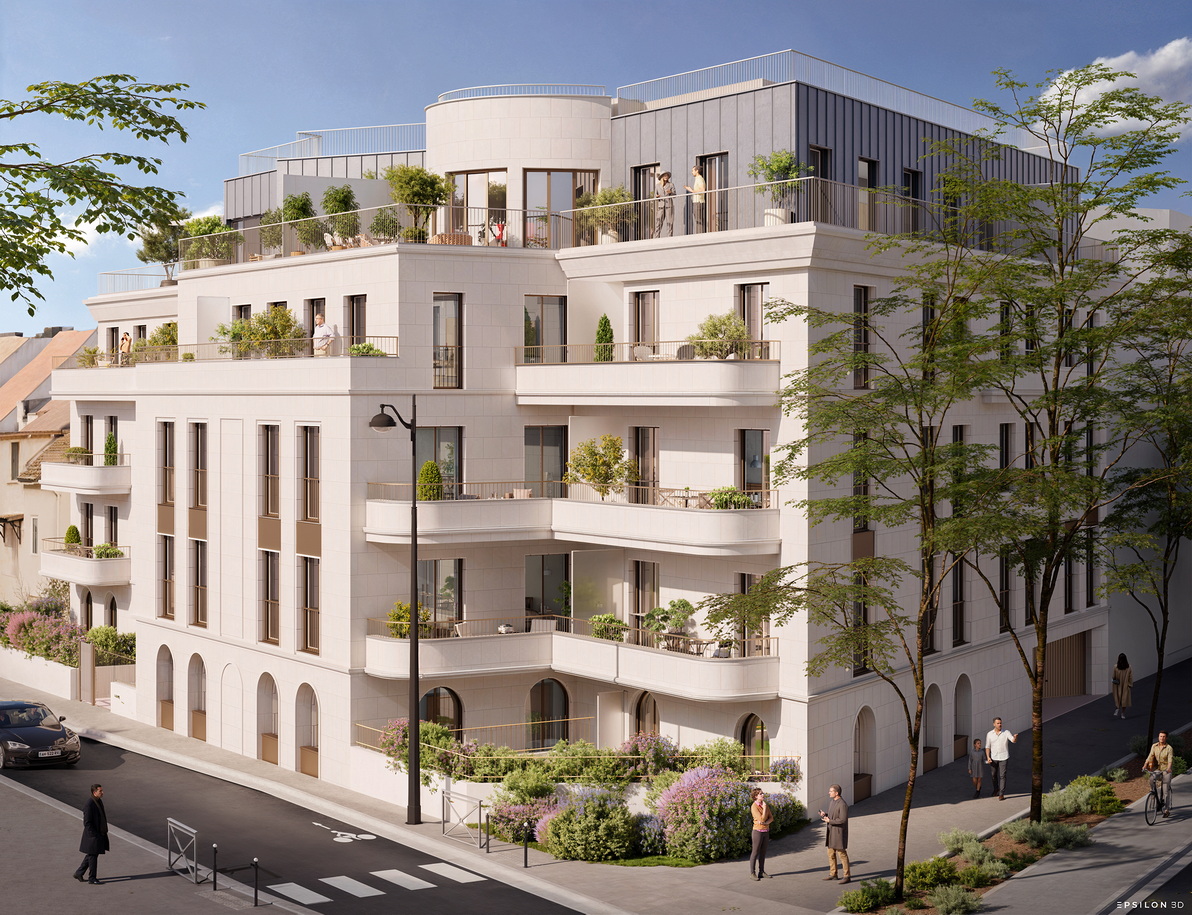
Real estate is above all an investment. Investors – banks, insurers and other investment funds – are now required to follow the sustainability requirements of the European taxonomy.
Publi-Information 


Created in 2019 by Raphaël Tréguier, Karegheadquartered in Paris, brings together four professions:
– real estate development;
– Structuring of investments;
– Transformation of real estate assets;
– And technical management of operations.
But what makes Kareg particularly interestingis that the company has well understood the enormous influence of the European taxonomy in the financing of real estate transactions. It therefore structures all its operations to make them attractive to institutional investors within the framework of this taxonomy. Which leads her to talk less about energy consumption than about carbon load and to promote the transformation of existing buildings, rather than demolition-reconstruction. On April 9, we met with Kareg and his partners about the transformation of an office building in Antony in 32 new housing units. But first, here is a little reminder of what the European green taxonomy.
The European green taxonomy guides investments
In 2018, the European Commission presented a set of legislative proposals, the cornerstone of which is the “Taxonomy” regulation, definitively adopted by the political authorities of the European Union (EU) in 2020. taxonomy measures the “green” part of the activities of a company or financial product (portfolio or investment fund). It is used to compare the contribution of different economic actors and financial products to the ecological transition in order to guide investment decisions. It is also used in the definition of criteria for awarding “green” labels, such as the “EU Green Bond Standard”.
According to the taxonomy, which concerns 90 economic sectors, including construction, both new construction and renovation, an economic activity is considered sustainable if it contributes to at least one of the following six objectives:
– climate change mitigation;
– Adaptation to climate change;
– Sustainable use and protection of aquatic and marine resources;
– Transition to a circular economy;
– Pollution control;
– Protection and restoration of biodiversity and ecosystems.
THE companies subject to the taxonomybasically those with more than 500 employees, are also subject to an obligation to communicate social and environmental information. With regard to buildings – new construction, renovation and acquisition/operation of buildings – delegated regulation (EU) 2021/2139 of June 4, 2021 relating to the building sector explains what the greenness criteria are:
– for new buildings having filed a building permit after January 1, 2022 and subject to RE2020, compliance with the requirements of RE2020 leads to automatic compliance with the “NZEB – 10%” criterion or Near Zero Energy Building – 10% requested by the taxonomy. France considered that the RE2020 performance corresponds to the NZEB level. This level could be revised this year thanks to the transposition in France of the Directive on the Energy Efficiency of Buildings modified in 2025 and it varies with each tightening of RE2020.
– for the renovation of an existing building, it is particularly necessary to comply with the requirements applicable to major renovation work (compliance with the overall RTx); or, failing that, to achieve a reduction in primary energy demand of at least 30% following the renovation.
As a result, all institutional investors present in real estate are looking foroperations that fall within the criteria of the taxonomy. And there, Kareg innovates.
Highlight the carbon burden
Kareg indeed decides to highlight the carbon chargerather than strict energy consumption, and focuses on renovation rather than demolition-reconstruction. The office building converted into housing in Antony served as an example to illustrate this approach.
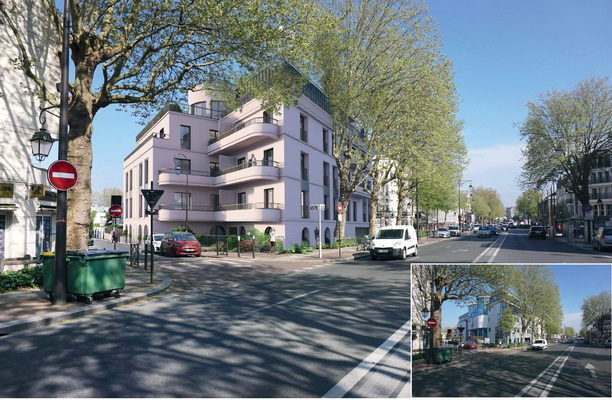
At number 2 rue de Bône in Antony (92), an office building built in 1990 was empty. A team, bringing together Kareg, an investor specializing in the transformation of real estate assets, Wild Trees, an ESG and AMO Environnement strategy consultancy, Cap Synthesis, developer, and Outsign, project architect, is transforming it into a building with 32 housing units. © Kareg
From a regulatory point of view, this operation is subject to global RT. This appeared in 2008 and hasn’t really been modified since. For housing, maximum consumption must not exceed 80 to 165 kWh/m2.year depending on the case. Unfortunately, during the project presentation, Kareg and its partners were not able to provide the results of the overall RT study.
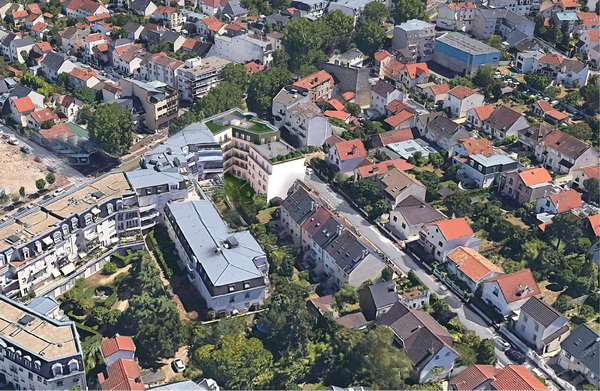
For this building, with 12 m deep platforms, 2.85 meters high ceilings and a load-bearing facade, Kareg presented us with the result of a RE2020 study. © Kareg
The RE2020 study provides the ICéneregie coefficient = 86.8, while the RE2020 ceiling reaches 260 from 2028 and without further tightening, i.e. a gain of 67.85%, and the ICconstruction coefficient = 430, against a ceiling of 480 from 2028, i.e. a gain of 10.41%. These two coefficients, expressed in kgCO2/m2indicate the environmental footprint of the building: ICéneregie measures the influence of the building’s energy consumption over 50 years, while ICconstruction translates the GHG emissions during the construction of the building and for its maintenance over 50 years. The RE2020 study provides the Cep = 71.5, against a ceiling of 88.2, i.e. a gain of 19%, the Cep,nr = 71.5 against 72.6, gain of 1.5% and the DH indicator of summer comfort: 600 °Ch, against a ceiling of 1250 °Ch With all this, the building will have a class A DPE. It will be in collective heating with a single pump to heat. Which is not a good idea: if it breaks down, the 32 homes lose heating and hot water. The classic rule in collective boiler rooms tends to install at least two generators to avoid this risk. Most of the very significant gain in the ICéneregie coefficient comes essentially from the external thermal insulation implemented in this renovation and the use of a collective heat pump, running on electricity.
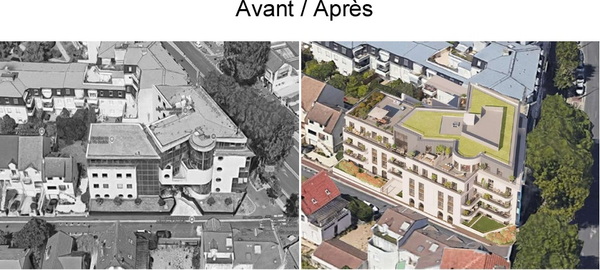
Here is the Before / After. © Kareg
The advantage of renovation
This operation was launched for the GPS Court fund, now closed in Kareg. Kareg is launching a second GPS fund in 2026. Kareg’s GPS (Grand Paris Select) funds are two asset repositioning funds in Île-de-France, classified art.9 SFDR (Sustainable Finance Disclosure Regulation – SFDR) on the theme of saving carbon footprint, i.e. an evaluation of the contribution of an asset to sustainable development.
In RE2020, any reused material carries a zero carbon burden. In this operation, 1,831 m2 of floor area (SDP) are retained on a final total of 2,492 m2. The two basement levels which are particularly GHG intensive are retained. 894 m2 of SDP are reconstructed. Which results in a final SHAB, used for an RE2020 calculation, of 2,032 m2. Kareg has decided that to qualify for its GPS funds, operations must show avoided GHG emissions of at least 180 kgCO2/m2. In this context of highlighting the CO balance2renovation naturally has an advantage over new construction. The greater the portion of the existing building structure retained, the more its balance sheet in terms of GHG emissions linked to construction is reduced. Kareg has also proven with this operation that energy consumption can be as efficient as in new construction.