
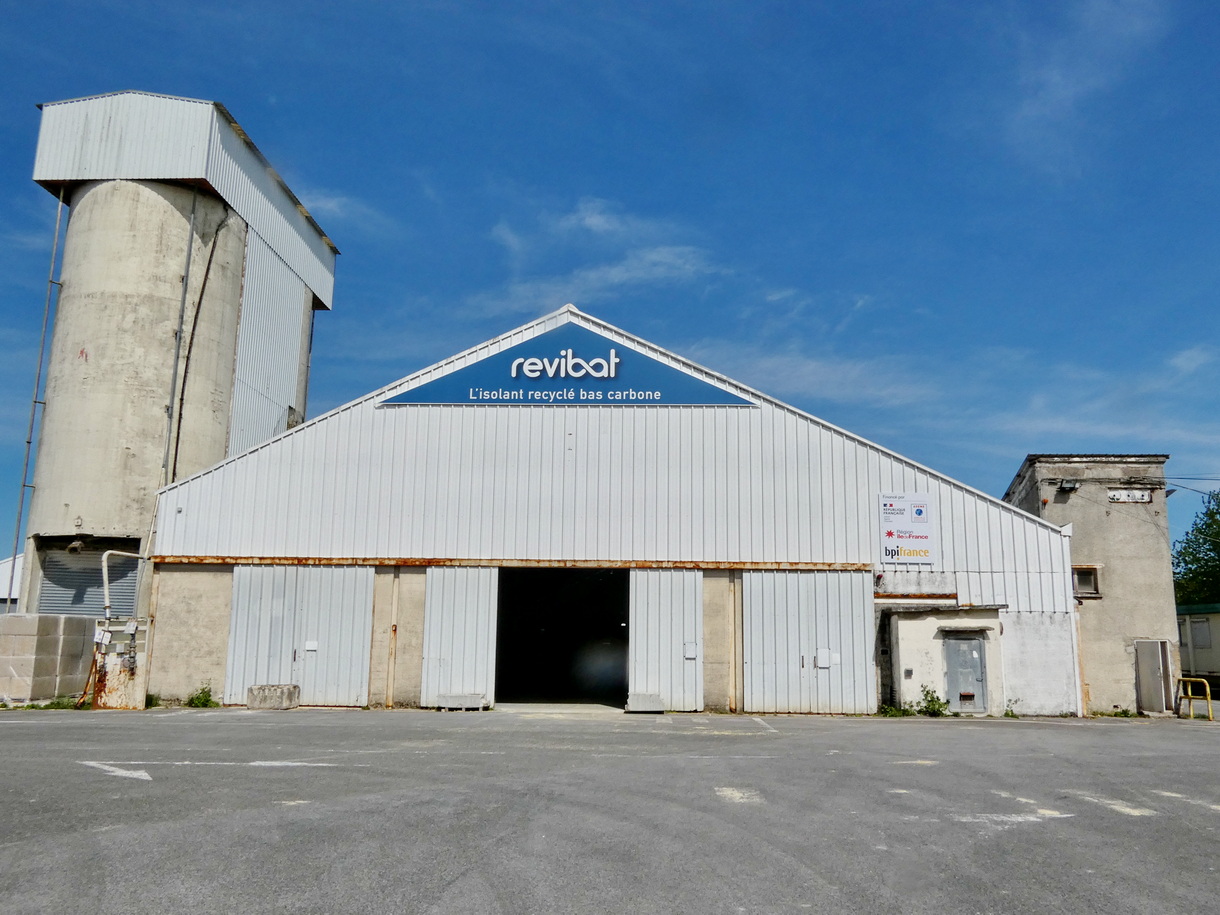
Revibat has developed and patented a new method, which consumes significantly less energy, to produce glass wool from the recycling of glass wool deposited on construction sites.
Publi-Information 


According to the FILMM, the union of mineral wool manufacturers156,000 t of glass wool are deposited per year in France or from production scraps. 90%, or still 140,000 t/year, are buried and only 10% are recycled. There already exists a recycling solution, developed and used by Isover Recycling, which consists of remelt glass wool in a melting furnace at 1250°C to recycle it.
However, Revibat, a very young company created in 2021has developed another method – defibration – which uses an oven at 200°C only to manufacture glass wool entirely from recycling and as efficient from a thermal and acoustic point of view as wool made from new glass.
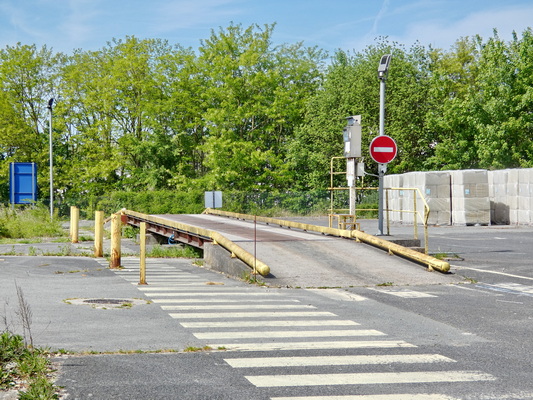
Trucks delivering glass wool waste are weighed upon arrival and departure to measure the mass of waste delivered. Revibat accepts glass wool in bulk, not too compressed to avoid breaking the fibers. © PP
Three years of development
Revibat, founded by three partners, including Nicolas Brousse, its current manager, Sophie Brétillon, in charge of sales, and Quentin Hervé in finance, began with three years of research and development with the FCBA, before moving on to industrialization in 2024.
Thanks to his contacts, Nicolas Brousse was able to set up the first Revibat factory on a former Siniat plaster factory of the Etex group in Monthyon, near Meaux. The site offers 3.6 ha of land, 10,000 m2 of buildings, including 6,500 m2 dedicated to the production of Reviver, Revibat’s product made from 100% recycled glass wool.
If the glass wool recycling technology by recasting accept any glass wool wastethere refibering technology developed by Revibat only applies to glass wool manufactured after 1997. Indeed, the compliance of mineral wools with Note Q of Directive 97/69/EC, adopted by the European Commission in December 1997, and transposed into French law in August 1998, exempts them from the carcinogenic classification. Revibat can only recycle glass wool that complies with this Note Q. As a result, the company must systematically test all glass wools that we offer him.
As soon as a removal site is indicated, Revibat will take a 30 g sample of each of the glass wool which are installed there. Its laboratory, located in Monthyon, analyzes the samples, identifies “the chemistry of the waste”, as Nicolas Brousse puts it, and compares the results with a database of mineral wools conforming to the famous Note Q. The response is obtained within 48 hours and Revibat can then indicate whether it is interested in the wool being deposited or not. If the waste is delivered directly to them and it turns out to be non-compliant, Revibat compacts it in a baler and returns it to the recycling circuit by remelting.
Revibat does not buy the waste, it is delivered free of charge by the companies which thus save €180/t in landfill for glass wool. Its competitors practice differently and charge companies that supply them with deposited glass wool.
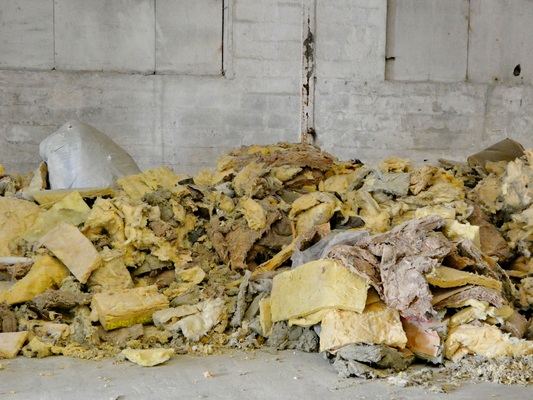
Glass wool waste comes from disposal on site, but also from manufacturing waste from factories producing or cutting glass wool. At the request of a British producer of blowing glass wool, Revibat developed a solution to recycle it by mixing it in a given proportion with the base of the waste used. © PP
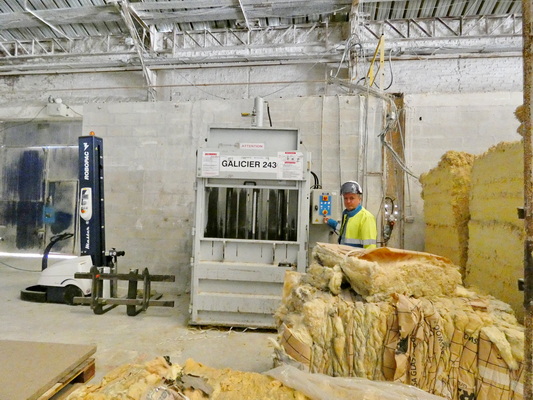
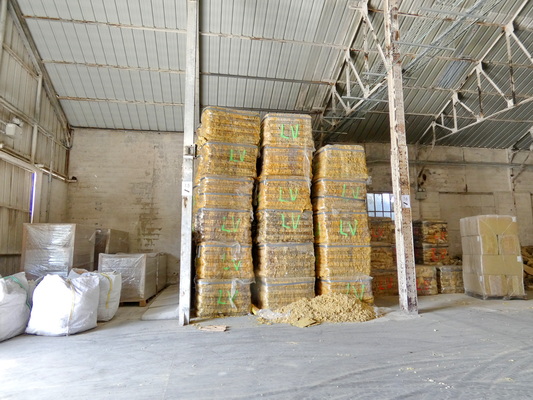
For large removal sites, Revibat has purchased a baler that it rents to companies to compact the glass wool before shipping it, so as to minimize transport costs. © PP
An advantage in carbon footprint
On the INIES database site which brings together all the FDES, we find four FDES attributed to Revibat at the beginning of February 2026 for its glass wool Reviver Nude Pfor thicknesses ranging from 45 mm to 245 mm, with a pitch of 5 mm, and uses in ITI, in insulation of slopes, in ITE and in thermal and acoustic insulation for interior partitions. They are calculated for a lifespan of 50 years, according to standard NF EN 15804+A2, and indicate very low environmental impacts, expressed in kgCO2eq:
– 1.60 for the bare Reviver P from 45 to 80 mm thick;
– 2.52 from 100 to 120 mm;
– 3.48 for thicknesses 140, 160 and 180 mm;
– And 4.63 kgCO2eq for thicknesses 200, 220 and 245 mm.
Reviver is also Acermi certified and non-combustible (A2 s1 d0 classification). Reviver is also used in wooden frames and insulating the underside of low floors. It’s a glass wooltherefore a traditional product which is installed according to DTU 45 – for example 45.10 for attic insulation – and meets the requirements of standard NF EN 13162.
On the thermal insulation side, the Reviver panels display a λ = 0.035 W/mK This advantage of Reviver in carbon footprint is particularly interesting in new construction. RE2020, let us remember, has two chapters that must both be satisfied: maximum energy consumption and a maximum environmental footprint of the building not to be exceeded. To consume little and less and less, as predicted by the RE2020 development schedule, we must insulate more and more and more. Using thermal insulation, the implementation of which is already widely known by companies, but whose environmental footprint is particularly low, becomes a powerful asset in new construction.
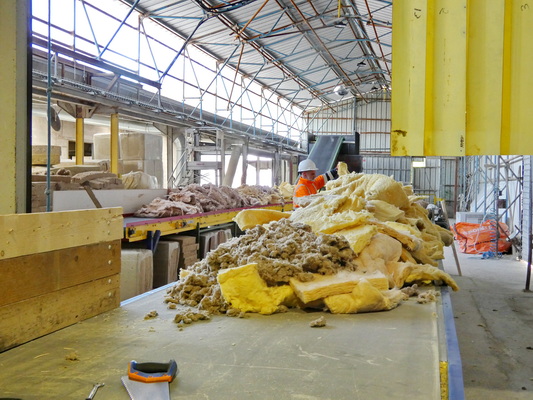
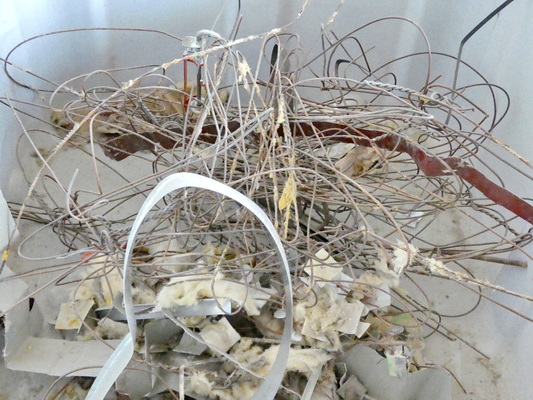
The manufacturing process begins with sorting the waste that reaches the factory. There are all kinds of things there and, in particular, all metals must be removed. © PP
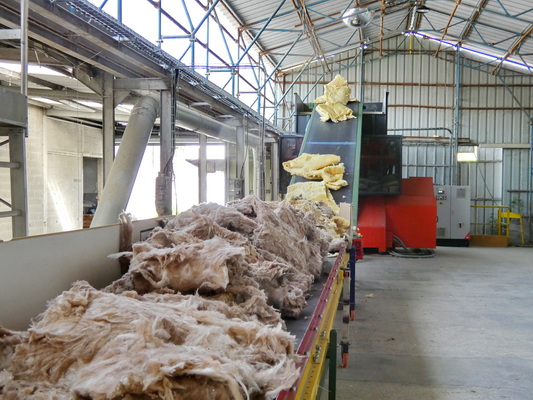
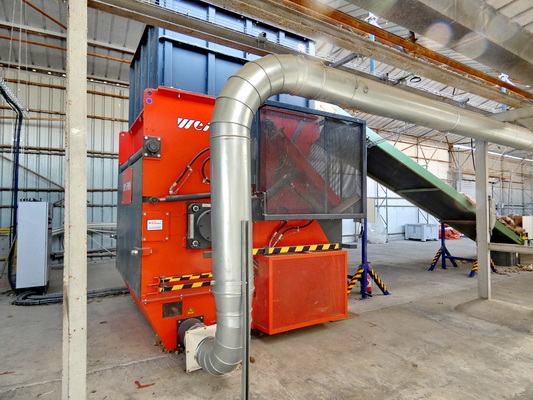
Once sorted, the waste passes through a first machine, a shredder, which transforms the material into flakes. © PP
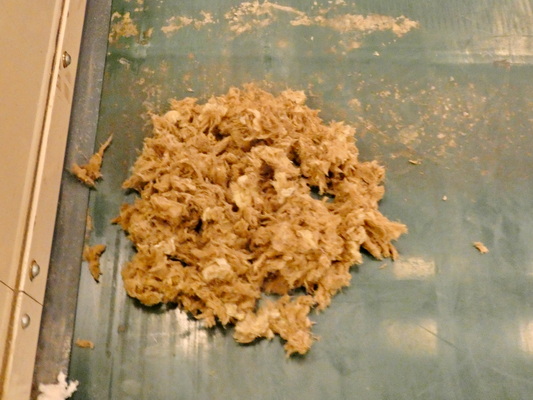
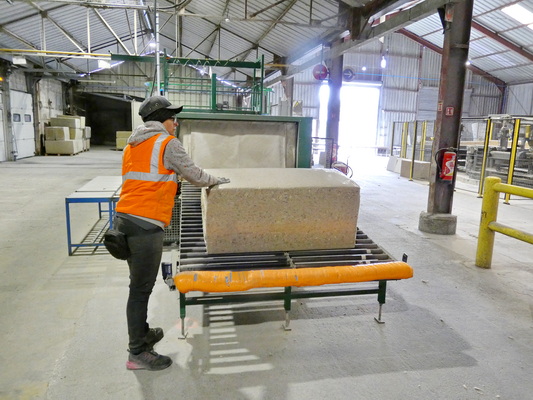
Depending on their origin, the flakes are mixed to reach the right proportion, then pass through the machine which adds the glue. The result is a sheet which passes through the oven 16 m long at 200°C. This causes the binder to melt, before cooling with blown air, until the web reaches a core temperature below 80°C. © PP
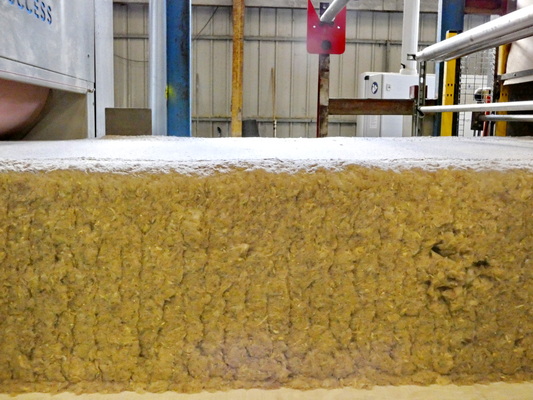
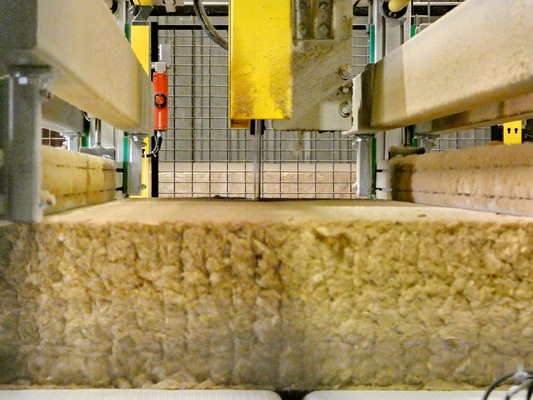
The tablecloth is then cut into strips 60 cm wide and 1.2 m long. The strips are stacked to a height of 60 cm, before being packaged in a shrink oven, using recycled plastic film. © PP
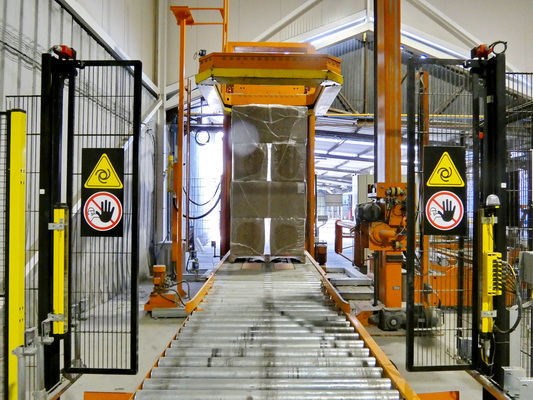
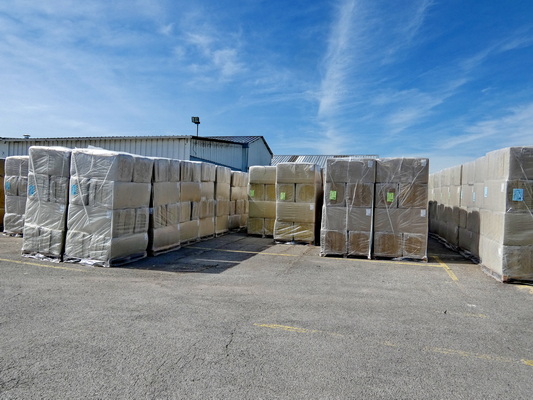
The lays are fitted with a parachute cover with a waterproof cover, which allows them to be stored outside. © PP
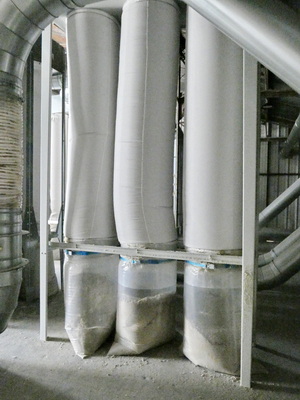
Inside the factory, all the machines – most of them second-hand machines modified for their new use – are filtered. The dust is collected in bags, before being sent for recycling by remelting. © PP
Revibat targets seven factories in France
This first Revibat factory showed the practical and industrial feasibility of the defibration process. Production began in February 2026 and 350 tons of glass wool have already been recycled. The factory employs fourteen people and has a production capacity of 10 t/day, in other words 2,000 m2 per day, in 1/8 for the moment.
In short, the industrial solution is reliable and a market exists for the product. After initial funding helped by ADEME, the Île-de-France Region, Bpifrance, the CIC and the BNP, notably for the leasing of several machines, Revibat’s goal is now to move on to a Series A fundraising round, the first significant financing round of a start-up by investors. This involves financing the creation of two other factories in France in 2027 in glass wool deposit basinslike Lyon and Toulouse, for example. Then to organize the financing of another factory in France per year, until reaching seven factories, before launching into Belgium, Germany and Austria, other important potential sources for the deposited glass wool resource.
As Reviver is a prescription product, Revibat sells it directly to companies and does not go through professional distribution, for the moment. The first customers, general contractors, recommended the product. And, for now, Revibat is doubling its turnover every month.
