
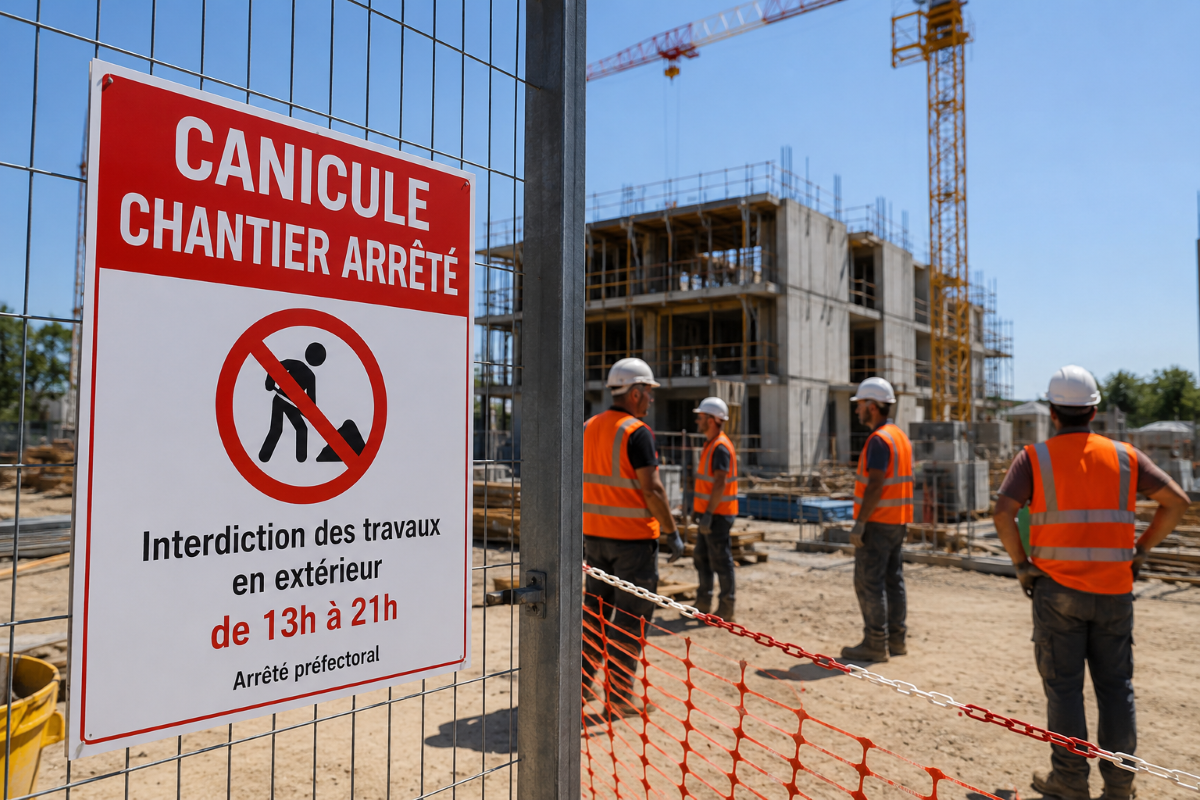
Faced with extreme temperatures, several prefectures require construction sites to be stopped during the hottest hours. A development which illustrates the growing adaptation of construction to climate risk.

Work stoppages in the afternoon, advanced hours from dawnrecourse to bad weather unemployment: faced with increasingly intense heat episodesthe building sector is starting to adapt its organization. Indeed, since the start of the week, several prefectures have taken orders requiring the interruption of construction site activities during the hottest hours of the dayin the departments placed on red alert.
Construction sites shut down in the middle of the day
The movement began in the departments most exposed to high heat. In Haute-Garonne, the construction site activities are suspended between noon and 8 p.m. in the Toulouse area. In Puy-de-Dôme, the work must stop between 12 p.m. and 10 p.m. in municipalities with more than 10,000 inhabitants. In Île-de-France, several departments have adopted similar measures, with stops imposed between 1 p.m. and 10 p.m. In order to To compensate, businesses are allowed to start much earlier, sometimes as early as 5 or 6 a.m.
This reorganization aims to avoid the exposure of employees to temperature peaks which can exceed 40°C in the middle of the afternoonparticularly on heavily mineralized sites where the heat felt is often higher than official weather reports.
The Minister of Labor, Jean-Pierre Farandou, also called on the prefects to act without delay when local conditions require it: “I asked the prefects, in the departments which would switch to red vigilance, not to hesitate to stop construction sites from 1 p.m. to 9 p.m. if the local situation requires it“.
The heat risk changes dimension
If the construction companies are used to dealing with summer episodesthe current situation goes far beyond the part of the usual high heat. THE heatwave episodes multiply, lengthen and gain intensity. In some regions, temperatures now regularly exceed the thresholds that make physical work particularly strenuous, even dangerous. For professionals, the risks are well identified: dehydration, discomfort, thermal exhaustion, heat stroke or even accidents linked to reduced alertness.
The question has become all the more sensitive as a young 19-year-old worker died at the end of May after having been victim of hyperthermia on a roofing site during a previous episode of high heat. This tragedy has accelerated the discussions undertaken around the protection of exposed employees.
There multiplication of prefectural decrees could herald a more profound transformation of the sector. The subject should also be at the heart of discussions between the Ministry of Labor, employers’ organizations and unions. Because beyond the current health emergency, a question now arises recurrently: how can we continue to build when certain hours of the day gradually become incompatible with outdoor work?
Moreover, on this subject, Jean-Christophe Repon, the president of CAPEB, recalls – during the CAPEB press conference this Thursday, June 25 at the Rencontres des Métiers du Bâtiment by CAPEB in Marseille – with irony: “we’re not too stupid either: we’ve already thought about adapting our schedules“. However, despite everything, constraints, particularly administrative ones, remain. Thus, in the Gard department,since June 23 and until June 29 inclusive, if the construction companies benefit from an exemption allowing them to bring forward their working hours – construction sites can thus begin at 6 a.m. and continue until 9:30 p.m. in order to avoid the hottest periods of the day – this only concerns construction sites located more than 100 meters from sensitive establishments, such as health and medico-social structures or nurseries. In addition, in return, companies must implement several measures intended to limit noise pollution for local residents: inform the neighborhood concerned in advance of the noisy work as well as the measures taken to reduce the impact, use exclusively approved equipment, properly maintained and used in accordance with its intended purpose, etc.
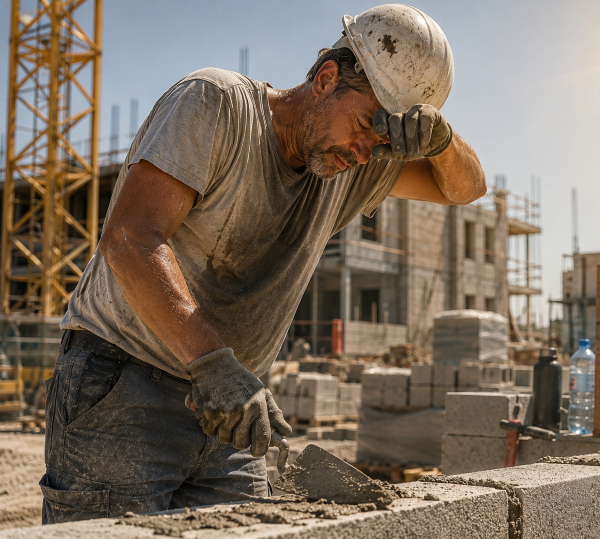
According to a survey carried out between May 21 and June 12 by CAPEB, the heatwave is now the climatic phenomenon which most affects building craftsmen, ahead of episodes of heavy rain, floods or even periods of cold and snow. Nearly seven out of ten professionals also believe that these hazards have increased over the last five years. Their consequences are very real on activity: 58% of the companies surveyed report construction delays. Among those having assessed the economic impact of these disruptions, the median loss reached five days of work and nearly 4,800 euros in turnover. CAPEB also observes disparities between trades, with masonry and tiling being particularly exposed, unlike activities such as electricity or plumbing-heating, which are relatively less affected. To cope with these increasingly frequent conditions, most companies have adapted their working hours, while some have invested in specific equipment or used the bad weather unemployment scheme. © Laure Pophillat
