
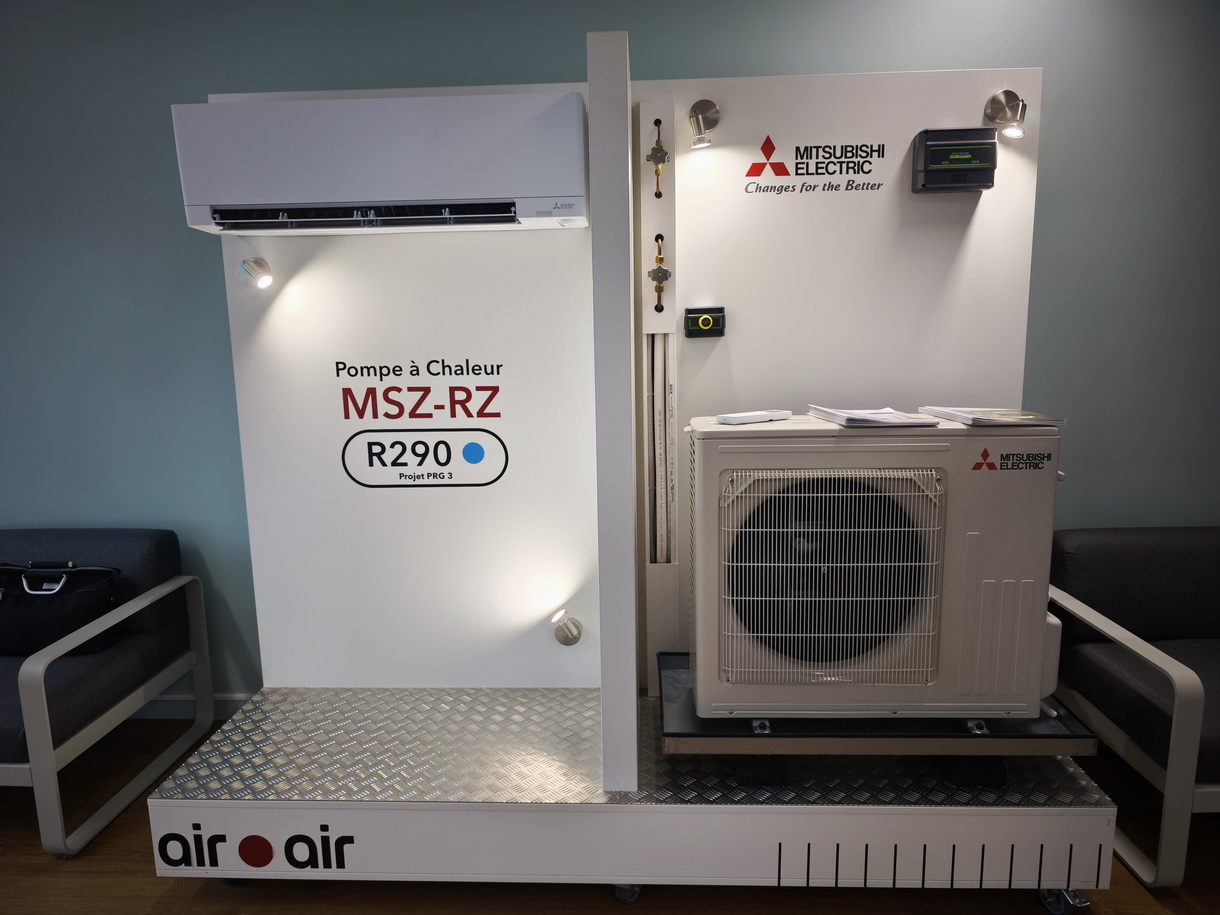
After the R290 air/water heat pumps, here are the first direct expansion systems from Mitsubishi Electric operating on R290. Spotlight on this solution.

For a while now, Mitsubishi Elecric offers air/water heat pumps using R290. This is their ECODAN PUZ-WZ monoblock range, with powers from 5 to 50 kW. On July 1, Mitsubishi Electric announced the marketing of an R290 air/air monosplit : there Ultimate+ Wall range MSZ-RZ.
Monosplit MSZ-RZ to R290
Mitsubishi Electric begins the introduction of R290 in direct expansion with the MSZ-RZ monosplit wall unit, with three models of 0.9 – 3.5 kW, 1 – 4 kW and 1.4 – 5.8 kW in cooling and classified A+++ for the first two and A++ for the most powerful. In heating mode, the powers for an outside temperature of -7°C are 3.2, 4 and 6 kW, with SCOPs of 5.3 (A+++), 5.2 (A+++) and 4.7 (A++).
The operating temperature range of these units is from – 30°C to + 24°C outside temperature, with constant heating power down to – 25°C and the ability to heat up to – 30°C thanks to its technology Hyper Heating Ultimate.
The first two units come preloaded with 390g of R290. This allows up to 10 m of network without additional charging. The maximum network length is 20 m and 12 m height difference. These first two units must be installed in 9 m rooms2 at a minimum. The third is preloaded with 700 g of R290, or 20 m of network without additional charging. The maximum network length for this unit is 30 m with 15 m height difference. R290 has a GWP (Global Warming Power) of 3 over 50 years and 0.02 over 100 years.
Several security measures
Like the R290 is classified A3, explosiveMitsubishi Electric has developed several safety measures to detect possible fluid leaks. The most interesting is odorization. THE R290 has no odor. Add a odorization with R290 degrades its thermodynamic properties. Mitsubishi Electric therefore had the idea of incorporating odorization into the oil used in the system. In the event of a circuit leak, you will smell natural gas. But as the odorization is linked to the oil, it remains in the circuit as long as it contains oil. In case of fluid refill, it is not necessary to add odorization, in this case tetrahydrothiophene or THT. This odorization solution makes it possible to use fittings flarethe classic connections in direct expansion air conditioning: the habits of installers are therefore not disrupted. The wall-mounted indoor unit, a second safety measure, is equipped with leak detectors in the immediate vicinity of the connections flare. If a leak is detected, the indoor unit fan turns on, blowing downwards, to deconcentrate the R290.
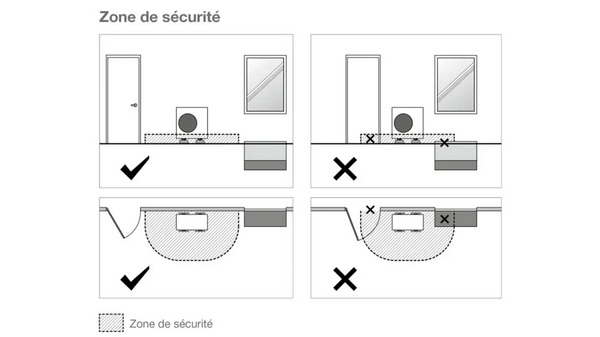
In addition, it is naturally necessary to respect the safety zones linked to the use of R290: protection zones during installation. In the case of a stand-alone installation, there must be no sources of ignition, openings or entrances to the building in an area of one meter around the device and a maximum height of 30 cm. If the device is installed in a corner or niche, the safety zone extends up to 2.5 m in front. © ME
eLearning on the R290
Mitsubishi Electric offers training on R290 in all its training centers in France. The company should put online a module eLearning on the R290 during the summer. There is already a webinar on the air/water heat pump provided by the Melcollege, the Mitsubish Electric training organization.
This announcement of a first direct expansion monosplit with R290 should be followed at the start of the school year by the introduction of reversible R290 multisplits with up to 8 kW of power and four indoor units. Midea already markets the 2.9 kW Zenith monosplit and should also introduce R290 multisplits, already marketed in Germany. Haier could also introduce its direct expansion solutions in France at the beginning of 2027.
For now, the R290 is not intended for VRF systems which remain solidly at R32.