

Construction professionals finally see a recovery in 2026. A study carried out among 727 French and German players predicts growth of 7 to 9% in France and around 7% in Germany.

Would the low point finally be behind the construction sector ? In any case, this is what the professionals interviewed by Simon-Kucher anticipate as part of his “Future of construction” study, carried out in the first half of 2026 among 727 players in the sector in France and Germany. Respondents expect an increase in their activity of between 7 and 9% in France and around 7% in Germany. Encouraging prospects, but which remain conditional on the evolution of the cost of operations as well as access to financing.
The observation is all the more interesting since the two countries should not emerge from the crisis by the same route. In France, the renovation and rehabilitation of the existing stock constitute the main driver identified by professionals. In Germany, new construction benefits more from public investments and housing needs.
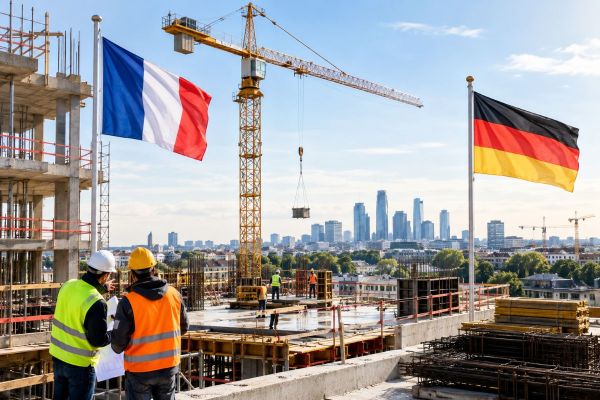
The “Future of Construction” study was carried out in the first half of 2026 among 727 professionals covering the entire value chain: real estate developers, architects, design offices, construction companies, manufacturers and distributors. The results therefore constitute professional expectations and not a macroeconomic forecast of the actual evolution of the sector’s turnover. © IA / Laure Pophillat
In France, renovation takes over from new
The French specificity appears clearly in the distribution of projects observed by Simon-Kucher since the renovation and rehabilitation represent 45% of the operations covered by the study, compared to 37% for the new construction. This orientation reflects a profound evolution of the market: while the new construction remains faced with high production costs, more restrictive financing conditions and limited solvent demand, theimprovement of the existing park constitutes a more immediately accessible source of activity.
Public data nevertheless confirms that the nine starts to recover. According to the SDES, 370,673 housing units were authorized for construction between August 2025 and July 2026. This volume remains 9.5% lower than the average of the previous five years, but the average monthly level of authorizations over the first seven months of 2026 exceeds that recorded for the whole of 2025 by 1.4%.
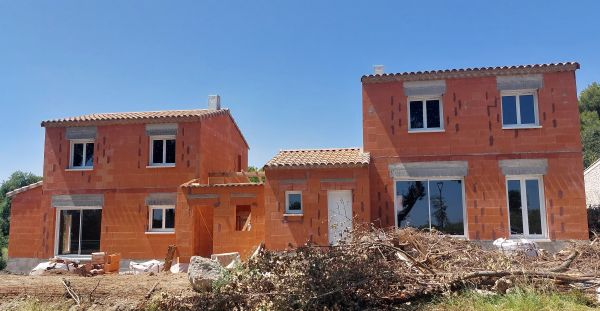
In July 2026, 27,677 housing units were started, an increase of 8.9% over one month. © Laure Pophillat
Germany more driven by new construction
The situation appears different across the Rhine. According to the professionals interviewed by Simon-Kucherthere German recovery relies more on new constructionsupported both by public investments and by housing needs. This difference in structure is important for companies in the sector. The players present in the two markets cannot therefore apply exactly the same commercial strategies, nor target the same work segments. “Although the expected growth is comparable between the two countries, the underlying factors are fundamentally different“, underlines Franck Brault, Expert Partner at Simon-Kucher.
For materials manufacturers, general contractors, distributors and even design offices, this divergence could notably result in order books more oriented towards renovation in France and towards new construction in Germany.
Financing remains the main obstacle
The other lesson of the study concerns the economic conditions which continue to weigh on investment decisions. Since 2020, Simon-Kucher estimates that theconstruction cost index increased by 20%. At the same time, mortgage rates rose sharply before falling again. In France, the average rate for new home loans excluding renegotiations stood at 3.08% in December 2025, compared to a peak of 4.17% in January 2024 according to the Banque de France. It was still 3.30% in July 2026 for new credits excluding renegotiations.
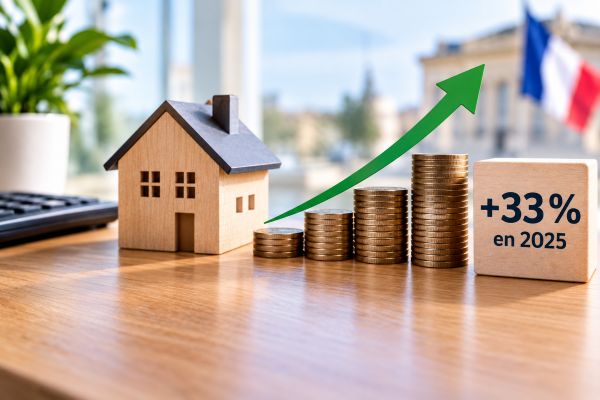
The credit market, however, recovered at the same time: the Banque de France indicates that the production of home loans excluding renegotiations increased by 33% in 2025. © IA / Laure Pophillat
The pressure doesn’t just come from funding. Companies also have to deal with a level of costs that remains significantly higher than that observed before the inflationary crisis. In fact, the latest data from INSEE show that in the first quarter of 2026, theconstruction cost index stood at 112.4, with a decrease of 2.89% year-on-year. The iproduction cost index in construction reached 116.6, up 2.1% over one year. Maintenance-improvement work also showed an increase in their prices of 1.9% over one year. The slowdown in cost inflation is therefore a more favorable signal, but it does not mean a return to previous price levels.
Operational efficiency before the ecological transition
In this context, business priorities are evolving. According to Simon-Kucher, operational efficiency should constitute the main focus of players in the sector in 2026 and 2027. Cost reduction, productivity improvement, process optimization and finer market selection thus become priorities, while investments linked to digital transformation and ESG issues temporarily take a back seat. This hierarchy of priorities constitutes one of the most interesting points of the study. It shows that economic pressure can slow down transformations that have been underway for several years in construction.
However, the environmental transition has not been abandoned. In France, it remains identified as a longer-term growth lever. In Germany, energy issues occupy a more important place in strategies, but more because of the sustainable level of energy costs than as a tool for differentiation.

Digitalization is progressing in the construction sector, but it does not yet constitute a real differentiating factor. Faced with a more constrained economic context, companies are favoring technologies offering a rapid and measurable return on investment, to the detriment of more structuring and long-term digital investments. © IA / Laure Pophillat
© AI / Laure Pophillat