
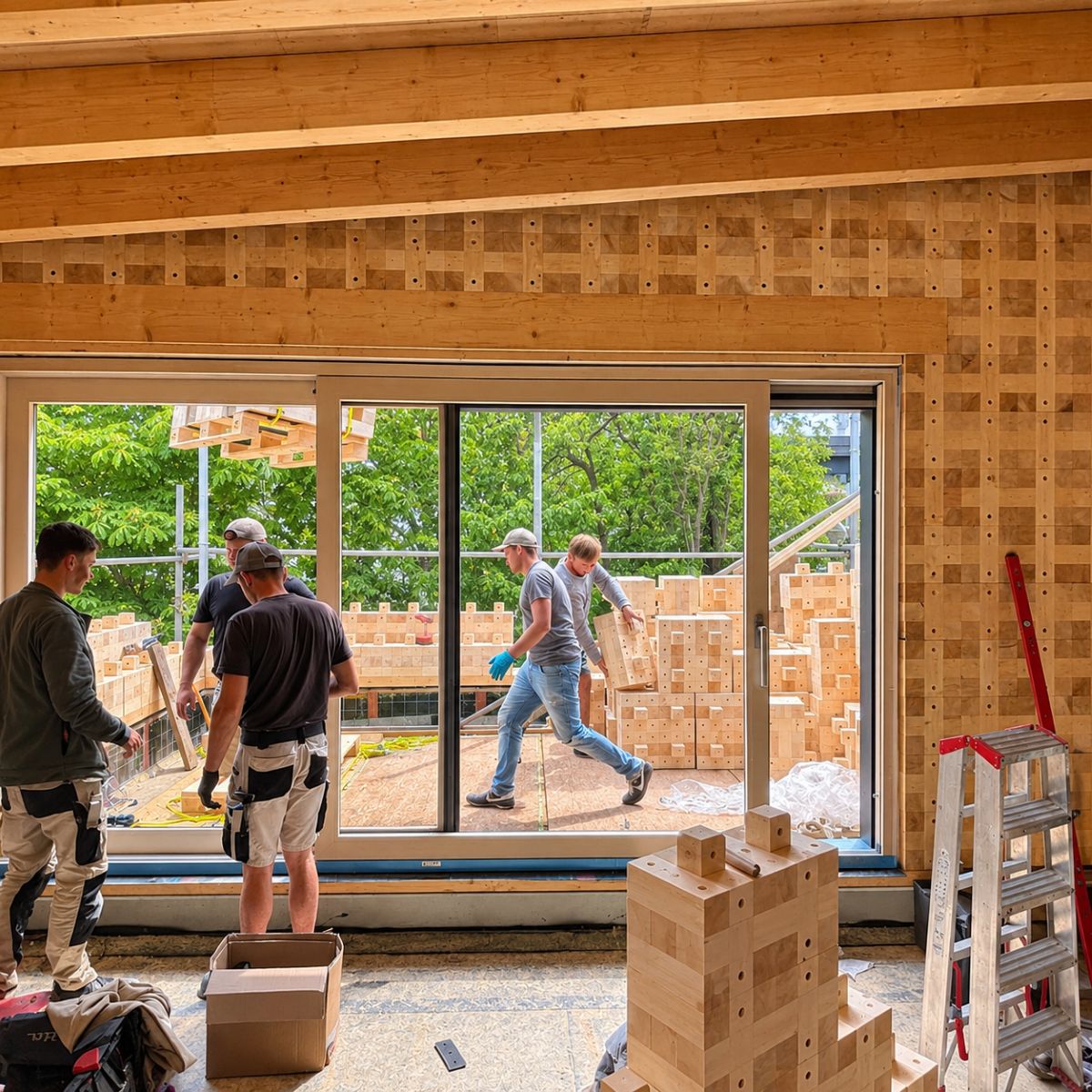
Inspired by Lego, TRIQBRIQ’s wooden bricks fit together without glue, screws or mortar. Enough to build load-bearing walls, then dismantle them to reuse the materials rather than producing rubble.
Publi-Information 

What if the walls of a building could be dismantled as easily as they were assembled? It is the bet of TRIQBRIQ, a German company who developed a solid wood construction system composed of interlocking blocks held by beech dowels strongly resembling Lego giants. Its particularity? Transforming lower quality wood into structural elementswhile anticipating their reuse from the design of the building.
Founded in 2021 by Maximilian Wörner, the company has developed a solid wood construction system made up of prefabricated blocks called BRIQs. Their assembly is based on a mechanical principle, without glue or metal fixing: the elements are stacked in a staggered manner and held together by beech wood dowels. A technique which makes it possible to create load-bearing walls, but also to consider their dismantling without destroying the components. © YouTube video TRIQBRIQ
Decommissioned wood transformed into construction elements
The interest in the process begins well before implementation, at the time of choice of the raw material, because the BRIQs are made from industrial wood, damaged wood or from forests affected by climatic events or pest attacks. The company also uses wood recovered during deconstruction. These resources, whose characteristics do not always allow valorization in traditional lumber sectors, can thus be transformed into construction elements. The process gives them a second life in long-lasting structures, rather than directing them towards energy recovery or uses of lower value.
There manufacturing is based on wooden elements assembled to form standardized blocks. On the site, these are arranged one on top of the other, using a staggered arrangement, then locked using beech dowelsL’absence of glue and metal fixings avoiding the multiplication of materials in assemblies and facilitating their subsequent separation.
TRIQBRIQ offers two wall systems, with thicknesses of 15 and 25 cm.
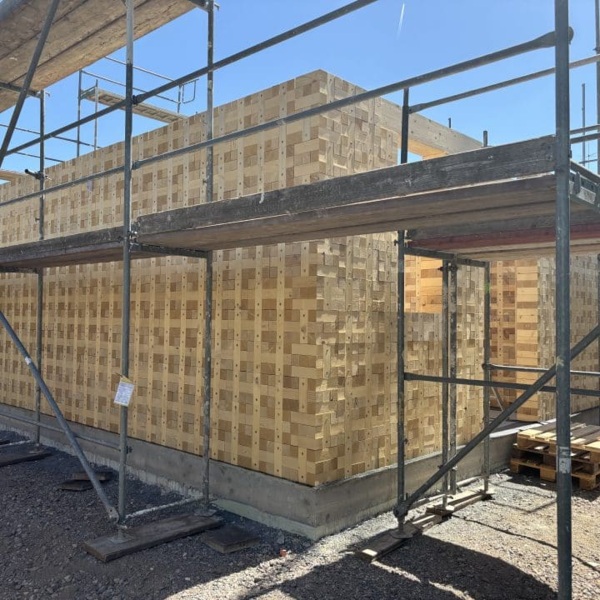
The manufacturer also offers several block formats, particularly for treating openings and different masonry configurations. © TRIQBRIQ
Load-bearing walls
The system is not limited to partitions or lightweight constructions. THE WS25 model indeed benefits from a general technical approval issued by the German Institute of Construction Technology (DIBt), under the reference Z-9.1-912; an authorization which governs the design and construction of load-bearing and bracing walls, for clear heights of up to 4 m per level. The company also indicates that the system has been tested within the Karlsruhe Institute of Technology (KIT), relating in particular to its bearing capacity and rigidity.
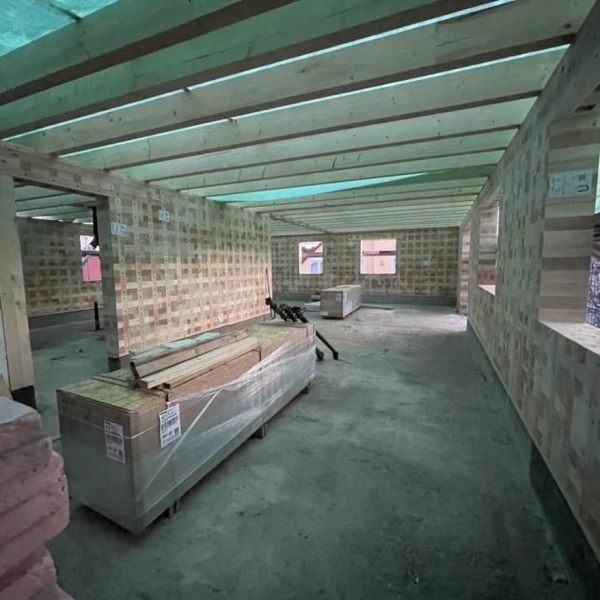
Technical approval is issued within the German regulatory framework, and therefore does not constitute automatic authorization for implementation in France. © TRIQBRIQ
TRIQBRIQ announcement of the rankings of resistance At fire REI 45 Or REI 60 according to THE configurations. Otherwise said, THE walls can preserve their ability load-bearing, their waterproofing to flames And their function insulation thermal during 45 minutes has a hour during of a fire, In THE terms of the test standardized
Thermally speaking, walls do not necessarily provide additional insulation. To achieve a thermal transmission coefficient U of 0.24 W/(m2.K) with the WS25 systemthe manufacturer indicates that approximately 75 mm of wood fiber insulation must be added, the wooden block constituting part of the wall complex, not a universal solution that would be sufficient in itself.
Dismantle rather than demolish
It is at the time of dismantling that the system reveals its singularity, because once the wooden dowels have been extracted, the BRIQs can be separated from each other and recovered. TRIQBRIQ has even developed a specific tooladaptable to a perforator, to facilitate this operation.
This reversibility was put to the test with the CRCLR Hut, a 40 m experimental pavilion2 made in Berlin with the Beta Realities agency and several partners. Designed as a demonstration of circular construction, the building was completely dismantled and then rebuilt at another location on the Urban Tech Republic site. The operation, completed in 2025, made it possible to reuse around 98% of the pavilion’s materials, according to data communicated by the project partners. There structure in BRIQs was thus recovered to participate in the new constructionrather than ending up in a dumpster. The site was also distinguished at the Iconic Awards 2025, notably in the Circular Design category.
The company claims storage of 177 kg CO equivalent2 per square meter of wall, according to its environmental product declaration. This figure concerns the wall system and must be placed within the calculation scope of this declaration: it does not constitute, in itself, the complete carbon footprint of a building.
Automated production to change scale
In June 2026, TRIQBRIQ reached a milestone with the commissioning of a fully automated production line at its factory in Tübingen, Germany. The installation, designed with equipment manufacturer VKE, extends over approximately 25 m and uses five KUKA robots distributed in four cells. She must be able to produce up to 100,000 BRIQs per year. The device automates several operations, from checking pieces of wood to cutting them, assembling them and palletizing them.
The company also plans to develop decentralized production, as close as possible to sawmills and forestry resources. It works in particular on the establishment of international partnerships and licenses, with the objective of limiting the distances betweenwood supply, block manufacturing and construction sites.
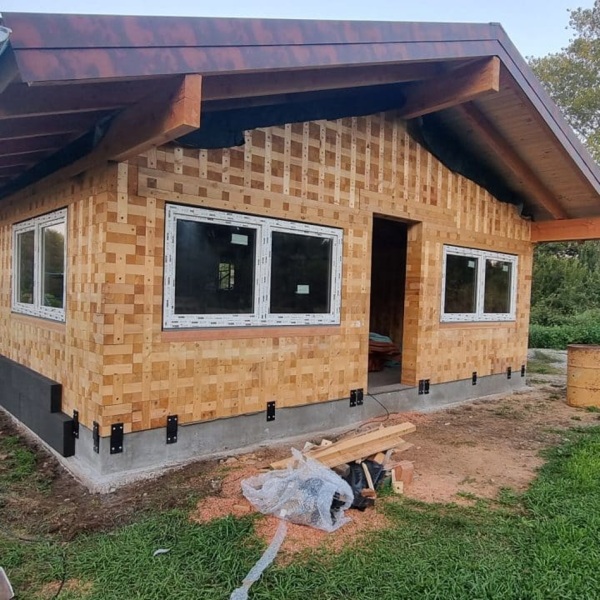
TRIQBRIQ already boasts more than 40 completed projects, nearly 4,000 m2 of walls built and approximately 415 tonnes of wood used. © TRIQBRIQ
The system poses a question that goes well beyond the wood material alone: why continue to design buildings as definitive assemblies, when their components could be considered as a stock of reusable materials? With his BRIQs, TRIQBRIQ provides a technical answer to this question. And above all, the life-size demonstration that a building can also have a second life without going through the demolition box.
TRIQBRIQ