
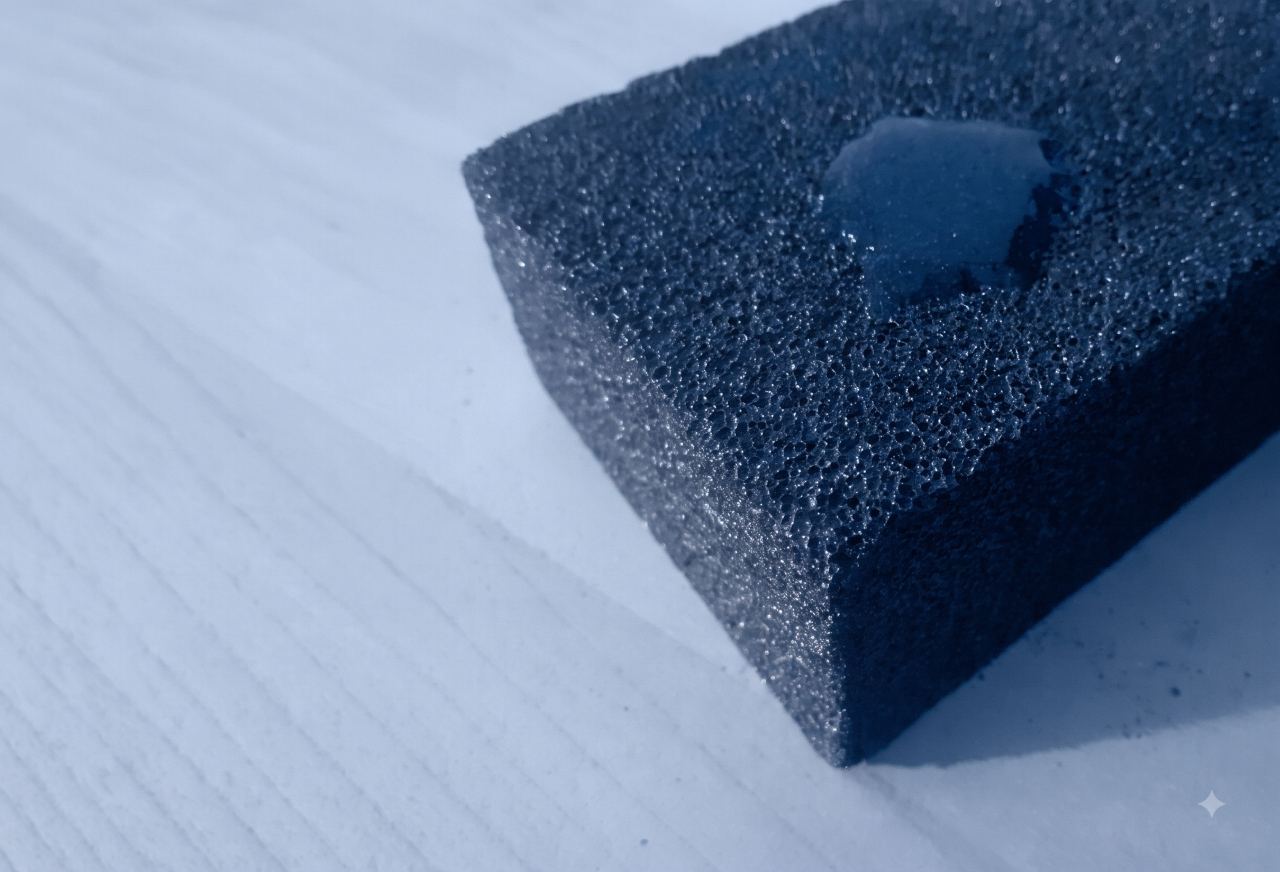
How gravel and expanded cellular glass beads are produced
The manufacturing procedure for these materials is very similar to the one used to produce panels, with the only difference being the cooling process, which occurs more quickly, rather than slowly. With this procedure, the compact block of cellular glass undergoes a thermal shock which causes the cells of which it is composed to break into numerous irregular fragments, very similar to small stones, which, once screened and selected in homogeneous sizes (from approximately 2 to 6 cm in diameter for gravel, while in sizes of 2/8 mm for expanded pearls), are contained in special big bags or deposited in piles to be used in the forms previously described.
Expanded glass beads for cavities and screeds
The expanded glass beads appear as tiny rounded stones, with technical characteristics similar to those of sheet cellular glass, but in a minute shape, which is optimal for filling empty spaces in wall cavities, where they are inserted dry.
Another possible application is as a lightening element of screeds, combined with binding products such as cement or lime. For example, the Austrian company Berolan has developed a binder (Berotherm), with very particular characteristics, for the formation of lightened layers for underfloor screeds in aggregation with loose insulating materials, such as expanded glass beads. The particular characteristic of this binder, in combination with pearls, is its ability to maintain high resistance and stability, together with low water absorption. The lightened screed formed with this product combined with expanded glass beads is a compact, light mixture, very resistant to compression, which dries in a very short time – thanks also to the waterproof characteristic of the expanded beads which do not absorb liquids – therefore suitable for use in conditions where it is better to avoid the presence of water, such as on wooden or CLT floors.
Cellular glass gravel: properties and applications
Cellular glass gravel is a well-known product in construction, especially for its main use as an insulating and draining filler for excavations, instead of traditional construction gravel. It is a multifunctional product, suitable for filling the sides of vaults, where it acts without weighing down the structures or as a drainage layer for green roofs or for creating insulating ballasts, where for example it is necessary to avoid the formation of ice.
Compared to sheets, it has a higher thermal conductivity value (0.080 W/mK); Although it has a similar function to natural gravel, it is still a thermal insulating material and not an inert material. Each single element (stone) of cellular glass gravel is waterproof and has a resistance value to the passage of vapor identical to the compact slabs (µ value = ∞), while the insulating system created with the compacted filling has a high breathability (µ value = 1) due to the multitude of air voids that remain between the individual expanded glass elements after compaction.
How to lay cellular glass gravel under foundations
As mentioned, the main use of cellular glass gravel is as a draining and insulating layer under the foundations of buildings. The installation phases can be summarized in the following ways: once the excavation has been carried out, before the foundation is built, a separating layer is placed on the bottom of the ground, generally made of non-woven fabric, appropriately turned up on the edges of the excavation, which generally extends at least one meter beyond the perimeter of the building that will be built.
The quantity necessary to obtain the desired insulating layer will include the final effective thickness increased by approximately 30%. This is a greater quantity necessary to avoid reducing the final layer resulting from the compaction of the laid material. The spillage of the cellular glass gravel can take place using big bags or placed directly loose from a truck equipped with a vibrating platform. Once the material has been placed on site, it is compacted, which can be carried out with a roller or a road compactor. With this operation the gravel aggregates forming a compact and solid layer on which the reinforced concrete foundation can be cast, after laying a second separation layer, generally of polyethylene (PE) sheets.
In this way the layer that is created has a draining and insulation function from rising water vapour, but also thermal insulation. Such a system can replace the ventilated crawl space, perhaps by integrating into the layer of gravel the placement of a perforated pipe, slightly inclined towards the outside, to facilitate the removal of any water present in the ground, as well as Radon gas, even if to block its passage it is necessary to equip itself with the appropriate physical barrier of an anti-Radon sheet, certified and designed for this purpose.