
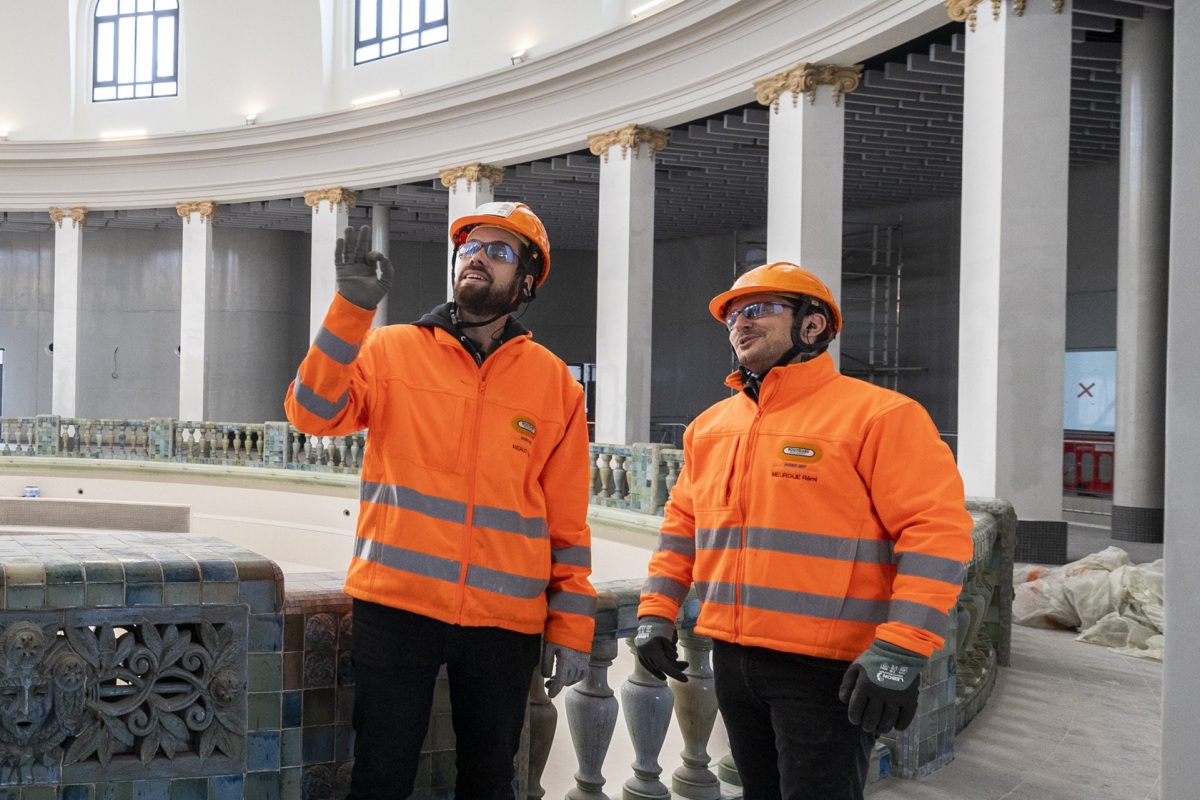
The Bouygues group posts net profit up to 1.1 billion euros in 2025, driven by the improvement in its operational profitability. In construction, the order book remains at a high level.

THE Bouygues juggernaut, present in construction and public works or telecommunications, achieved a net profit of 1.1 billion euros in 2025, up 7.6%, despite the exceptional contribution weighing on large companies, for sales stable at 56.9 billion euros (+ 0.2%).
Results judged “very solid“
THE Bouygues group recorded a net profit in 2025 group share of 1.1 billion euros, an increase of 7.6%, while its turnover remained generally stable over the financial year.
The French conglomerate, parent company of Equans, Colas, Bouygues Telecom and TF1, reports results judged “very solid“. Its current operating income from activities (ROCA), the group’s main indicator of profitability, increased by 4.7% to reach 2.7 billion euros.
The group also indicates that the exceptional contribution to the restoration of public finances should weigh up to 69 million euros on its profit.
A still high order book in construction
In the construction – which brings together Colas, Bouygues Construction and Bouygues Immobilier – the group posted an order book of 32 billion euros at the end of December, a level described as “very high” and offering good visibility on the activity. This volume, however, fell by 1% year-on-year. In detail:
– we note + 2% in Europe (excluding France);
– We note stability in France and – 4% internationally outside Europe.
A rising dividend for shareholders
With these performances, Bouygues plans to offer its shareholders a dividend of 2.10 euros per share, up 5%, subject to approval at the general meeting scheduled for April 23, with the aim of maintaining a high level of profitability.
For 2026, the group is targeting stable turnover at constant exchange rates, after an increase of 1.3% in 2025. The past financial year was marked by a negative exchange rate impact of 580 million euros, almost entirely concentrated in the second half.
Bouygues also intends to maintain its current operating profit at a historically high level. The expected improvement in Equans’ profitability should in particular offset the anticipated drop in that of TF1 – penalized by tensions in the linear advertising market – as well as that of Bouygues Telecom, linked to an increase in depreciation.
The fear of Olivier Roussat, the boss of Bouygues
THE boss of Bouygues, Olivier Roussatexpressed his “fear“to see settle down for”several years” there exceptional contribution to large companies – renewed in France for 2026, taking into account the level of State spending – in the Ecorama program on Boursorama. “We thought that the exceptional would be lasting. In reality, it concerns the amount, because this tax could ultimately be incurred over time” he said.
The manager believes that the business participation can be understood, provided that it remains punctual. “Why not let businesses make an exceptional contribution to improving the State’s tax revenues? But if, at the same time, there is no reform of public spending, the exceptional cannot remain limited to a single year“, he added.
Asked about a possible renewal of the system in 2027, Olivier Roussat admitted to fearing it “sincerely“.

Like several business leaders before him, Olivier Roussat, pictured here, explains that, in his opinion, businesses use their resources more efficiently than public authorities: “we use the money from our investments better than the State can do. If we take away resources from businesses to create wealth, they create less, and there is therefore less to redistribute.” © Bouygues Group