
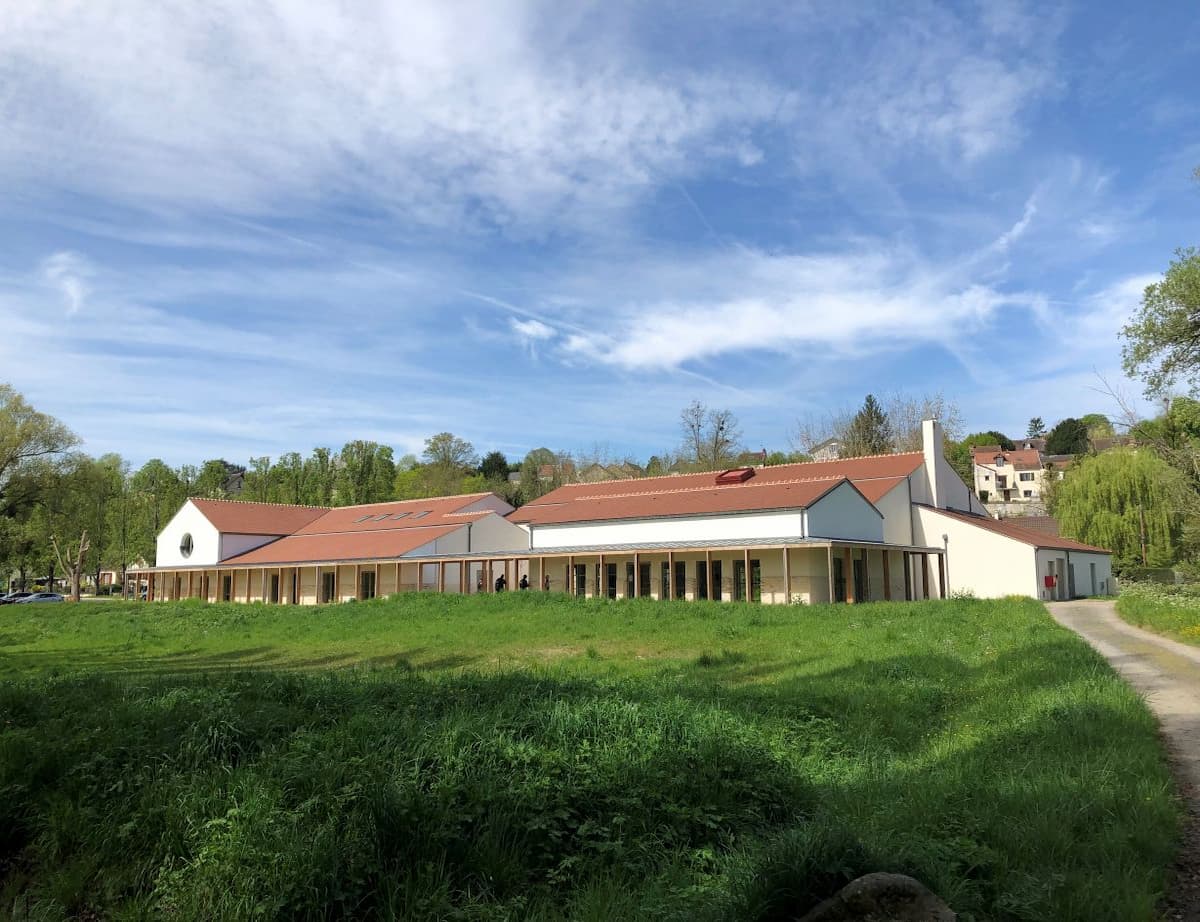
The village hall of Van Gogh, on the banks of the Oise, from 1982, has been profoundly transformed into a cultural center, retaining most of the structure and some reinforced frames.
Publi-Information 


With a works budget which has increased to around €2,000/m2 for equipment of 2,070 m2 of SDP after work including 471 extension, we could almost have raze the Auvers-sur-Oise village hall and rebuild. But not with this level of finish and detail, just to recreate something like the 1982 village hall to be rebuilt or demolished in 40 years. Anyway, for the young Italian and Parisian agency ObloThis renovation and extension project is blessed bread.
Firstly, the agency did a good job for the city’s public developments, then for rehousing the popular relief precisely in the perspective of this renovation. Second, because the younger generation of architects don’t like to demolish. Added to this is a desire for transformation that is quite significant to allow us to fully play the biogeosourced card and that of local supplies. The luck, all the same, is that the young team finds itself facing a municipality which understands, from 2020, the link between culture (of the inhabitants), climate respect, vernacular choices and architectural quality. Auvers-sur-Oise manages to reinject into its local culture the recipes of the continuous global pilgrimage around Van Gogh. And not with a ridiculous “Van Gogh” work.
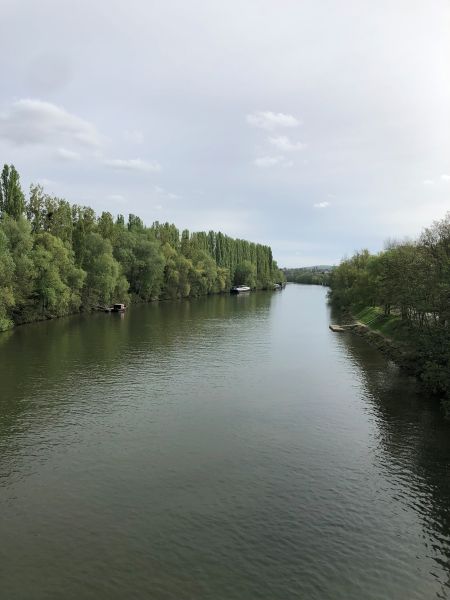
The Oise which puts us at ease after crossing the beautiful millstone villas on line H under the planes of Roissy. © Jonas Tophoven
A village hall from the “belle époque”
There is indeed a postcard of the “casino” (Hotel restaurant de la Grande Terrasse) adjoining the Oise bridge and since destroyed to defend the wooden passageway which functions as the biosourced signal of the operation. When we take a work like the village hall of Auvers-sur-Oisea large shapeless building marked by a slate roof with four slopes, which dates back to the prosperous France of the second oil crisis when Auvers-sur-Oise was not yet at this point the Disneyland of Impressionism, we are not obliged to make a motif for the great painter. At the time, below the beautiful promenade where the motif of one of the master’s last paintings was recently located, a car park and a prefabricated school extension clad in a wooden bard. In this blessed period, we also did not have the brand new RER H line at 2.55 euros with bicycle. Now, Auvers is the Parisian suburbson line H, the only patch of greenery from Paris is the route around Frépillon, just before Méry-sur-Oise, after the constructive experiments in the distant second ring of the ZAC des Meuniers in Bessancourt.
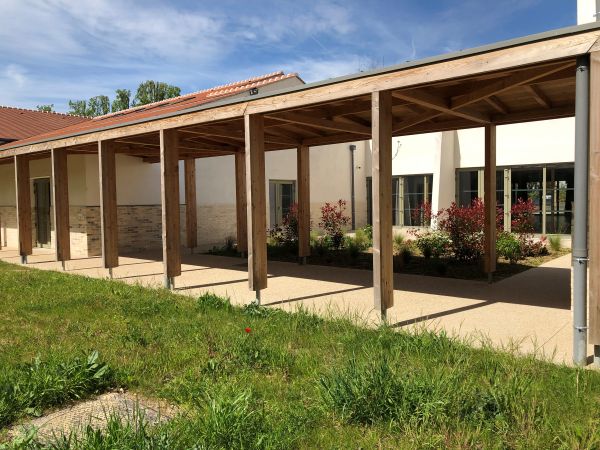
To the west, the passageway opens onto an atrium with a passageway which leads to the foyer, to the south, it is a patio with a split passageway which benefits from the shade. © Jonas Tophoven
In the middle of nature
Passing the Oise bridge, we have been in the French Vexin PNR for thirty years up to the northern limit of the Val d’Oise and therefore the IDF region. And if the RER H did not branch off to follow the Oise valley on the left bank, 45 minutes from the Gare du Nord, this park would become for Parisians and Greater Parisians of the northern suburbs like the forest of Fontainebleau. Now, crossing the bridge is entering the somewhat preserved universe of van Gogh but also treat yourself to towpath with the House of the Isle in the middle of a large overflow (in fact on an ancient island).
Oblò recommends wood-straw still unknown for the town of Auvers in 2020 but the PNR is trying to develop local natural resources and dubs with its room of 600 standing places, the Maison de l’Isle has become over the decades a gathering point in the upper Oise valley. The agency takes this into account, preserves and beautifies this space, cleans up the constructive clutter on the west side and creates, so to speak, three rectangular look-alike rooms, one of which is upstairs, whose gable with an immense oculus will become the icon of the place in the same way as the wooden passageways. In fact, the slate roof covering the space on four sides is clarified in succession of clean, white orthogonal sections of various proportions, which resemble the living chance of an old town compressed into a rectangle.
The “Oblò ring road”
It is all the same this peripheral wooden passageway which constitutes the great success of the renovation. It legally encroaches on the preserved land because it remains above the foundation. It hides a base made of local bricks which legally exceeds the highest flood level, before being extended by the straw walls coated with lime. It protects the ground floor premises from the long south-facing façade.
Inside, the circulations open as much as possible onto the landscape of the river and since we end up there, we might as well have covered passages to go from one place to another. On the parking side, the access route to the foyer passes through a green atrium also surrounded by these beautiful passageways. A home where the Saint-Maximin stone layout (30 km), combined with a wooden column, is worth a look. Laurent Mouly Ingénieurs, the structural and thermal BE, plays an important and useful role through the complementarity of the thermal and static approach, and intervenes in particular in the definition of beautiful scissor trusses.
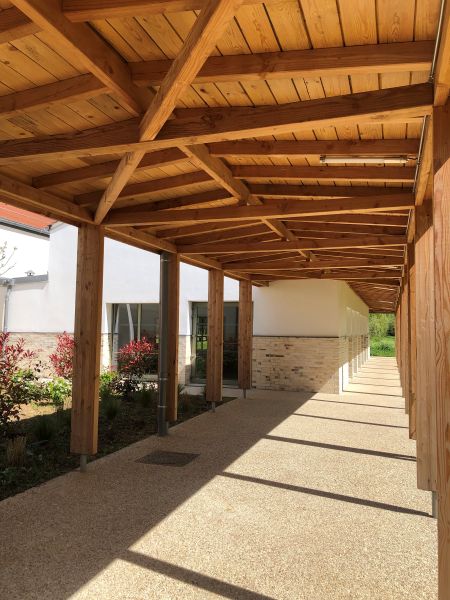
The double passageway in the West-East axis. Note the brick base which rises 50 cm above the highest flood, magnificent local flamed bricks. © Jonas Tophoven
Five complementary uses of wood
The wood which creates unity through these passageways is only one of the five avatars which establish the unity of the place. Exterior joinery very fine in oak, the circulation of peripheral fluids of the pieces framed with plywood in light softwood or poplar Drouin M1THE farms solid wood whose simple and elegant design takes into account respect for the flat slope of the initial project, the wood fiber panels Origin from Knauf for acoustic correction. So many visual markers in a set which retains a certain complexity and must accommodate all kinds of associative activities.
Delivered in September 2025, this work needs to be compared to the renovation work carried out by the agency in Romainville, and which will be unveiled at the end of April 2026.
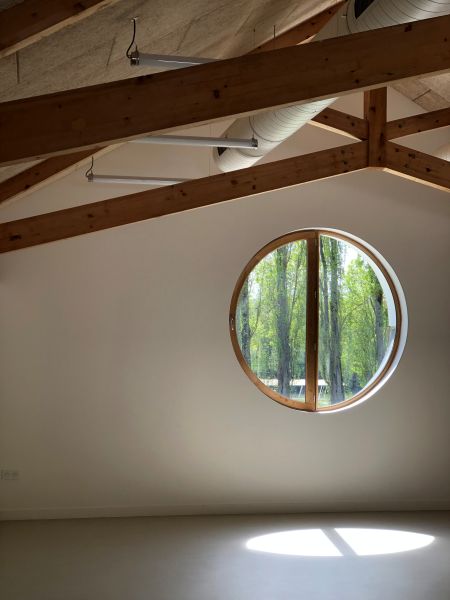
White gable, giant porthole (openable), massive © Jonas Tophoven
Jonas Tophoven / © Jonas Tophoven