
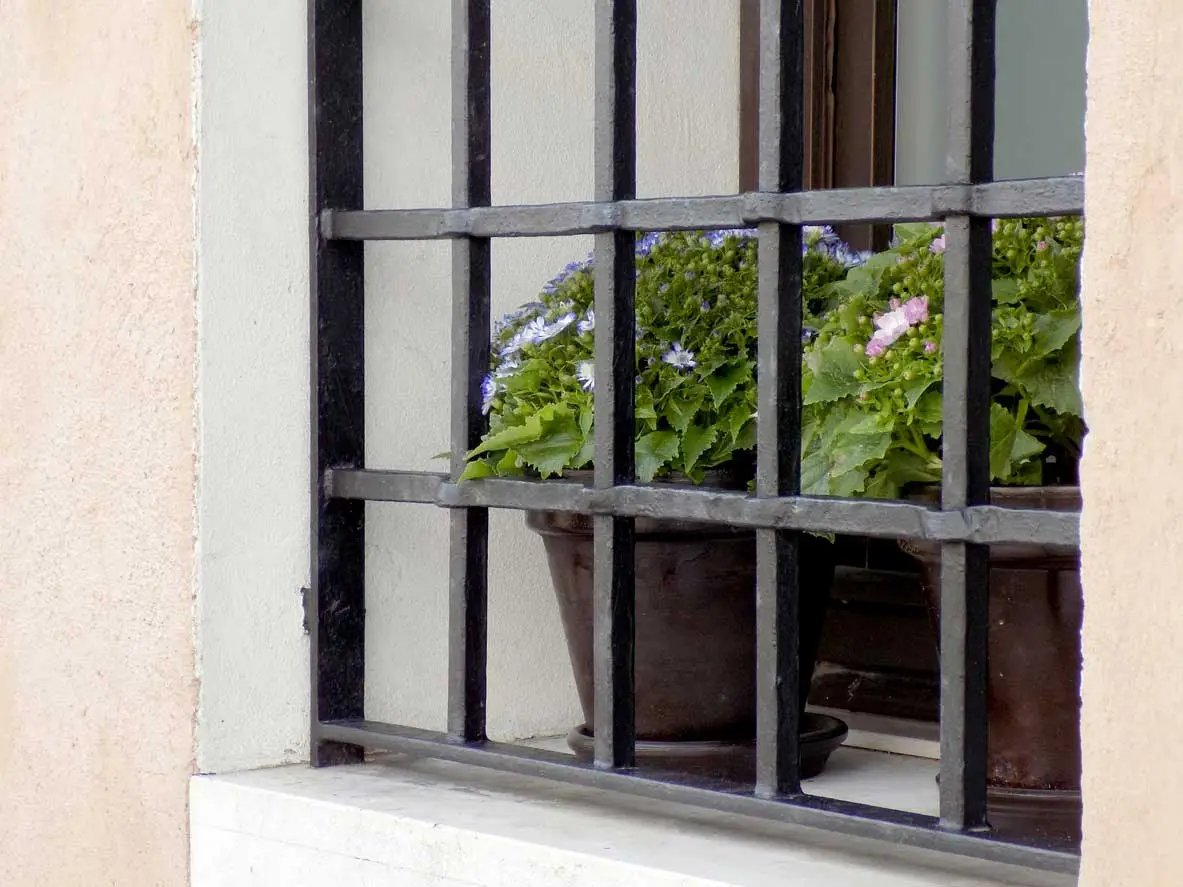
Technical and regulatory requirements for railings
In Italy there is no univocal specific regulation for anti-intrusion gratings as there is for armored doors (UNI EN 1627:2011 standard), however it is consolidated practice to refer to:
- European regulations on burglary resistance (UNI EN 1627/1628/1629/1630);
- rules for correct installation and anchoring in the building sector;
- municipal regulations and landscape restrictions where present;
- any references to CAM (Minimum Environmental Criteria) in public procurement.
Railings, if built and installed with professional criteria, can reach high levels of mechanical resistance, helping to improve the safety of the building envelope. Parameters to consider include:
- certified materials (steel or iron, often with galvanization and powder coating);
- minimum sections of load-bearing profiles;
- distance between vertical bars (often no more than 120 mm);
- reinforced welding points;
- anti-slip fastening systems;
- European cylinder locks or multi-point systems for opening models.
However, the absence of a specific certification does not exempt you from design and installation responsibility: in condominium, public or professional contexts, it is essential to document the materials, construction methods and technical solutions adopted, also for insurance purposes or to obtain tax deductions.
Advantages of steel and iron for protective casing
The use of iron (mild steel) for the construction of railings is based on consolidated mechanical properties:
- high tensile and torsional strength;
- ductility that allows tailor-made workmanship;
- excellent weldability;
- compatibility with anti-corrosion treatments.
In particular, the iron used for professional railings is subjected to:
- hot galvanizing or galvanic processes, to guarantee resistance to corrosion;
- thermosetting powder coating, which improves durability and aesthetics;
- Possible phosphating or sandblasting treatments, to prepare the surface for painting.
The combination of these treatments guarantees durability even in outdoor environments exposed to rain, humidity, smog and UV radiation. In building specifications, it is always advisable to specify the minimum thickness of the profiles, the quality of the treatments and the resistance to expected stresses (static and dynamic).
Types of railings: functional and construction classification
Iron security railings can be classified according to different criteria:
- Type of opening
- Fixed: welded to the wall frame, they do not allow opening – maximum resistance
- Hinged: one or two opening doors, ideal for windows and French windows
- Sliding: mounted on horizontal guides, more convenient in narrow spaces
- Standard straight
- Shaped on arches or irregular openings
- With decorative elements (studs, curls, weaves) for limited contexts
- Provision for safety locks
- Automatic locking systems
- Compatibility with integrated mosquito nets
From a technical point of view, each type requires dedicated design, especially if inserted in historic buildings, listed or with ventilated facades. In these cases, the project must include non-invasive anchoring and reversible solutions, in line with the provisions of the Superintendency.
Installation criteria: installation is an integral part of safety
The installation of the railings represents a critical moment for the effectiveness of the protection system. Even the best structure, if secured with inadequate systems, can become vulnerable. The main criteria to be respected include:
- deep structural anchoring, with chemical or mechanical anchors inserted into solid masonry or reinforced concrete;
- anti-infiltration perimeter seals;
- use of metal subframes or support plates for load distribution;
- hidden and inaccessible fixings, to prevent disassembly from the outside;
- absence of clearances or tolerances, which could allow the insertion of levers.
During the design phase it is important to evaluate the compatibility with the existing window, the possibility of interference with shutters, roller shutters or mosquito nets and the possible need to modify the window hole.
Railings and energy requalification: compatibility with building bonuses
In some contexts, the installation of railings has been considered a driven intervention in the context of global redevelopments with Superbonus, if related to works that improve the performance of the building envelope. However, with the gradual dismantling of the Superbonus and the transition towards ordinary deduction mechanisms (50% or 36% Home Bonus, Security Bonus), it is worth remembering that:
- railings are eligible for the Security Bonus, provided they have anti-intrusion features;
- detailed expense documentation is required, indicating the technical characteristics;
- traceable payment methods must be respected and ENEA communications sent, where requested.
Contribution to the sustainability and value of the property
Although they do not directly influence the energy performance of the building, iron safety railings contribute to overall living comfort and to the enhancement of the real estate asset. Benefits include:
- reduction of insurance risk;
- greater tranquility perceived by the occupants;
- increase in market value, especially in properties intended for rent or in high-traffic areas.
Furthermore, the choice of durable, recyclable and low-maintenance materials falls within the sustainability criteria promoted by the European guidelines for residential construction.
Thank you for subscribing to the newsletter.
