
At the Light + Building 2026 trade fair, LEDs won hands down the battle of light sources for lighting. They equip all lighting fixtures, from bedside lamps to public lighting.
The Light + Building trade fair closed its doors on Friday February 13 in Frankfurt. 1,947 exhibitors from 49 countries offered their latest solutions in equipment connectivity, building power, electric vehicle charging and lighting. In total, 144,767 visitors came to the show during its 6 days of opening. There next edition of Light + Building will be held in Frankfurt from March 5 to 10, 2028.
The essential LEDs
THE LEDs are essential at Light + Building 2026. It is even very difficult to find other light sources, whether for interior lighting in homes, offices, hotels, businesses or even public lighting. Let’s remember some basic concepts.
Light is measured with various units. THE lumen, denoted lm, is the total quantity of light emitted by a light source. L’efficiency is expressed in lumen per watt, lm/W. This is a key indicator of the efficiency of the light source. The lux, noted lx is the quantity of light diffused over 1 m2 : 1 lx = 1 lm/m2. There light temperature, noted in degrees Kelvin (K)expresses the shade of light diffused by a light source.
For a comfortable environment conducive to well-being, warm color temperatures, from 2700 K to 3000 K, lean towards yellow and red and are suitable. Colder lights, from 4000 K to 6500 K, stimulate concentration and alertness. They are used in professional spaces to promote productivity.
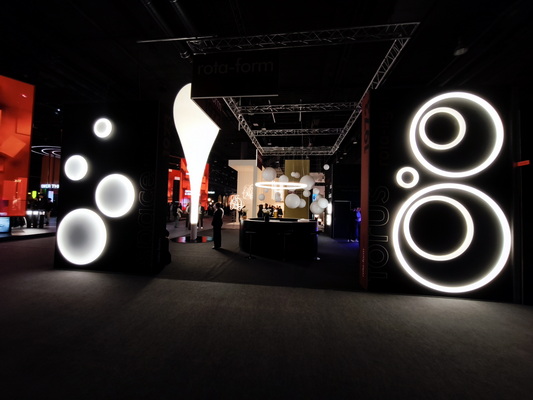
Thanks to their very small dimensions, LEDs lend themselves well to making curved, circular lighting fixtures, etc. Moreover, the adoption of curved shapes was the main trend observed for lighting fixtures exhibited at Light + Building 2026. © PP
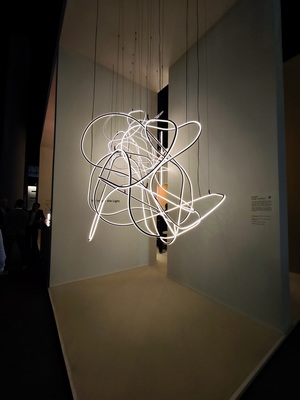
At FLUFF, the Design Collection offers an abstract and sculptural form, created from thin profiles of tangled LEDs which offer a dynamic, spherical shape. This luminaire is designed for large volumes: hotel lobby, exhibition halls. Its dimensions are tailor-made and must be specified when ordering. ©PP
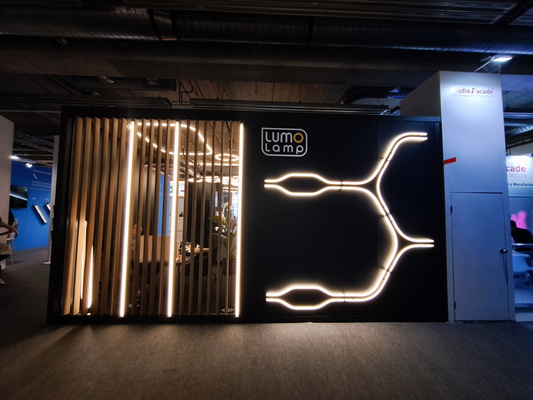
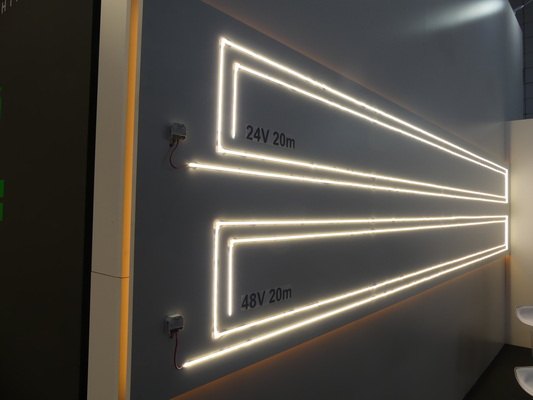
There are no limits to the shapes or dimensions of LED-based luminaires. As a result, at Light + Building 2026, we saw the strong development of tailor-made lighting offers. Which reinforces the interest in the intervention of lighting designers. © PP
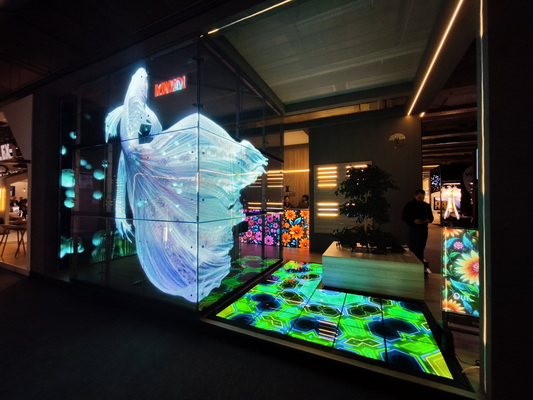
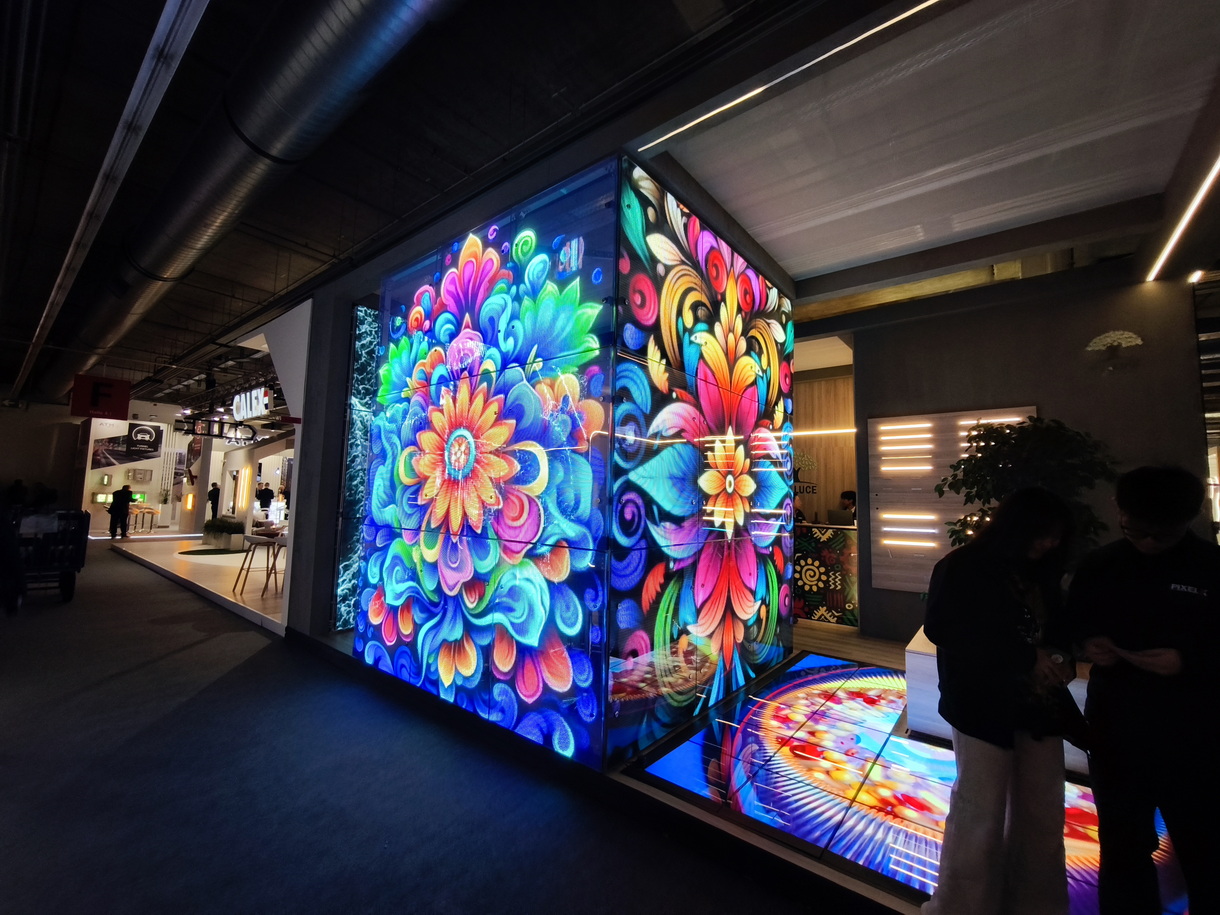
LEDs can also be incorporated between two glass plates and used to animate facades, floors or glass partitions. Their color can be changed and a good dozen exhibitors, both LED manufacturers and specialists, offered software for designing and controlling and animating these glass walls. It is perfectly conceivable to display the logos of a company on the glass facade of its building and to add various messages. © PP
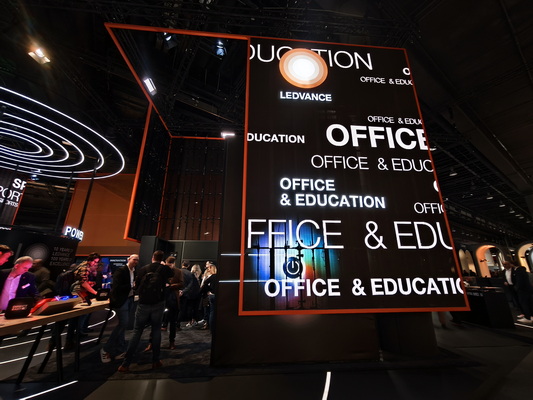
LEDVANCE took advantage of the Light + Building 2026 exhibition to celebrate the 10th anniversary of its transformation from a manufacturer of light sources to a provider of solutions for various types of premises. The slogan “10 Years of LEDVANCE. 100 Years of Excellence. Your Vision. Our Light.” has highlighted its expertise in lighting offices, teaching premises, housing, commercial spaces, sports premises and even outdoor spaces. The company notably showed projectors controlled by AI, capable of recognizing objects in a room and adjusting the light flux accordingly. It also showed a gesture control solution which avoids touching the controls – the legacy of Covid 19 – and reduces health risks. © PP
Suddenly, controlling LEDs becomes a real challenge
THE LEDs operate on direct current. THE driver LEDs in a luminaire transform the alternating current of the building into direct current. But it also has other functions: variation of intensity, light color, etc. Some drivers are also equipped with presence detectors and brightness detectors in order to dim the light emitted by the luminaire to just reach the number of lx programmed for a given room. Additionally, a driver is designed to understand orders given in a specific communication protocol: DALI, KNX, etc.
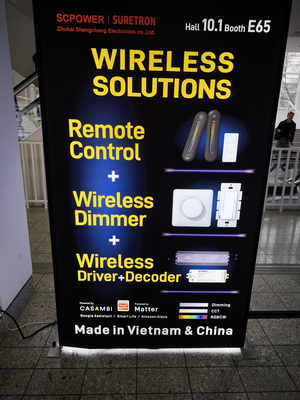
At Light + Building 2026, two communication protocols were particularly highlighted for controlling LED drivers. The first is Matter over Ethernet and PoE (Power over Ethernet) or Matter wireless over Thread. The second is an open, but proprietary, protocol developed by Casambi Technologies Oy, a private Finnish company. Casambi has developed an entire ecosystem for wireless lighting control and is opening it up to its partners: lighting manufacturers, component manufacturers, lighting designers, etc. At the show, around ten driver manufacturers offered compatibility with the Casambi universe. © PP
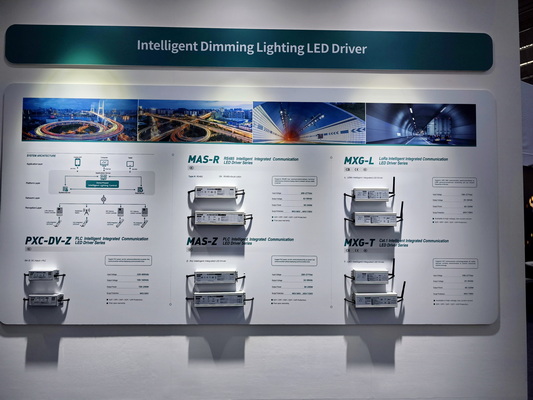
In addition to drivers for interior lighting, we saw at Light + Building drivers for exterior LED lighting: public lighting, stadiums, etc. They use different communication protocols, including the LoRa Wan wireless protocol with a radio antenna directly on the driver, control by RS485 or by an industrial programmable logic controller (PLC). © PP