
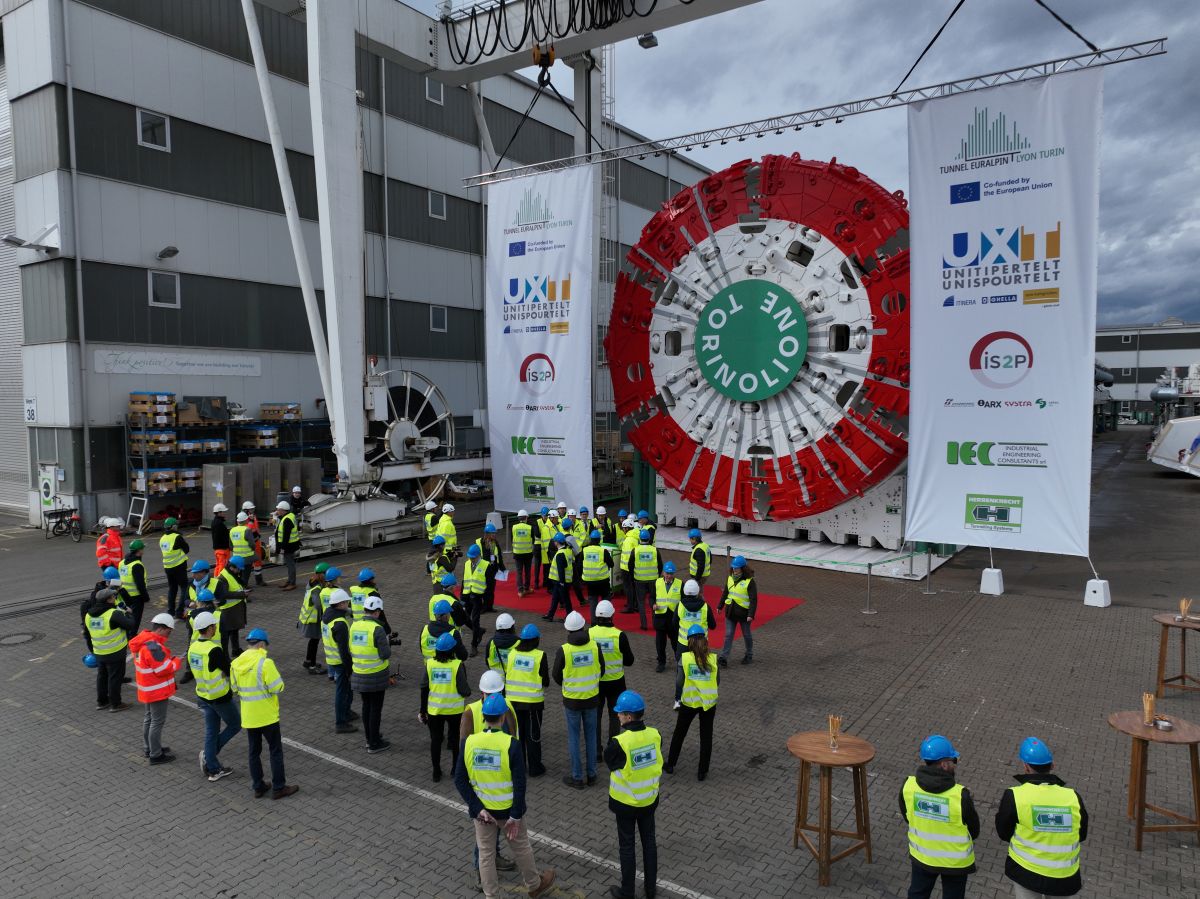
The first of the two tunnel boring machines which are to drill the Alps on the Italian side has been received in Germany, a key industrial stage of the gigantic Franco-Italian tunnel project expected by the end of 2033.


235 meters long and equipped with a cutting wheel of more than 10 meters in diameter, this tunnel boring machine was received at the Herrenknecht factory in Germany before its transfer to the Chiomonte sitein the Susa valley, as indicated in a press release byFranco-Italian company Telt, responsible for carrying out and managing the cross-border section of the project. It will allow “to accelerate the digging of the southern tube of the base tunnel, joining the work already carried out on the French side“, according to the said press release.
Immerse yourself in the heart of an exceptional construction site, where engineering, industrial power and long-term vision are redesigning the infrastructure of tomorrow.
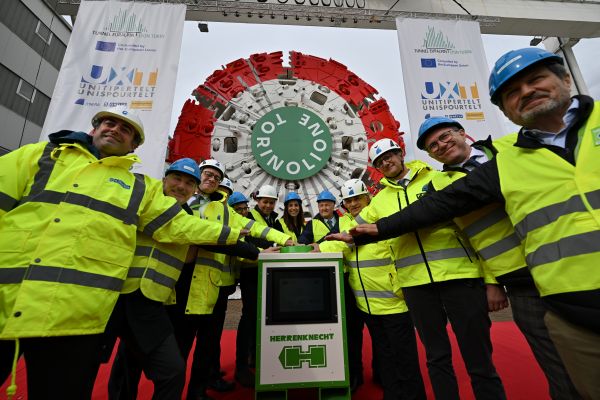
The tunnel boring machine was received at the Herrenknecht factory in Germany. © TELT / TBM
The equivalent of two football fields
235 meters long – the equivalent of two football fields – and weighing several thousand tonnes, the first of two giant tunnel boring machines intended to dig the Italian part of the Mont-Cenis base tunnelheart of the future railway axis Lyon-Turinwas officially received today at the German facilities of the constructor Herrenknecht. Designed on behalf of UXT group of companies – bringing together Itinera, Ghella and Spie Batignolles –, this cutting-edge equipment is intended to operate in particularly demanding geological conditions, under covers of up to 2,000 meters of rock.
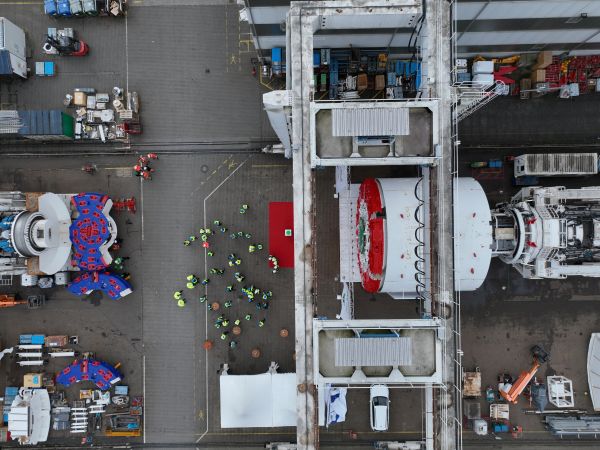
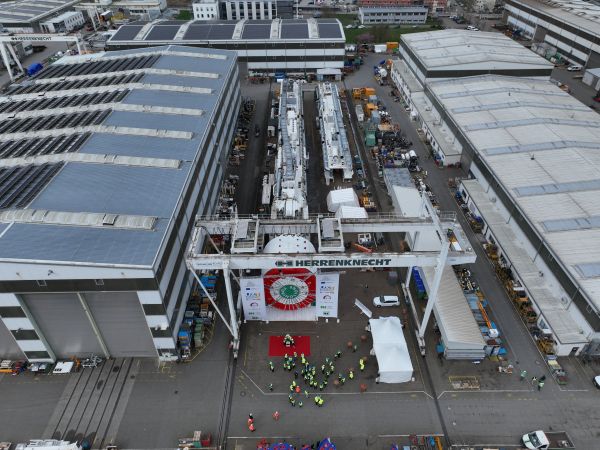
Assigned to the construction site Chiomontethe tunnel boring machine will first create the second tunnel before continuing to dig the southern tube of the base tunnel, already underway on the French side, progressing under the mountain to Susa. Ultimately, over the next few years, seven tunnel boring machines will operate simultaneously to carry out approximately 75% of the base tunnel excavations, in France and Italy. © TELT / TBM
The reception ceremony, symbolically marked by the rotating the cutting headwas held in the presence of Daniel Bursaux and of Maurizio Bufalinirespectively president and general manager of TELTentity in charge of the implementation and future management of the cross-border section of the project. Also present were representatives of the UXT group, IS2P project management (FS Engineering, ARX, Systra, Setec), as well as the vice-president of the Piedmont Region, Elena Chiorino. The interventions of the French Minister of Transport, Philippe Tabarotas the Vice-President of the Council of Ministers and Italian Minister of Transport and Infrastructure, Matteo Salviniwere pronounced remotely.
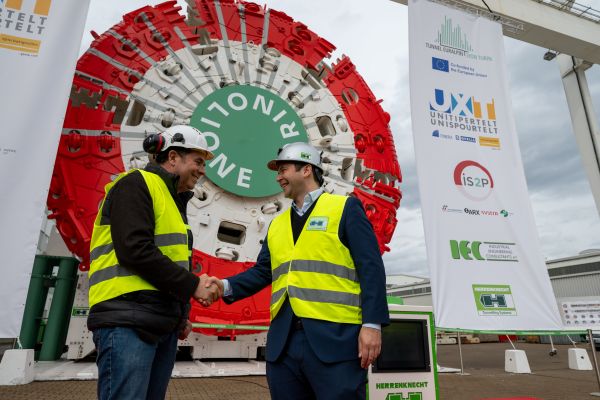
“Today, the Lyon-Turin work is becoming even more concrete and visible: the arrival of this tunnel boring machine marks a new stage of the project which is now entering a new operational phase also on the Italian side. This link will be a major European infrastructure, designed to strengthen sustainable mobility and bring the territories together. It also represents a technical challenge of exceptional complexity, made possible thanks to the support and cooperation of the French and Italian governments as well as Europe, who continue to believe in the strategic value of this project.” said Maurizio Bufalini, CEO of TELT, pictured left. © TELT / TBM
In the belly of the tunnel boring machine: technology at the service of digging
A true mega-engineering machine, the tunnel boring machine deploys its 235 meters long in the heart of the siteembodying the power and precision necessary to carry out a work of this magnitude. It is equipped with a cutting wheel measuring 10.16 meters in diameter, as well as an external shield which ensures both the protection of operators and equipment during excavation. This device also plays an essential role in the secure installation of prefabricated segmentswhich will gradually constitute the final lining of the tunnel.
The propulsion of the whole is based on thirteen motors with a total power of 4,550 kW, allowing an average progression of around ten meters per day. L’advance is carried out using hydraulic cylinders relying on the segments already installed, guaranteeing a digging rate that is as regular as it is controlled. Designed to cope with the diversity of geological contexts encountered, theequipment has been developed in a dual-mode version (dual mode). He can thus evolve in open mode (open mode) in hard rocksbut also operate in closed mode (closed mode) when crossing soft ground or areas under water table.
In this closed configuration, theevacuation of debris is no longer carried out by conventional conveyor, but via a closed loop hydraulic circuit. This process combines a crusher intended to reduce the size of excavated materials and a transport system for transporting a mixture of water, bentonite and crushed rock to the outside. To guarantee safe interventions in these pressurized environments, the tunnel boring machine is also equipped with a hyperbaric compression-decompression chamberauthorizing possible human operations in pressurized conditions. A pressurized shuttle device completes the package, allowing the evacuation of personnel and progressive decompression, without interruption of the digging cycle.
Digging into the heart of the mountain: an engineering feat
Engineering adapted to extreme conditions
THE use of this type of tunnel boring machine meets a set of particularly restrictive technical requirements:
– the great heterogeneity of geological formations;
– The remarkable depth of the structures: up to 2,000 meters under the mountain cover;
– The need to take routes with tight curves, both in plan and in profile;
– And, finally, the management of high natural temperatures at these depths.
The detailed analysis of the characteristics of the massif was made possible thanks to the recognition gallery of Maddalena, carried out in Chiomonte. The data from this preparatory phase made it possible to design to calibrate the tunnel boring machine in perfect accordance with the geotechnical specificities of this section of the project.
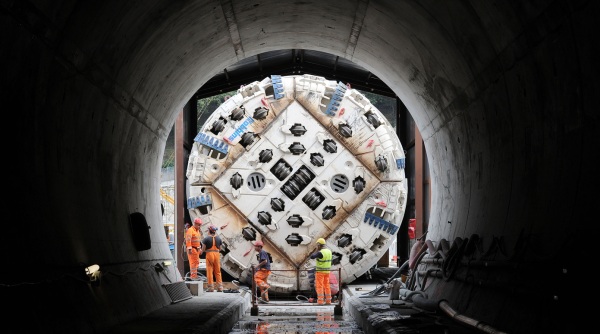
Between 2012 and 2017, the Maddalena recognition gallery, in Chiomontewas carried out in order to analyze in depth the structure of the massif intended to accommodate the new railway line. 7,020 meters long, this structure was dug using the GEA open tunnel boring machine, with a diameter of 6.30 meters. This operation made it possible to explore the Ambin Massif up to the maximum coverage zones of the future Mont-Cenis base tunnel, while collecting essential geological, hydrogeological and geomechanical data to refine the design of the final structure. © TELT
Chiomonte, operational heart of the Italian shipyard
THE Chiomonte site constitutes the main Italian construction site of the cross-border section. Classified since 2012 as a site of national strategic interest, it represents the major access point for completion of work on the Mont-Cenis base tunnel in Italian territory. In total, nearly 30 kilometers of galleries will be excavated from this platform, both using the traditional method and means of two dual-mode tunnel boring machines. In addition to the two base tunnel tubes, the program also includes the construction of the Maddalena 2 descenderthe communication branches between the two tubes, the underground security site of Clarea, as well as the covered trench located at the eastern entrance to Susa.
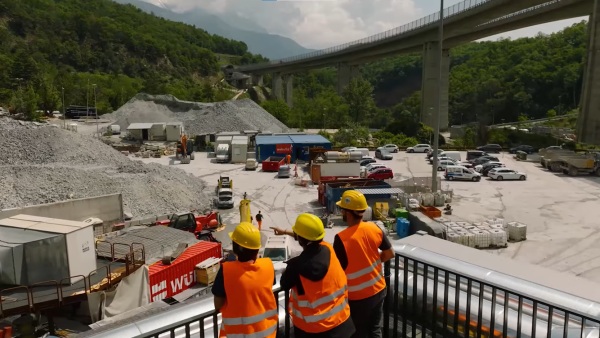
Chiomonte is the largest Italian construction site in Lyon-Turin. Since 2012, a site of national strategic interest, it constitutes the access point for the base tunnel works in Italy. © TELT
Preparatory operations for the reception of the tunnel boring machine are underway. In January, construction of the new interchange was completed, facilitating the movement of machinery and materials via the A32 motorway; this work was carried out under project management delegated by Sitaf. The implementation of the retaining wall, called “Berlin”, has also begun, before the lowering of the existing platform, prior to the excavation using traditional method of approximately 160 meters of the Maddalena 2 gallerywhich will then allow the tunnel boring machine to descend.
The machine will now be dismantled and transported to Chiomonte. Its cutting wheel and its motor module will be reassembled on the construction site before its immersion in the mountain in 2027, where it will have to dig around 10 kilometers to Susa. At peak activities, nearly 700 people will be mobilized on this site.
A European-scale project in full progress
There construction of the cross-border section of the new Lyon–Turin railway line65 kilometers long between Saint-Jean-de-Maurienne and Susa, is progressing simultaneously open-air and underground, in France and Italy, with more than 3,300 people mobilized.
As of February 28, 2026, more than 47 kilometers of galleries have been excavated in total, including more than 20 kilometers for the base tunnel, or approximately 29% of the 164 kilometers of galleries planned for the work. This exceptionally complex infrastructure includes two parallel railway tunnels, four descenders and 204 communication branches dedicated to safety.