
Construction of major events as an accelerator of quality, innovation and sustainability
Starting from the alpine context of Trentino, where the Lago di Tesero Cross Country Stadium symbolizes a historical example of construction and redevelopment oriented towards durability, up to the urban context of Milan, with the Olympic Village of Porta Romana which integrates solutions for infills in wood certified for its sustainable origin, the path traced by the construction of major events exemplifies its role as an accelerator of quality, innovation and environmental responsibility, with concrete impacts on the territory well beyond the time of the event.
“The PEFC certification applied to wood for construction allows the origin of the material to be made transparent and to give value to short, documented and controlled Italian supply chains. The Olympics are bonds, interactions, dialogue, fraternity: values that PEFC wants to share and live to the full with local authorities, businesses and associations. We relaunch this commitment by looking at the places”continues Bussone.
Alpine case: TV building and cross-country stadium in Lago di Tesero (TN)
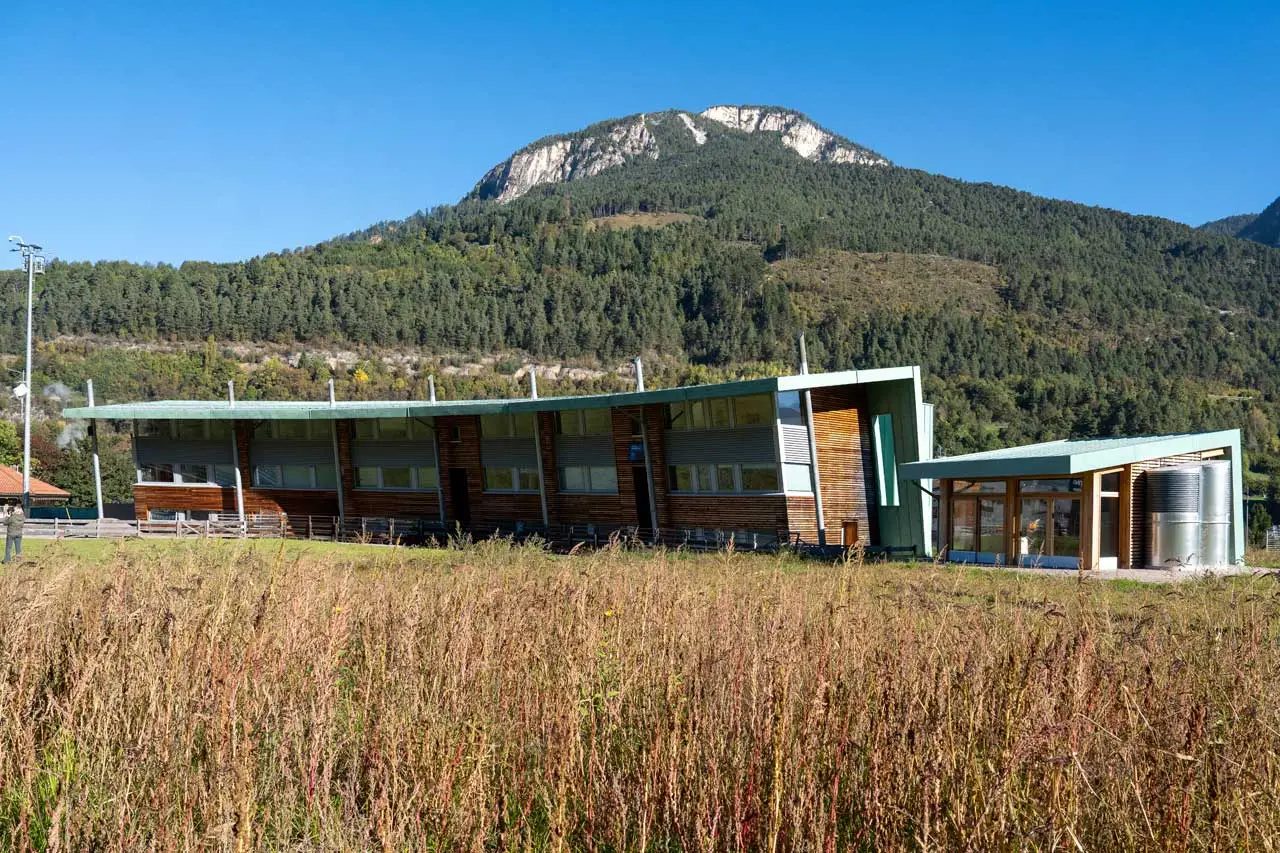
In Trentino, the Lago di Tesero Cross-Country Center in Val di Fiemme represents one of the most emblematic cases of application of PEFC certified wood in the sports and infrastructure sectors. Here certification allows you to transform a construction choice into verifiable data, enhancing the responsible origin of the wood and traceability along the entire supply chain.
TV building of the Lago di Tesero cross-country skiing centre
Built for the 2013 Nordic Ski World Championships, the TV Building of the Lago di Tesero Cross Country Center is certified according to the PEFC traceability standard (technically called “Chain of Custody”). For its construction, 12,926.98 m² of woody material from a fully PEFC certified supply chain, traceable and verified by a third party, were used, broken down as follows:
- 1,724.48 m² of spruce planking and 7,394.43 m² of planks from the Magnifica Comunità di Fiemme (TN)
- 2,202.72 m² of walls and 727.97 m² of floors in Trentino red spruce XLam
- 877.38 m² of larch cladding and uprights from Trentino woods
From a technical point of view, the XLam panels have variable thicknesses between 81 mm (internal walls) and 285 mm (roof), while on an environmental level the choice of local Trentino wood has contributed to reducing the emission impact linked to transport, with around 60 tonnes of CO₂ equivalent avoided (usually the wood is instead imported from countries hundreds of kilometers away, with road transport).
Cross Country Stadium – redevelopment of the “Fabio Canal” Cross Country Center
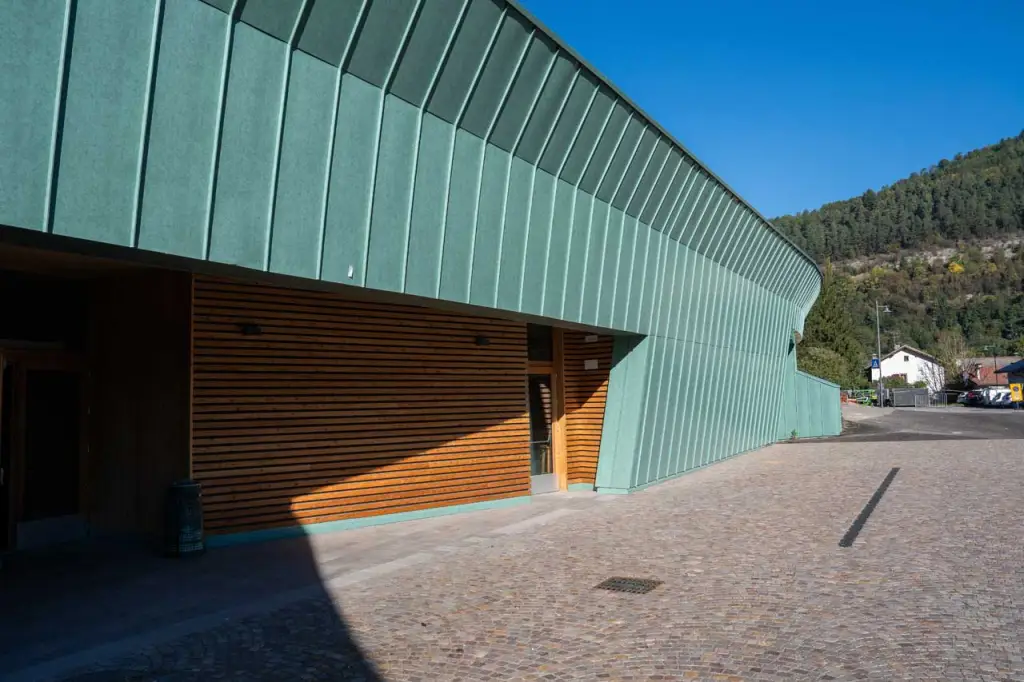
Alongside the experience of the TV Building, the “Fabio Canal” Fund Center has been involved in a recent redevelopment process that integrates certified materials and a philosophy oriented towards durability, in line with a long-term approach that aims to leave functional infrastructures to the territory, usable beyond the event and capable of storing CO2 inside the wood used. Overall, the following were employed:
- 1,443 m² of XLam panels in Alpine fir
- 19.5 m³ of laminated fir wood from Val di Fiemme
- 36 m³ of Alpine larch laminated wood for the glass facades
- 344 m² of larch planks from Val di Fiemme for the cladding of the façades
The use of certified and traceable materials reinforces, in this case too, the idea of a supply chain capable of connecting responsible management of the forest and the creation of sports infrastructures oriented towards legacy and lasting value for local communities.

Urban case: the Olympic Village of Milan (Porta Romana)
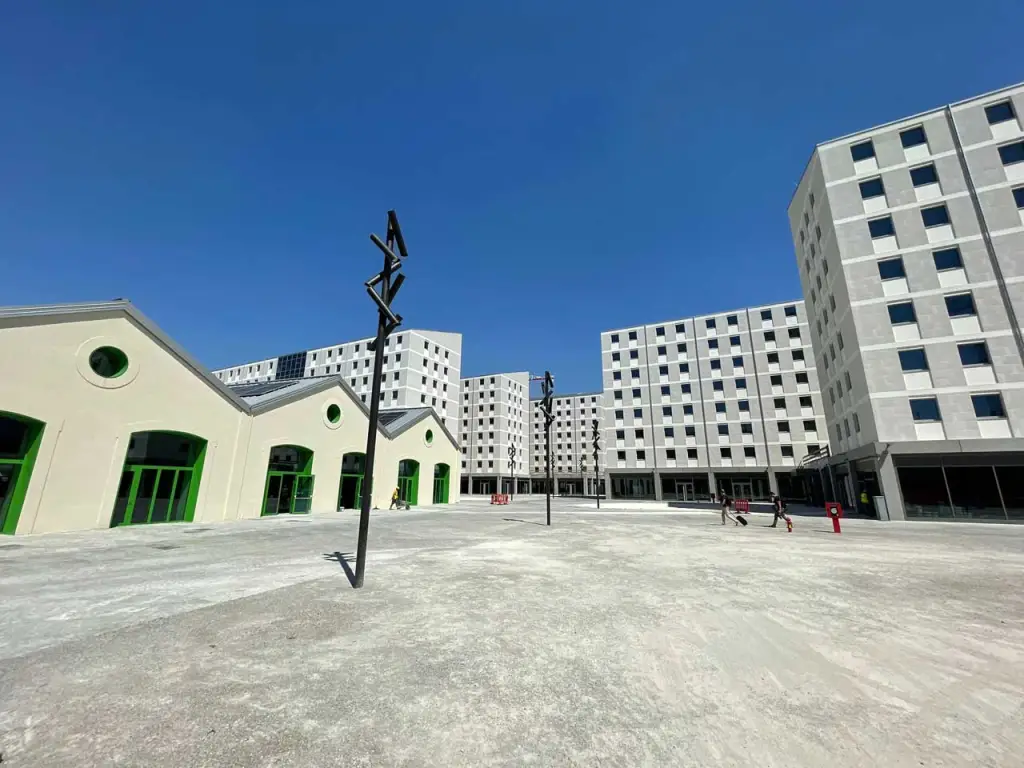
If Trentino represents an Alpine example of a short and legacy supply chain, the Olympic Village of Milan, in the western area of the former Porta Romana airport, offers a highly visible urban case in which the construction choices linked to certified wood enter into the creation of an infrastructure destined to have a long life even beyond the Games.
The Olympic Village is in fact designed to temporarily accommodate athletes during the event and subsequently become a student residence, confirming a strategy of reuse and continuity of use consistent with the new expectations of building sustainability.
The project was created using XLam panels in PEFC certified wood for the infill walls, with an extension of approximately 15,000 m². A choice that allows the integration of criteria of traceability and transparency of materials even in an urban context in which the quality of the works and the supply chain documentation represent increasingly relevant elements for administrations, citizens and stakeholders.
As explained by Antonio Brunori, General Secretary of PEFC Italy, “PEFC certified wood offers a concrete guarantee along the entire supply chain: from the forest to the finished product, passing through the construction site. Projects such as that of Lago di Tesero demonstrate that PEFC certification can be an operational tool to highlight the importance of the traceability of local wood and make it appreciated as a verification tool also in public infrastructures and highly visible works. In this context, the use of certified wood for three structures of the Olympic Games made it possible to avoid a total of 6,764 tons of CO₂, thanks to the choice of wood to replace structural steel, confirming the strategic role of renewable materials in reducing the climate impact of large works”.
PEFC certification: traceable and controlled supply chain
We remind you that PEFC Italia is a non-profit association that constitutes the national governing body of the PEFC certification system, i.e. the Evaluation Program of forestry certification schemes. PEFC is an international initiative based on a broad understanding of stakeholders in the implementation of sustainable forest management at national and regional levels. Representatives of forest owners and poplar groves, environmental organizations, end consumers, users, freelancers, research, the world of the wood industry and crafts participate in the development of the PEFC.
In large infrastructure projects, sustainability is no longer just a declaration of intent: it becomes a measurable requirement linked to traceability, compliance and control. In this context, the PEFC traceability certification applied to construction allows us to guarantee that the wood used comes from responsibly managed forests and from a documented supply chain, reducing the risk of unverifiable supplies.
PEFC Certification takes on a particularly significant role because it allows you to qualify specific works and enhance not only the material itself but the solidity of the process: from the selection of wood to industrial transformation, up to its implementation. At a time when the construction sector is called upon to contribute to climate and environmental objectives, the combination of renewable materials, short supply chains and independent certification represents an operational lever to reduce emissions, increase transparency and accelerate more responsible models for the construction of public works.