
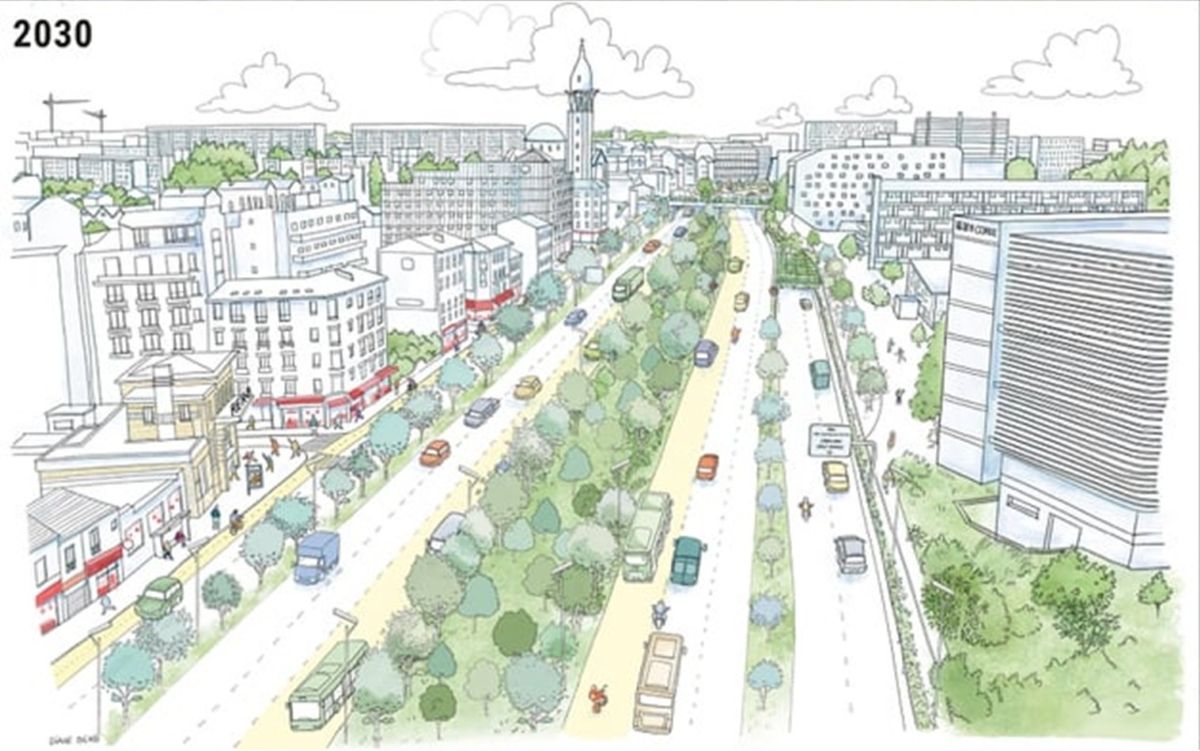
Municipal in Paris: environmentalists propose transforming the Paris ring road into an “urban boulevard”. Among the first measures put forward: the development of a pedestrian crossing at Porte de Gentilly.

THE environmentalists, committed alongside Emmanuel Grégoire in the run-up to the municipal elections in Paris, revealed their project to transform the Paris ring road into an “urban boulevard”. First step envisaged:development of a pedestrian crossing at Porte de Gentillysouth of the capital.
Towards a gradual transformation of the ring road into an urban boulevard
In the perspective of municipal elections in Parisenvironmentalists, committed behind Emmanuel Grégoire, defend a gradual transformation of the Paris ring road in order to profoundly modify its morphology. The objective, according to David Belliard, leader of Parisian ecologists and third on the list of the left outside LFI, is that at the end of the next mandate theinfrastructure no longer functions like a motorway loop but like a real urban boulevard.
A development which would aim in particular to improve the living environment of the approximately 500,000 inhabitants living on either side of this road ring. For the current deputy for the transformation of public space in Anne Hidalgo’s team, the change first involves the introduction of urban developments that break with the current motorway logic. “Installing a pedestrian crossing already means changing the model“, he explained during a press point organized on the edge of the infrastructure.
A first pedestrian crossing planned at Porte de Gentilly
First concrete translation of this orientation: the creation of a pedestrian crossing at Porte de Gentilly. The development would make it possible to directly connect the town of Gentilly and the Cité Internationale Universitaire de Paris on foot, currently connected only by an elevated footbridge.
The cost of the operation is estimated between 10 and 15 million euros. At the same time, Emmanuel Grégoire’s team plans to complete the installation of a lane dedicated to carpooling on all 35 km of the ring. This program, already voted on by the Paris Council, would represent an investment of around 7 million euros.
Among the other projects mentioned also include the reconfiguration of the Porte de Bagnolet interchangeregularly presented as one of the black spots of pollution in Europe, as well as that of the Porte d’Orléans.
Speed reduction and political debate
In the longer term, the transformation of the ring road into an urban boulevard would involve a reduction in the number of lanes and a lowering of the speed to 30 km/h in certain sectors in order to promote its urban integration. Since the decision taken in October 2024 to lower the maximum speed from 70 to 50 km/h, noise pollution has already fallen significantly, particularly during the night, according to Dan Lert, climate deputy. This regularly describes the environmental situation around the ring road as “health scandal“. The reduction in speed would also have produced measurable effects on air quality, according to Airparif analyses.
However, these directions remain strongly contested by the municipal opposition. Candidate of the right and the center for mayor of Paris, Rachida Dati, supported by Les Républicains and the MoDem, pleads for a return to the initial speed limit, after the installation of soundproofing coverings. A position also defended by the president of the Île-de-France region, Valérie Pécresse.
© Diane Berg / Apur