
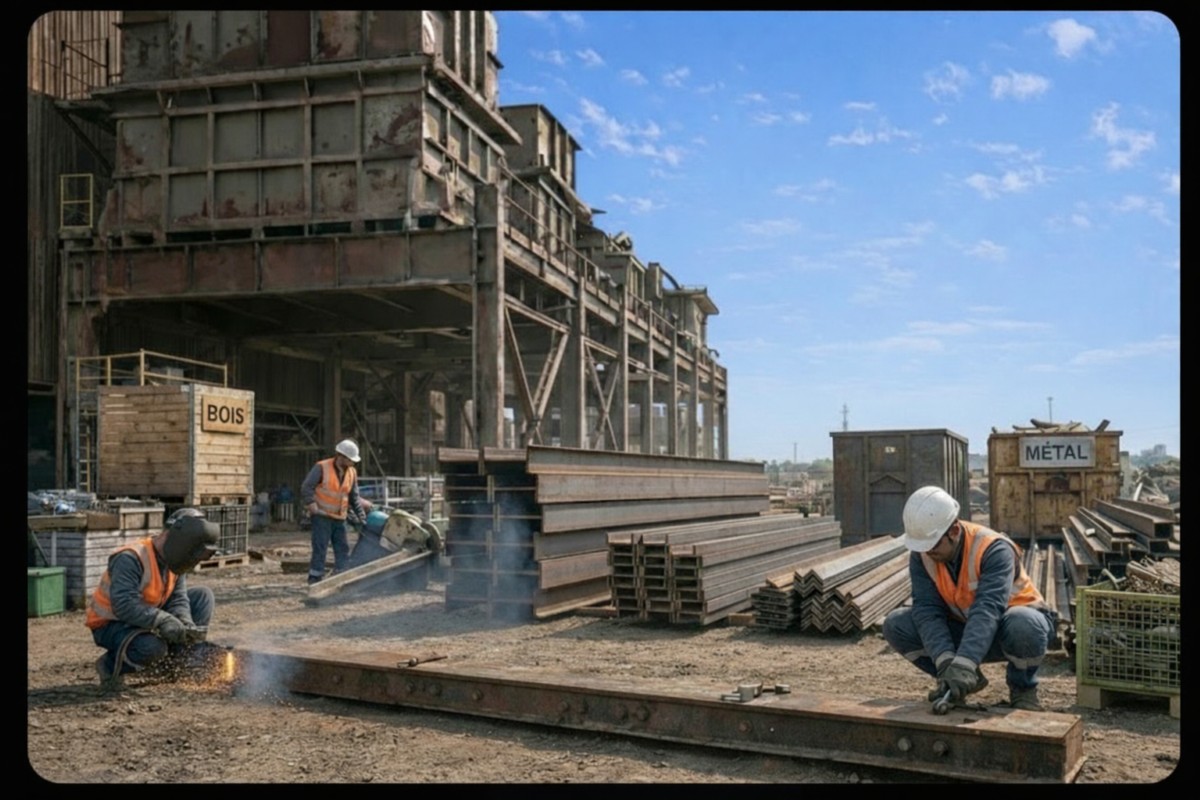
With the extension of RE 2020 to the tertiary sector and industry, the reuse of steel is emerging as an already operational solution to reduce the carbon footprint of buildings and secure supplies.
Publi-Information 


The rise of requirements of RE 2020 in the tertiary and industrial sectors reshuffles the cards for the metal construction sector. In a context of increased carbon pressure as well as tension on raw materials, the reuse of steel now stands out as a concrete solution, technically supervised – notably by the CTICM – and immediately usable in operations, far from its status long considered experimental.
As a reminder, the CTICM (Centre Technique Industriel de la Construction Métallique) is a private French organization created in 1962 by the State at the request of the French metal construction union. Funded by the metal builders as well as through commercial services (studies, certifications, etc.), it supports the development and promotion of metal construction based on research, standardization, certification and technical assistance activities for companies in the sector.
An immediate response to new regulatory requirements
With thegradual extension of RE 2020 to tertiary and industrial buildingsthere construction sector crosses a new threshold of environmental requirements. Project owners, designers and companies must now deal with reinforced carbon objectives, which require a rapid reduction in the footprint of materials and construction methods.
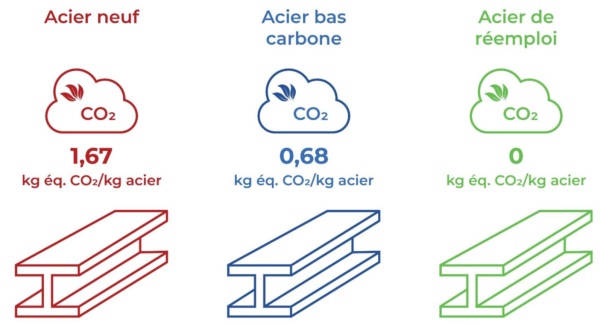
The reuse of steel is emerging as a solution that can already be mobilized on a project scale. For comparison, new steel generates on average 1.67 kg CO2/kg, a low carbon steel approximately 0.68 kg CO2/kg, while reused steel makes it possible to approach almost zero impact by avoiding a new phase of industrial production. © CTICM
Getting out of the “demolish to rebuild” model
The still dominant model is based on a well-established end-of-life logic: demolition of metal structuresthen recasting the material. A controlled chain, but one that emits a lot of carbon and is not very optimized from a resource point of view.
Conversely, selective deconstruction introduces a break in reading: thesteel is no longer seen as wastebut as a directly reusable deposit. This approach makes it possible to reposition the value of the material from the removal phase, upstream of any industrial transformation.
Reuse thus makes it possible to significantly reduce emissions linked to the production of new materials, preserve the value of existing structures and secure supplies in a context of tensions over raw materials. © CTICM
A sector now structured and industrializable
Long perceived as marginal, the reuse of structural steel is now part of a stabilized and equipped technical framework, supported by the structuring of the sector around the CTICM (Industrial Technical Center for Metal Construction) and like theMetal Reuse ecosystem.
This ecosystem is based on several operational and technical building blocks:
– a dedicated digital platform (metalreemploi.com);
– Professional recommendations recognized by the C2P of the AQC, guaranteeing the insurability of reused structural elements;
– A network of partners and certified requalifiers;
– A mobile laboratory to support the diagnosis of existing structures and the requalification of elements;
– And, finally, operational integration tools, including a clause facilitating the introduction of reuse in CCTPs.
“The reuse of steel is no longer a prospect, it is an operational reality. Today, we have a robust technical framework, recognized by the entire sector, which guarantees the traceability, performance and insurability of reused elements. In the context of RE 2020 and risks linked to supplies, it constitutes an immediate lever to reduce the carbon footprint of projects while securing resources“, underlines Amor Ben Larbi, Director of Research Projects at CTICM.
An industrial, environmental and territorial opportunity
Beyond regulatory requirements, the reuse of steel is part of a broader transformation dynamic in the sector. It constitutes an environmental performance lever for project owners, a differentiating factor for specifiers and an adaptation tool for companies faced with increasing carbon requirements.
Each year, nearly 650,000 tonnes of steel from construction are sent for recycling in France. A part of this deposit can now be reused, with a potential estimated at 15% by 2030.
In this dynamic, the structuring of reuse also contributes to strengthening industrial sovereignty, by relying on locally available resources and on a network of actors distributed across the territory. It is part of a logic of ecological transition, security of supplies as well as transformation of constructive practices.
© CTICM