
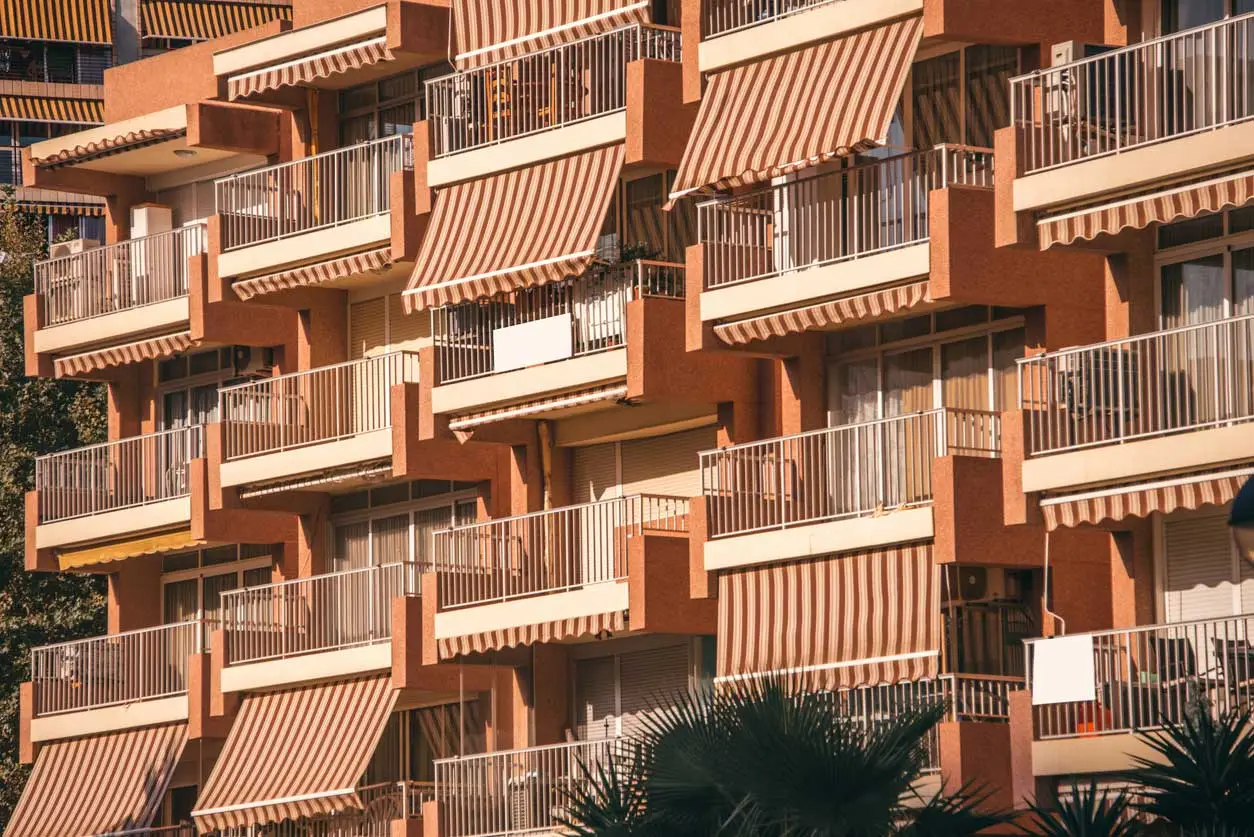
Built-in balconies: the underbalcony
Friezes, frames, ornamental coverings and, in general, everything that contributes to the aesthetics of the facade still remains a common good, even if it is located on a private sunken balcony. This is because the exterior appearance of the building belongs to all condominiums. If the sub-balcony is also decorative (drawings, stucco, etc.) then the costs for its maintenance are borne by all condominium owners.
When the lower part of the balcony above (i.e. the sub-balcony) does not contribute in any way to the aesthetics of the facade, it must be considered as an element of exclusive property of the condominium owner on the lower floor, because it effectively acts as a covering. It is therefore not a common good, but a structural portion that belongs to those who live below. Two very concrete effects derive from this qualification. The first concerns expenses: being a private property, it is the condominium owner on the lower floor who has to take care of the plastering, painting and any small decorative interventions on the sub-balcony.
The second effect concerns use. Precisely because the underbalcony is an asset of his property, the condominium owner on the lower floor can use it as he deems most appropriate, always respecting the general safety rules and the decorum of the building. Thus, for example, it can anchor an awning to the subbalcony.
Overhanging balconies: the different situation of the underbalcony
The overhanging balconies are those that protrude from the facade of the building, constituting only an extension of the apartment from which they protrude. These artefacts do not act as a roof for the lower floor as they, from a structural point of view, are completely autonomous with respect to the other floors, as they can exist independently of the existence of other balconies on the floor below or above.
In this case the subbalcony, if it is not decorative, belongs to the owner of the balcony. Consequently, the condominium owner of the apartment below can anchor an awning to the sub-balcony only if expressly authorized by the owner above: otherwise he or she may be judicially forced to remove the structure of the illegally installed awning.
The violent removal of curtains from the balcony: a recent case
The owner of an overhanging balcony, for the first time in nine years, sends a formal warning to the condominiums on the lower floor claiming that the sub-balcony is her exclusive property and therefore asking for the immediate removal of the curtains. In the following months he reiterated the request in person, warning that, in case of failure to remove it, he would appoint a specialized company. Subsequently, two workers, who arrived with a van equipped with a basket, intervened directly on the balcony and dismantled the curtains. At that point the underlying condominium owners filed a complaint for various crimes, including violence against property, private violence and trespass.
In the civil trial, the condominium owner tries to defend herself by claiming that the tents had been installed without any authorization. According to him, the removal was a “defensive” act, not an attack, and in any case the action of the condominiums below was late. The Court, however, reconstructs the story differently. Remember first of all that, to obtain possessory protection, it is not necessary to demonstrate that you are the owner: it is sufficient to prove that you have de facto possession of the property, exercised continuously and with the appearance of a real right. Even “illegal” possession is protectable, as long as it is stable and visible.
From this point of view, the appellants certainly had possession of the curtain hooks: they had been using them for years, without dispute. The defendant, however, had those attachments removed against their will. This behavior complements the counting, because it consists in depriving someone of possession of an asset without waiting for a judge’s decision, arbitrarily substituting the authority. It is the classic hypothesis of “reason made”, that is, of those who take the law into their own hands. The Court sentenced the owner of the balcony to reinstate the condominiums below in full possession of the assets in question.
>> If you want to receive news like this directly on your smartphone, subscribe to our new Telegram channel!