
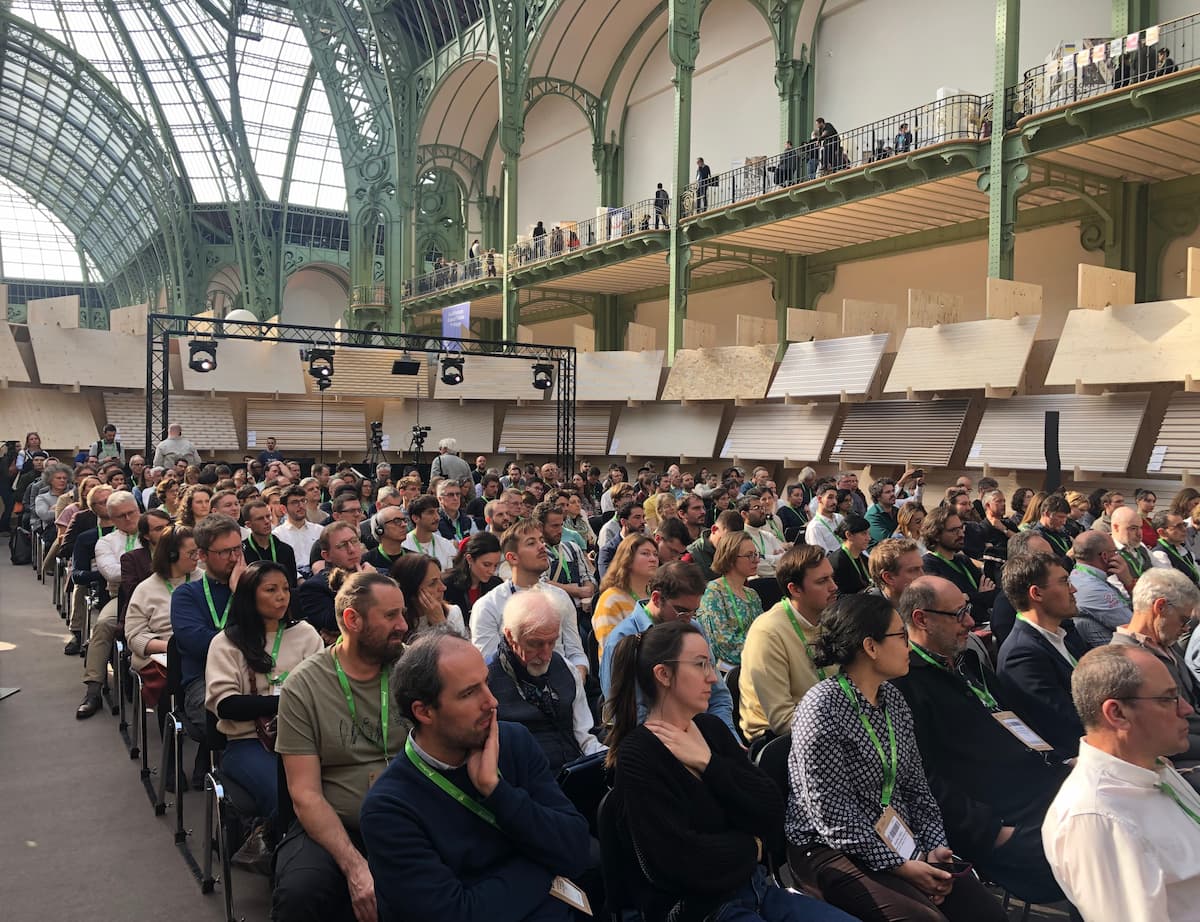
It is not at all natural to see the Grand Palais welcoming this world of marginal and committed construction which has made its way there from February 25 to 27, 2026.
We could go back tocontemporary history of wooden construction in Franceto the pioneers, to the CNDB, to everything that made possible two successive editions of the Forum at the Grand Palais. That would be a great thesis.
The chapter of edition 15 begins with the observation that edition 14 was highly publicized on social networks, because of the surprise of new Grand Palace. The team of Nvbcom prepares his first copy with the desire not to lose the effect of his news Gallery of 21st century wood/bio-based architecturea great idea difficult to reproduce elsewhere and in particular at the Center Prouvé where the 15th edition is expected. The satisfaction survey asks about staying in Paris. Suppliers are pushing Paris. The council is tense, the national organizations do not express themselves, except FiBois which expresses its reservations. The final choice of Paris is poorly received in the Grand Est.
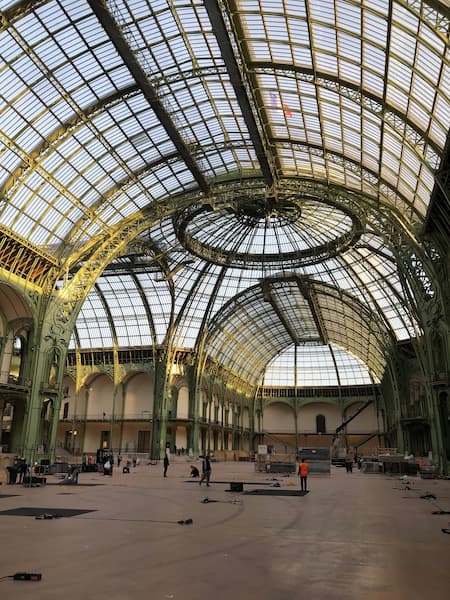
How to occupy the nave of the Grand Palais? A question that has tormented the Nvbcom team for seven years. © Jonas Tophoven
It all starts with the theme
Everything then starts with a brochure for which Nvbcom wishes to highlight the beautiful images of the Forum under the nave. You need a title, a theme. Once again, it will be the climate, with a simple and clear formula: “Face the climate”. Implicit in this is the push, in the first half of 2025, of the notion of adaptation, sometimes against mitigation. Yet how can we adapt to unbridled development? How can we believe that the curve can be reversed? Faced with climate, it is the theme of perplexity, but it must be nourished by constructive practice. The period of government announcement effects seems to be over, the RE2020 is under review, it is appropriate to concentrate on the local authorities which will be renewed shortly after the Forum for a mandate which leads straight to 2030. The elected officials are in the campaign but the territorial agents specialized in construction, those who will remain, do not have much to do three weeks before the elections. How to capture them? In summer, Construction 21 organizes a conference at the Assembly on adaptation which shows the way, with municipal figures. At the same time, Frugality publishes its Journal of Possibilities and announces its presence at the Salon des Maires.
Small towns of the future
The first Frugatour organized by Frugalité in Muttersholtz, the reflections of Simon Teyssou to revitalize town centers and the creation of a first rural Make Ici, in Lormes, draw attention to small towns where great architects do great things. It is the right complement to the necessary developments in the capital, which moreover is not very verbose and deserves that we turn to Greater Paris.
Thus, in addition, a third workshop is emerging on the metropolises, served by Lille and its Saint-Sauveur gymnasium, and Bordeaux with its sports courtyard. If we add the 9th edition of the workshop dedicated to donors, we cover almost a day dedicated to local authorities. A complement is provided by a workshop on territorial wood engineering, by the IBC association.
The overall challenge of this first day is to present the achievements by bringing in public authorities, on the one hand to raise their awareness of the Forum, and on the other hand to encourage them, through their model, to go further by 2030. An auditorium C is created under the mezzanine, in principle for conferences with headphones, in order to complete the day with workshops developed with partners (Off-Site, urban planners, Ekopolis, RFCP, etc.). A synthesis workshop around off-site, carbon and architecture, as well as a parallel workshop on the emergence of the Forum, creates the link to the opening of the Gallery of 21st century wood/biosourced architecture.
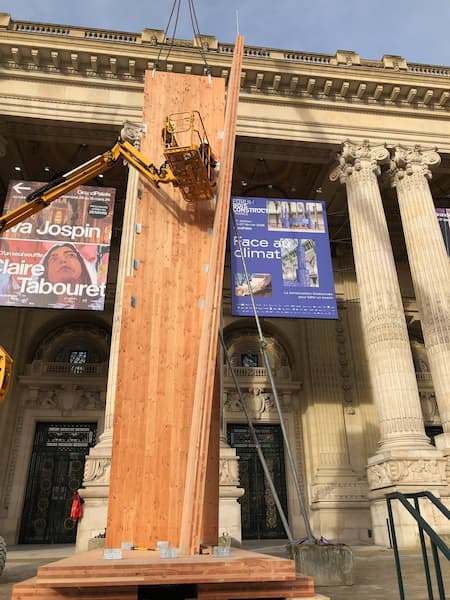
The Climate Wall operates in conjunction with Workshop B9 on the JOP 2030, and on the general theme: “Facing the Climate”. © Jonas Tophoven
Technical day
After this first day focused on project management, the second logically constitutes the heart of the Forum with what becomes a “technical day” centered on the technical morning and, in the afternoon, the essential Fire Workshop.
The Fire Workshop dialogues with the Workshop on tall wooden structures (possible elsewhere in Europe), which mirrors a Workshop on residential densification, itself in dialogue with the emerging market for wooden workplaces. This device moves the initial idea of placing at the heart of the day the confrontation of carbon with adaptation and biodiversity, in order to bounce back on fashionable concepts. However, the chosen approach is, here too, centered on the practice of the sector, with selected sub-themes:adaptation by the choice of crisis wood or climate woodand through reuse; biodiversity through construction with secondary hardwood species, and through planting. No one had thought of things that way.
Finally, two requests from the ETFs, a plywood morning, it is true, reoriented towards the themes of the Forum, and a Reuse Workshop which falls just after an overhaul of the BTP REP for wood. In order to concentrate events close to the spirit of the Forum in Paris, the Parisian part of the Osez Faire Frugal event is admitted as a real Forum Off at the end of the day, in parallel with the awards session extended to the Hemp Construction Awards.
Wellness
There remained the third day, often less crowded, and where the best Workshops are held. After a technical and militant day, it seemed good to end on something positive, and the choice fell on well-being based on the major theme of hospital wood finally concrete, passive certification, new educational approaches in schools.
At the same time, Friday concentrates an international approach with the Vents du Globe, dedicated to the DROM-COM, and the workshop on the universal exhibition, as well as the launch of the workshops dedicated to the JOPs of 2030. In the afternoon, the opening to the general public becomes a constant in the programming.
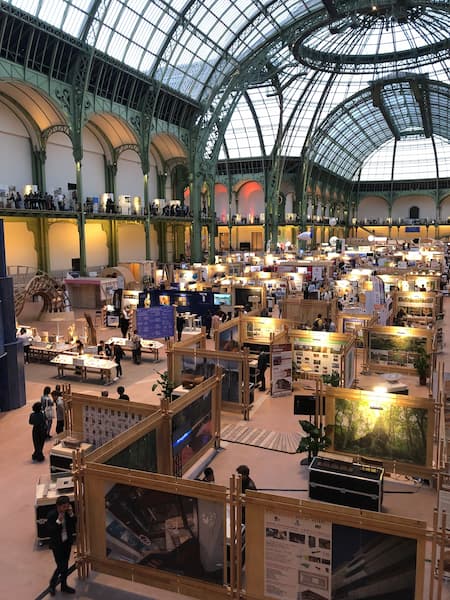
End of the first Day of the Forum, February 25, big moment of Workshop A3, presentation of emerging developments in Auditorium C. © Jonas Tophoven
Total mixing
Little by little, the Innovations Tribune was integrated as a complement to auditoriums, while emergences multiplied and regulations (reuse, RE2020, fire) evolved. From the outset, from the summer, the program had scrutinized the creations proposed by the agencies exhibiting at the gallery, often not submitted in a call for projects and yet interesting. So that the Forum is now not only characterized by the great mixing of professionals between Gallery, conferences, exhibitions, forums and emergences, but also by this dense thematic overlap which still has a few benchmarks:
– the theme of the Forum;
– The theme of the days;
– The theme of the workshops;
– And the orientation of the workshops towards the concrete.
Rigorous orchestration
We now see organizations taking the lead with IBC, FNB, UMB, UIPP, in addition to Offsite partners, RFCP, La Maison du Passive. It’s a long learning process, aimed at structuring the workshops, avoiding wooden language and soft microphone passages, the lack of interaction with the room, the lack of precision, i.e. all the childhood illnesses encountered by the Forum in its 15 years of existence. Now, almost all project presentations fit within the allotted time, down to the minute. The moderators adopt the pace of 2h15 + 5 min which allows the creation of standard reference workshops on specific subjects, accessible on the media. Thus, workplaces, residential densification, small towns of the future, hospital wood, new school approaches etc. are milestones, markers of the state of the art.
Questions
It appears that the Forum stands on four legs: visits, conferences, emergences and the Gallery which is now inseparable. The rhythm of four days seems established, one for visits, one for project management, one for the technical core and one which should be open more widely to the general public. THE Quadrilogue, just like the Architecture Gallerybrings something innovative. This is where the pulse of the Forum must beat in the future, with pitches on innovation, but also press conferences and collaborative workshops.