
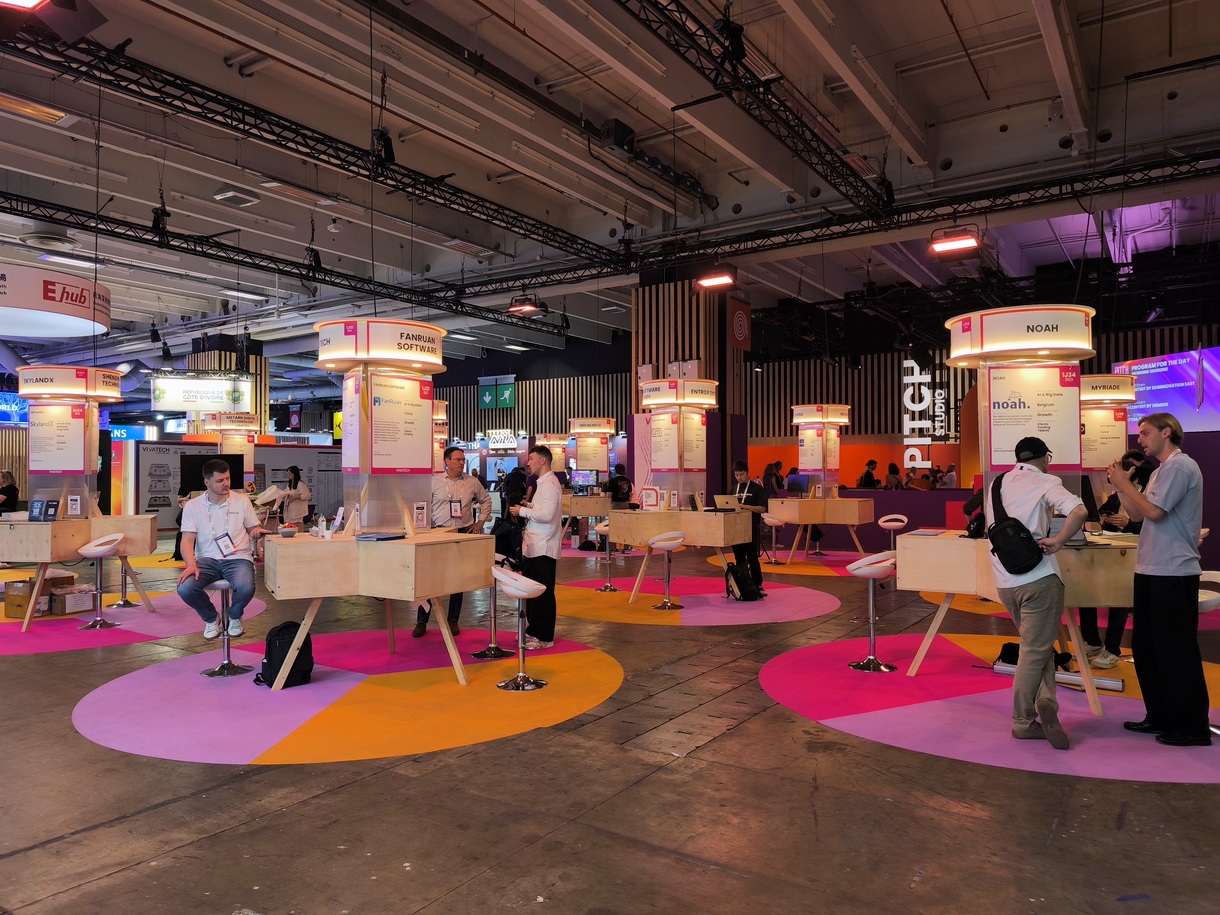
From June 17 to 20, VivaTech welcomed 200,000 visitors from 165 countries to discover more than 15,000 startups and listen to 1,155 speeches. The share of the building is modest.

VivaTech is growing, internationalizing and celebrating its tenth anniversary at Porte de Versailles in Paris, in pavilion 7 of the exhibition center. On three floors, large umbrella stands of large companies – La Poste, LVMH, Samsung and ADOBE – housed just over 15,000 start-ups. To say that we have met them all would be an exaggeration. Most of the innovations focused on AI, particularly applied to commercial functions and the management of company IT systems, but we discovered around twenty offering interesting innovations in our field: building and energy. Here are the top six.
Wattel Wall and Wattel Go
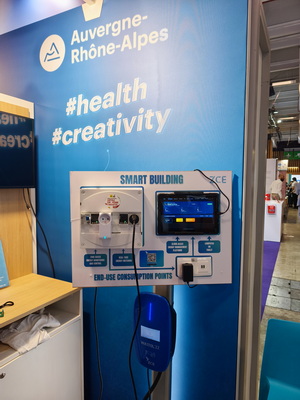
On the Auvergne-Rhône-Alpes Region stand, ZCE offered a complete range of connected modules, IRVE terminals and a cloud supervision platform for managing the energy consumption of buildings. © PP
L’company ZCE notably showed the Wattel Wall, an intelligent wall socketinstalled to replace a standard socket, it measures, controls and transmits the consumption data of each connected device, with integrated USB ports. ZCE also showed Wattel Go, the portable version of the Wattel Wallplugged into any standard outlet.
Both Wattel Wall and Wattel Go sockets measure three consumption quantities at the point of use (W, kWh, cos φ), allow individual remote On/Off control, include an integrated temperature sensor, detect phantom electricity consumption, transmit information via Bluetooth / Wi-Fi / MQTT for automatic feedback to the cloud ZCE and send alerts in the event of drift or anomaly. THE heart of the ZCE system is constituted by the dashboard and the cloud which centralize all building energy dataallow intelligent management and generate compliance reports with real-time supervision by zone, by building, by equipment. Predictive AI constantly analyzes operations to anticipate anomalies. The application generates exportable CSR and carbon footprint reports, sends automatic alerts in the event of deviation, and manages access and user roles. The application – the dashboard – is tablet and mobile iOs and Android compatible for managers. ZCE opens its APIs for data integration into existing CMMS / BMS.
Finally, ZCE offers accommodation cloud secure and maintain sovereign data.
Blue Planet Ecosystems
There start-up Austrian Blue Planet Ecosystemssupported by the Paris-Saclay University Foundation, by the Departmental Council of Essone, and the French data center operator Data4, presented the prototype of a data center capable of reusing the heat produced by the operation of the data center to produce energy by cultivating algae. The project explores CO capture2 to reproduce a photosynthesis mechanism allowing the cultivation of algae which will then be recycled into biomass to develop circular energy sources and bioproducts for various industrial sectors. By relying on a multidisciplinary team, this innovative project could transform the Marcoussis campus into a reference model, replicable internationally.
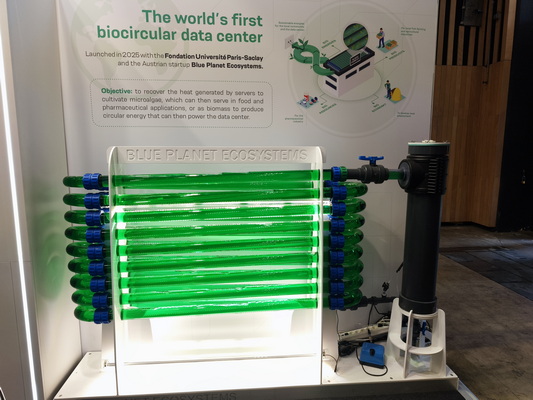
The project aims to capture CO2 to reproduce an artificial photosynthesis mechanism favoring the cultivation of algae. These are then valorized in the form of biomass in order to develop circular energy solutions as well as bioproducts for multiple industrial sectors. © PP
HexaDone
Supported by the Banque des Territoires and Orange, HexaDone is a software publisher that offers a scalable and secure platform to simplify the management of territorial data. They provide observability, artificial intelligence and decision support tools, allowing each community to manage the present and anticipate the future.
In January 2026, HexaDone acquired Hyvilo, a specialist in data analysis. By acquiring Hyvilo, start-up founded in December 2020 in Besançon, HexaDone enriches its platform with a suite of ready-to-use business modules. Based on “management object” oriented modeling – assets, equipment, obligations, processes, decisions, links – these fully configurable modules go beyond organizational silos and enable better management and exploitation of complex data. The whole constitutes an integrated, open and interoperable solution, which covers the entire value chain: compilation, analysis, processing and storage of data, up to operational execution.
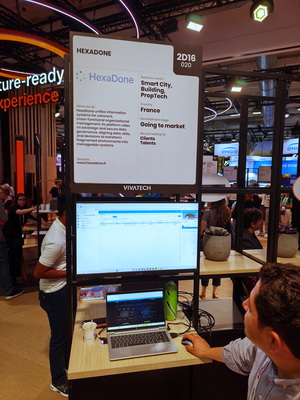
HexaDone is the French solution dedicated to local authorities to accelerate their digital and ecological transformation thanks to data. © PP
Revolty
Revolty recycles batteries from electric mobility. Every year, millions of lithium-ion batteries still full of potential are extracted from electric vehicles. At the same time, hundreds of thousands of solar homes in France lose up to 60% of the energy they produce because they cannot store it. Revolty brings these two worlds together and revalues second-life batteries from electric mobility and stationary storage to manufacture residential, local, sustainable and affordable solar batteries.
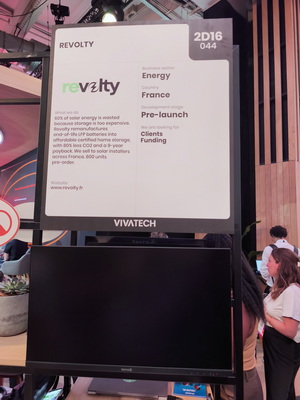
The Revolty battery is guaranteed for 10 years and offered in 5, 10 and 15 kWh capacities. It is compatible with any PV installation, new or existing. It is supplied with an application, for control by Ethernet and Wifi and automatic control during off-peak hours. © PP
Enermap by Engie
Enermap, developed by Engie, is a decision-making tool that allows communities to identify and plan their energy potential, by offering a simple and integrated vision of their territorial issues. Enermap covers solar, wind, hydroelectricity, biogas, batteries, heating networks and cold networks and offers a factual assessment of the renewable energy potential in a territory. According to Engie, accelerating the local production of renewable energies means strengthening the resilience of territories in the face of climate change, their attractiveness and improving the quality of life of residents.
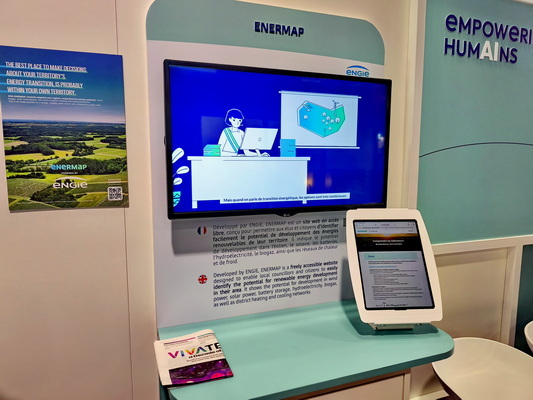
Enermap is developed by Engie. © PP
Decarbonize social housing
RegenEAU and CIEC, a subsidiary of ENGIE Solutions, are joining forces for the decarbonization of social housing. A feasibility study with a view to setting up a first demonstrator aimed at recovering up to 60% of the heat contained in a building’s wastewater has been completed. RegenEAU has developed a water/water heat pump, capable of recovering heat from wastewater, gray water and black water to produce DHW. RegenEAU promises up to 75% covered DHW demand and a reduction in operating costs of up to 50%. The heart of the system is the patented solid-liquid separator for wastewater. It is designed to extract solids and direct liquids into the system. It is installed on the main sanitary drainage pipe, managing both gray water and black water. The solid-liquid separation takes place passively by gravity, therefore without mechanical action (no motor) and without filter. Then RegenEAU offers two sets of heat pumps: PH2 for 50 homes and PH3 for 75 homes.
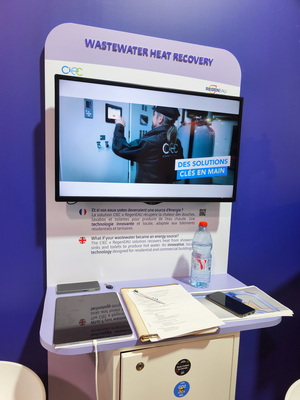
RegenEAU and CIEC, a subsidiary of ENGIE Solutions, are joining forces for the decarbonization of social housing. © PP