
The French market covered by the partly international members of the Association of Biosourced Construction Industrialists (AICB) is now close to 100 million euros in turnover.

When the barometer was inaugurated last year, it was a little difficult to chart a tangible evolution of the biosourced marketbecause the start of the decade was marked by ups and downs, particularly in the evolution of the volume of the insulation market since the pandemic. We had the AICB figures when the association left the UIMC in 2016 to join the UICB now renamed UICCB. But it wasn’t the same perimeter. One could wonder if this barometer would not follow the unfortunate trend of‘National wood construction surveyinitially supposed to support the sector’s progress while it has continued to illustrate its setbacks in the tone of “market that is resilient in a difficult context“.
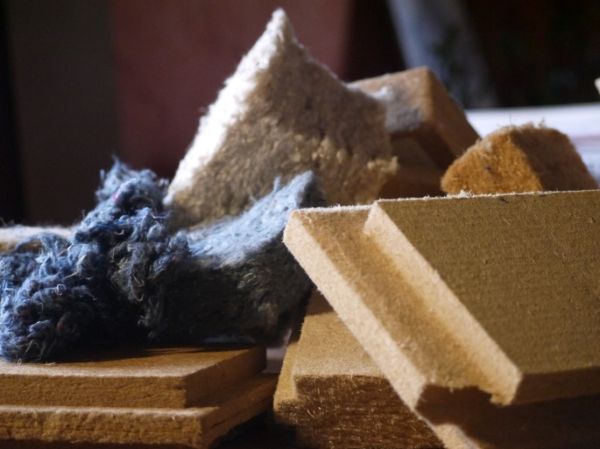
The wood base material dominates the AICB’s insulation offering. © AICB
Quantify a market that is too diffuse
The risk was all the greater as the barometer mixed rags (from Mélisse) and napkins with segments that were sometimes so unrepresentative as the wood concretewhose progress illustrates that of its sole member of the AICB, CCB Greentech. Not enough to make a poster with so-called “biosourced” concrete which progress in two years from 0.6 to 0.9 million 100 mm equivalent in m2or 50%. Which is somewhat normal with the launch of new dedicated production lines among concrete precasters. There palette of materials covered by the AICB is vast:
– cellulose wadding,
– wood fiber,
– recycled cottons,
– hemp linen jute,
– hemp,
– grass,
– straw via Profibres at Cavac.
The cooperative is continually diversifying and it is plausible that its director Vincent Hannecart assumes the position of president of the AICB.
Volume market shares are climbing
The ambition to represent 10% of the market was a little too noticeable in the AICB’s first communication attempts, but now the barometer is expanded with an indication of the insulation market share in 100 mm equivalent volume (8.2% compared to 7.5% in 2024 and 6.4% in 2023). At this rate, the AICB scope will reach 10% of the insulation market by volume before 2030. 10% in insulation pdm + well 100 million turnover + who knows 50 million equivalents 100 mm in m2these are tangible objectives.
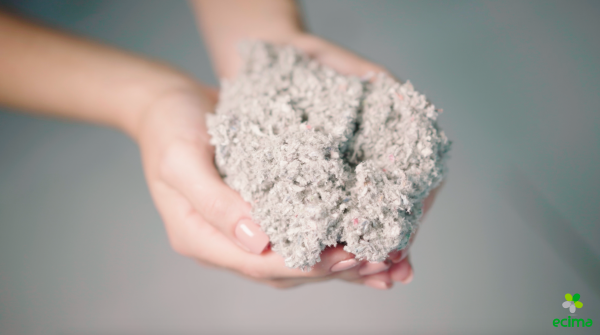
Cellulose wadding remains a safe bet. © Ecima
The world of ecomaterials is unfolding
The barometer is enriched this year with a regional breakdown calculated according to the m2 100 mm equivalents, which reveals serious inequalities between AuRA at 20% and Normandy at 3.3%.
The AICB has no problem considering that it represents the majority of volumes, while the RFCP for the straw or the hemp sector (projection) still have difficulty quantifying their market. We would have to dig. Particularly in the context of the new Ecomaterials Alliance that the AICB co-signed last February International Wood Construction Forum.
Strong progression of the LDF
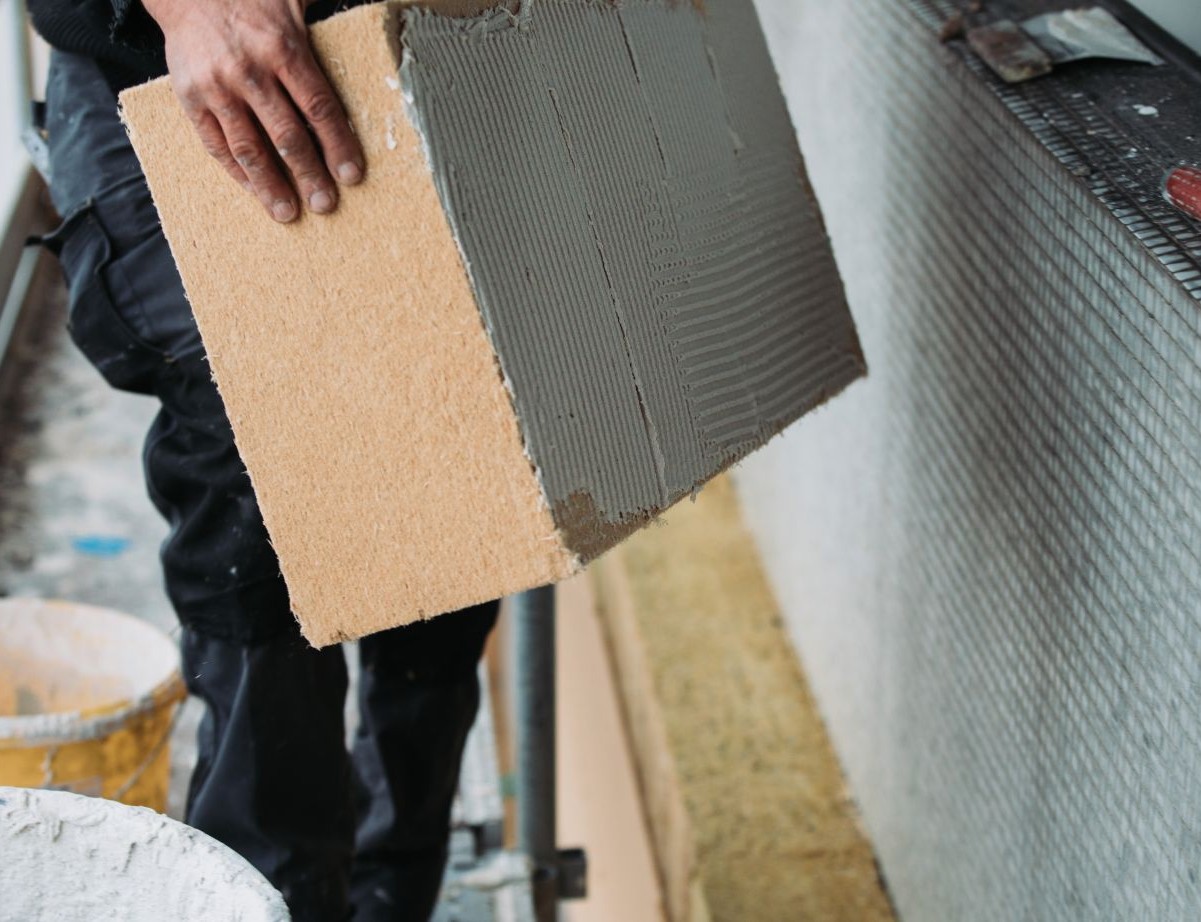
There cellulose, flex, panel, wood concrete : wood is hegemonic like basic subject at AICBwhich explains its affiliation with the UICCB. Today, wood material allows industrialization better than other natural materials. It seems that the various key materials based on wood, wood fiber and cellulose are maintaining their positions. The entry into service of LDF units from Steico, Gutex, and Pavatex – what the barometer calls rigid insulators – means that the barometer indicates 3.5 million 100 mm equivalent in 2025, a doubling of the 1.6 million in 2023 – better than wood concrete. The lines, however, do not yet seem to be moving with predominance of flexand it’s annoying because the so-called semi-rigid flex in the barometer is a battle product with lower margins, directly compared to mineral wools, while in France, everyone is still wondering how to use LDF, which has not become the must German for under-roofs. But the way ofBiosourced ITE on masonry is all mapped out.
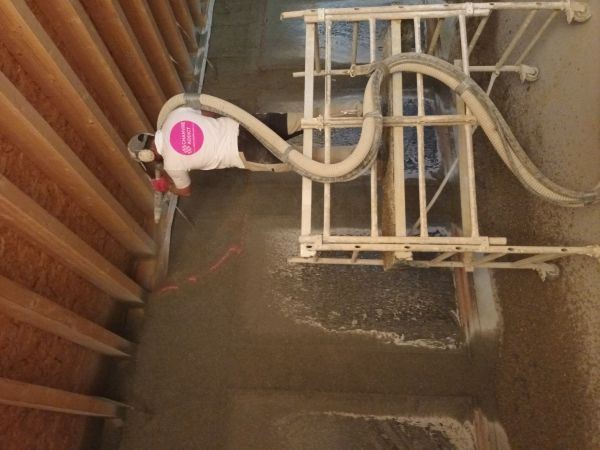
Hemp asserts itself in its multiple forms: projection, prefabrication, flex… © Cavac
Any good news is good to take
Last year, during the first presentation of the barometer, the credo was that France had acquired insufficiently used production capacities. Now we understand that the catch-up is taking place gradually, but undoubtedly continuously. This is good news to which the French market for new climatic construction is clinging, in the context of the massive blow of the decree of February 18 on the fire protection of biosourced structures.
How to explain?
There is the RE2020 which will become a little more biting in the 2025 version from 2026. The biosourced label revised and which better values insulation – compared to structural wood –, calculated by volume and not by weight. And there is industrial pressure, in particular from wood fiber installations and that of LDF driven by the two major German panel pressing manufacturers, while the German reference market is not in good shape. Perhaps also the commercial discourse on phase shift and thermal amplitude (AICB White Paper) plays his role on the field. But we are not yet at the point where green insulation will become an object of massive speculative investments, and the large insulation groups present behind many members of the AICB (Saint Gobain, Knauf, Kingspan, Soprema) are watching.
/ Jonas Tophoven / © BartoschSalmanski