
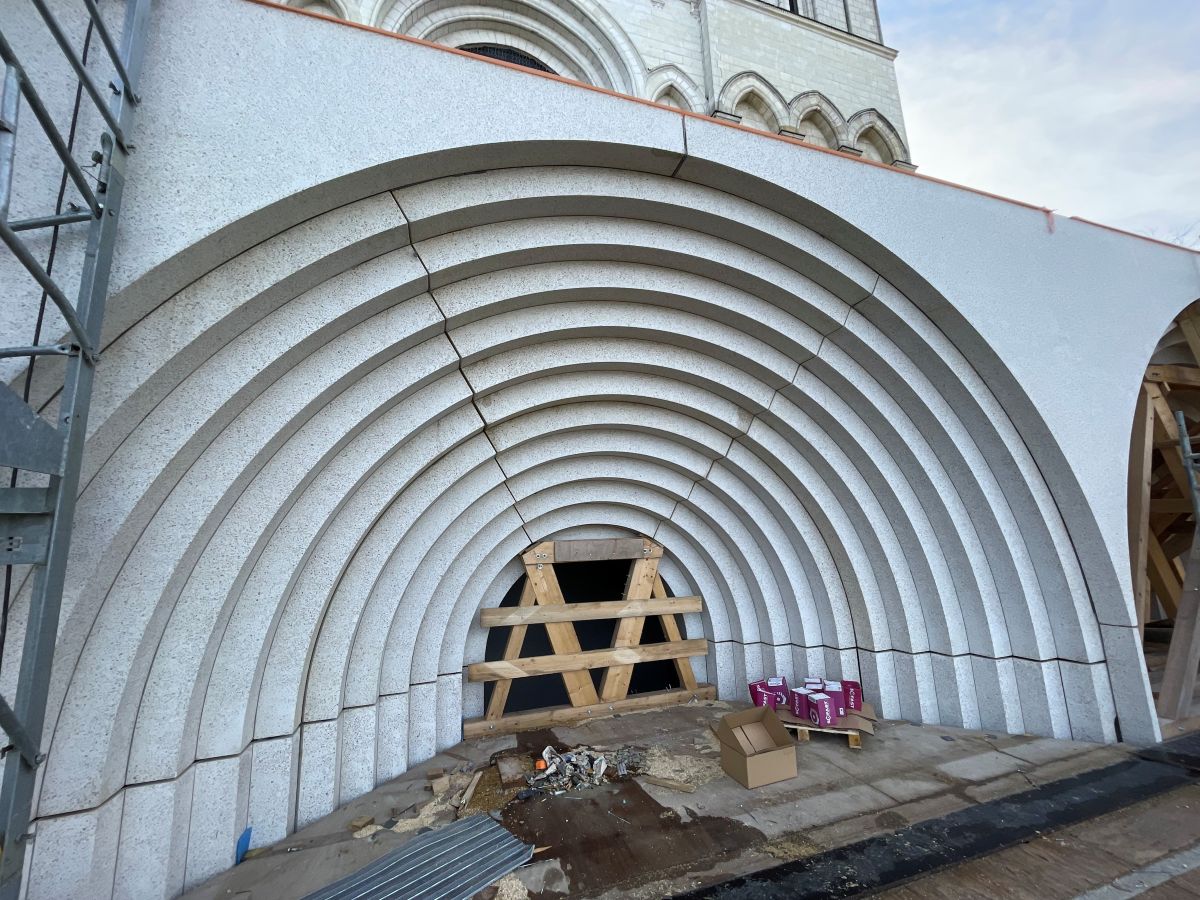
Lafarge’s CEM II/A 52.5 white cement, Holcim’s Ductal UHPFRC and the know-how of Jousselin Préfabrication made it possible to give shape to the contemporary gallery imagined by Kengo Kuma for Angers Cathedral.

HAS Angers, the Japanese architect Kengo Kuma makes concrete a material of nuance, light and aesthetic reconciliation in order to bringing gothic and concrete into dialogue in an extraordinary gallerythat of Saint-Maurice Cathedral. Behind this rare and delicate intervention lies a seemingly simple idea: offering a lasting setting for recently restored polychrome sculptures from the 13th centurynow protected from the assaults of time, rain and climatic variations.
For this, the know-how of Jousselin Préfabrication – with fifty years of expertise in prefabrication of reinforced concrete and UHPC elementsthe company Jousselin Préfabrication, subsidiary of the Guillerm grouphas also established itself as a key player in the manufacture of walls with integrated formwork, with or without insulation, integrating architectural concrete facings -, the exceptional whiteness of CEM II/A 52.5 BLANC du Teil cementessential forvisual harmony between historic stone and contemporary concreteas well as the technical performance of Holcim’s DUCTAL UHPFRC constituted decisive assets in the creation of the contemporary gallery of Saint-Maurice cathedral in Angers.
Contemporary architecture thought of as an extension
To give substance to this unique gallery, the implementation was entrusted to Albizzatti for the structural workwhile Jousselin Préfabrication, a subsidiary of the Guillerm Group, took charge of all the prefabricated elements.
The challenge was not only to build a contemporary structure at the foot of a major historical monument, it was also necessary to preserve the archaeological remains revealed during the preventive excavations carried out on the site. The choice of a structural system based on micropiles was then necessary in order to limit as much as possible the impact on the graves and rubble – buried as well as discovered – of the past. Beams were then installed to distribute the loads and support the building.
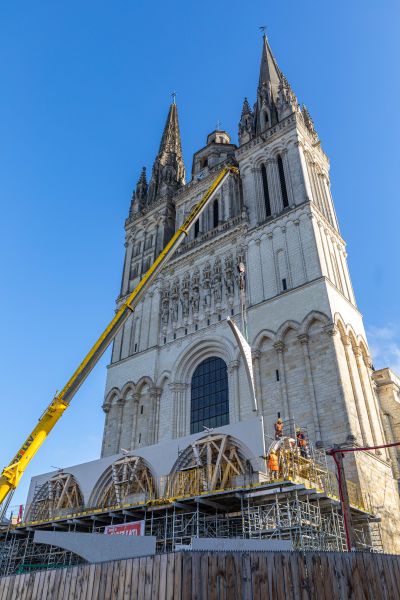
Another remarkable feature: the gallery remains entirely independent from the cathedral. No anchor point, no structural connection constrains the historic work. The new building functions in total autonomy, like an architecture carefully placed in contact with the old monument. This self-supporting design responds as much to a heritage logic as to a requirement for reversibility: if necessary, the dismantling of the gallery could be considered and carried out with relative ease. © Jousselin
660 unique pieces to give the illusion of a monolith
In the Jousselin Prefabrication workshops in Chazé-Henryonly a few dozen kilometers from the site, each element has been carefully treated. THE 660 prefabricated parts which make up the work were all made individually, with almost artisanal precision.
Before their pre-assembly in the factory, each of them underwent extremely demanding finishing work in order toobtain the polished finish imagined by Kengo Kuma. A specific machine was used to plan several millimeters of surface and reveal the concrete aggregates. This delicate operation made it possible to achieve exactly the texture, depth and color desired by the architect, validated during the presentation of the prototype.
Once the assemblies were pre-assembled, the different modules were transported to the site before being gradually assembled: first the arch-carrying sailsthen the archivoltsfinally the cover. Precision mechanics made all the more complex by the double exposure of the gallery walls, visible both from the outside and from the inside. This constraint imposed an impeccable level of execution in order to produce the impression of an almost monolithic material, homogeneous down to the smallest details.
The challenge of white concrete capable of marrying medieval stone
One of the great successes of the project lies in its chromatic subtlety. Between the patina of the 13th century stones and the resolutely contemporary expression of the concrete, a balance had to be struck. To achieve this very particular shade, Jousselin Préfabrication selected the CEM II/A 52.5 BLANC white cement produced on the Lafarge du Teil sitein Ardèche. Renowned for its exceptional whiteness and very strong luminance, this cement served as the basis for all the visible elements of the structure.
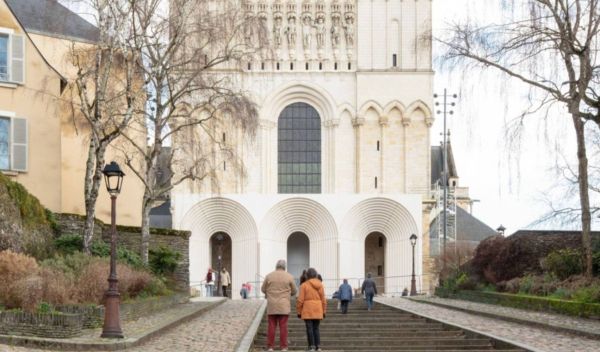
Thanks to its superior luminance (L*93), the CEM II/A 52.5 BLANC du Teil offered the neutral base allowing the final stable and very particular shade desired by the architect. A color that also highlights the aggregates used in the manufacture of concrete. The singular chromatic unity thus obtained between the stones of the cathedral and the concrete of the gallery contributes greatly to the exceptional character of the whole. © Paul Hamelin
Ductal, UHPC serving a centuries-old heritage
For the cover of the work, the choice fell on the Ductal, the ultra-high performance fiber-reinforced concrete developed by Holcimr. A cutting-edge material whose mechanical properties and lightness proved essential for completing the upper part of the construction. Invisible to the visitor, this component nevertheless plays a determining role in the general stability of the building.
This achievement also constitutes an exceptional showcase of the industrial know-how mobilized around the project. “Carrying out such a work, of exceptional importance and complexity, which requires great mastery of numerous technical, architectural and logistical elements, is a real challenge and above all a mark of recognition for Jousselin Préfabrication“, underlines Pierre Le Bihan, the manager of the production site. Same satisfaction on the side of Lafarge, whose materials were selected to support this extraordinary intervention. For Fabrice Agnesina, the Brittany Industry manager of Lafarge Ciments Distribution, this site illustrates “thehas renewed confidence” given to the quality, durability and aesthetic performance of the solutions developed by the group.
At the foot of the Angers Cathedral, the project by Kengo Kuma provides the essential demonstration that concrete can offer a new horizon to stone without seeking to dominate it.