
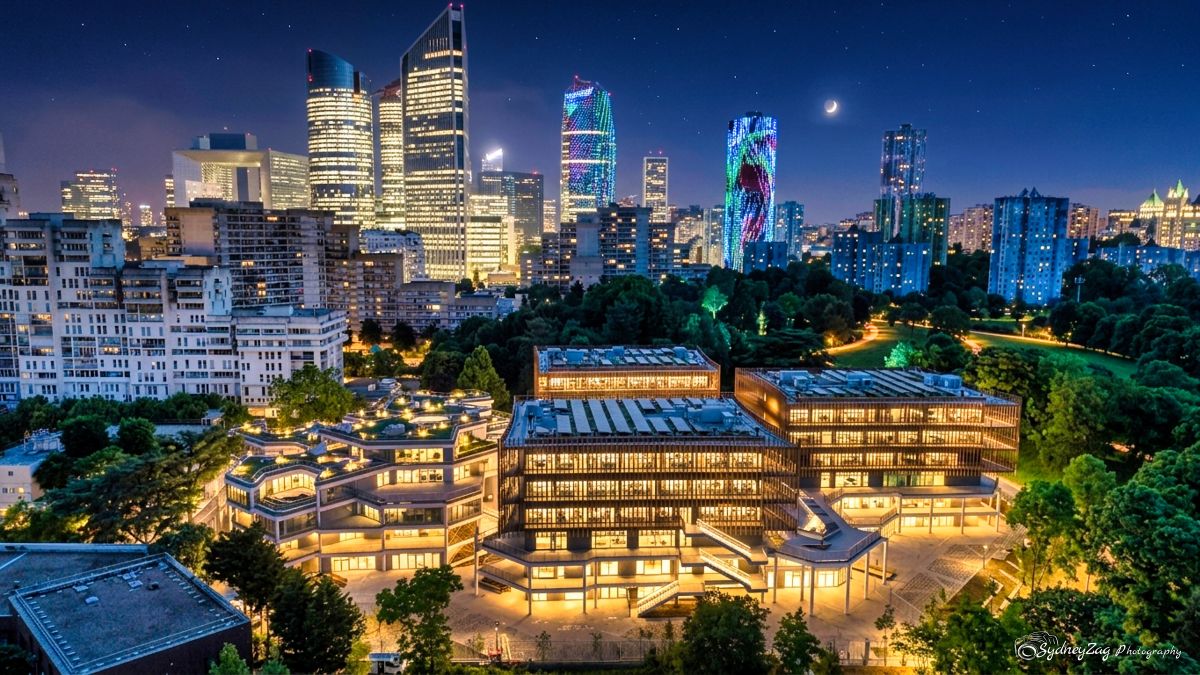
In Nanterre, Eiffage Immobilier is completing the Parc Campus, an 18,000 m² project combining heritage rehabilitation, educational innovation and environmental performance.

Fruit of a vast urban reconversion operation carried out in Nanterre, the Parc Campus now welcomes the establishments of De Vinci Higher Education within a complex of 18,000 m2 designed to support the growth of higher education. Carried out by Eiffage Immobilier, this project combines heritage rehabilitation, architectural innovation and environmental ambitions, while breathing new life into an emblematic building that has been vacant for more than twenty years.
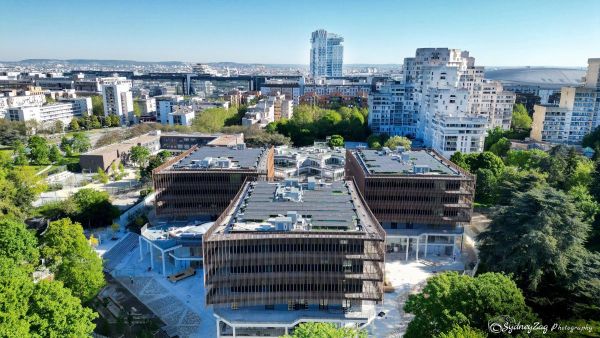
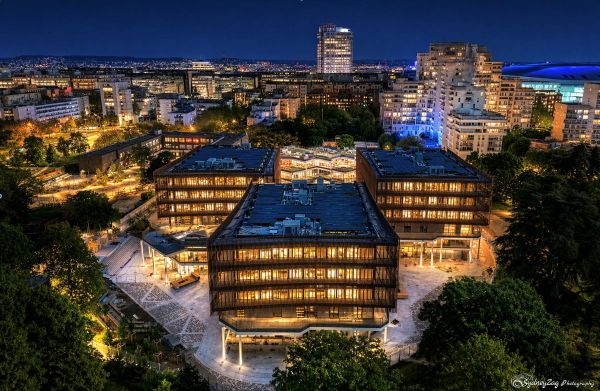
Winner of the call for projects “Inventing the Greater Paris 2 Metropolis”, Eiffage Immobilier has just delivered the Parc Campus, officially handed over to its user after validation of the latest regulatory authorizations. The operation transforms the former Nanterre architecture school, built in the 1970s by architects Jacques Kalisz and Roger Salem, into a new generation university campus. © Sydney Zag Photography
An ambitious reconversion in the service of urban heritage
Unoccupied since 2004, the building represented a major technical challenge. The ambition was not only to restore a remarkable architectural ensemblebut also to offer it a new use in line with the current needs of the territory. Faithful to the spirit of the original project, which sought to extend the surrounding park through architecture, the transformation retained the privileged relationship between built spaces and the landscape.
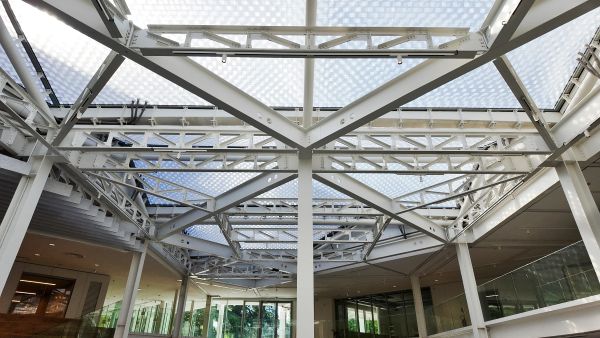
The rehabilitation required significant upgrading work, particularly on a metal structure partially damaged by time. The teams also had to adapt the structure to contemporary requirements in terms of fire safety, energy performance and user comfort, while preserving its architectural identity. © Sydney Zag Photography
This approach made it possible to significantly limit demolitions and to enhance existing resources:
– 80% of thefootprint of the historic building was preserved;
– 60% of the original metal structure has been rehabilitated;
– THE existing foundations were reused to accommodate new constructions;
– A large part of frames, posts, metal beams and concrete floors was maintained in the final draft.
This urban recycling strategy illustrates a growing trend in the real estate sector consisting of rebuilding the city on itself rather than mobilizing new land.
A campus designed to support the growth of De Vinci Higher Education
Developed in close collaboration with Da Vinci Higher Education from the first design phases, the Park Campus was imagined as an evolving educational tool capable of responding to transformations in higher education.
The complex can simultaneously accommodate up to 4,800 students, teachers and staff. Its organization is based on a rehabilitated historic building mainly housing administrative functions, supplemented by three new buildings dedicated to teaching. These different volumes are structured around a common base including a vast covered agora, an amphitheater, catering areas, collaborative work rooms and several service areas. The program also includes two basement levels housing a sports complex, associative spaces as well as the technical premises necessary for the operation of the campus.
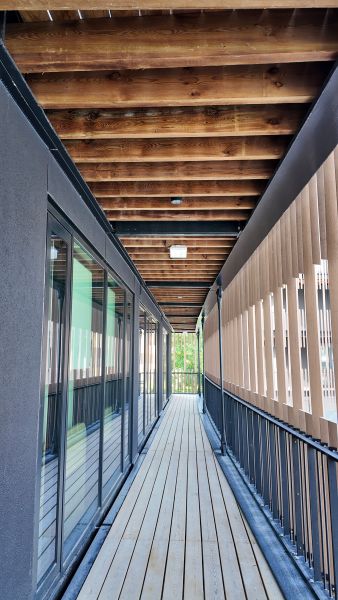
The architecture was designed to promote flexibility of use. Teaching spaces can be reconfigured according to the evolution of teaching practices, while circulations, balconies and intermediate spaces reinforce interactions between occupants and their environment. © Sydney Zag Photography
Located at heart of the Nanterre-La Défense district, the campus is part of one of the main economic and university centers of Île-de-France, thus strengthening the attractiveness of schools of the Da Vinci group.
A demonstration of new sustainable construction practices
Beyond its academic dimension, the Campus du Parc constitutes a showcase for the innovations deployed today in the low-carbon construction sector.
The new buildings combine several complementary materials, including wood, steel and low-carbon concrete. The whole benefits from a bioclimatic design resting in particular on a vast ETFE glass roof which covers the central agora. This device optimizes solar gain while promoting the natural ventilation of spaces and limiting the use of air conditioning systems.
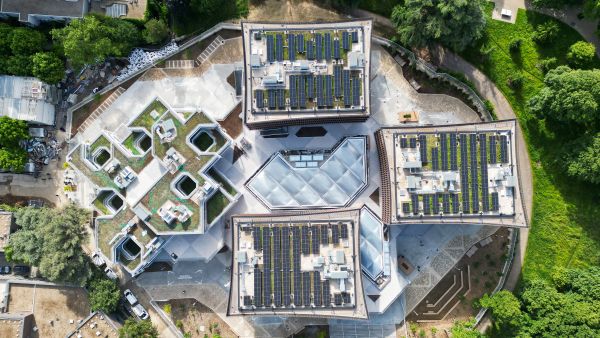
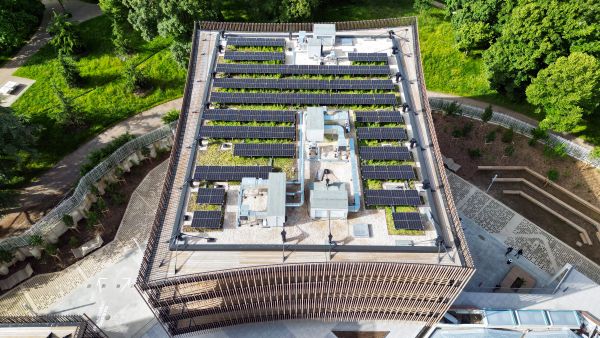
The project also includes a biosolar roof equipped with 750 m2 of photovoltaic panels. Expected production reaches around 170 MWh per year, making it possible to cover part of the site’s electrical needs. © Sydney Zag Photography
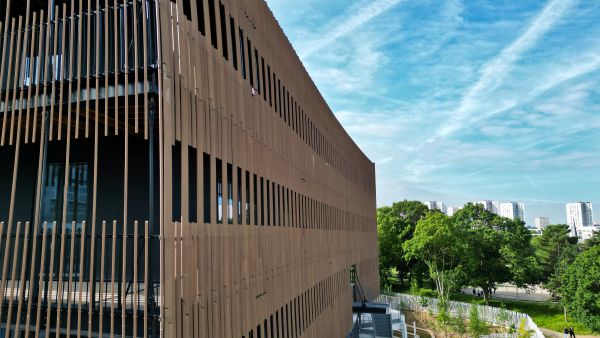
One of the particularities of the operation lies in the massive use of off-site prefabrication. Stairs, passageways, wooden structural elements and facades were manufactured in the workshop before being assembled on site. This method made it possible to reduce site nuisance, optimize completion times and limit the carbon footprint linked to on-site interventions. © Sydney Zag Photography
This approach is accompanied by ambitious environmental objectives, materialized by several reference certifications, including E+C-, BBCA Renovation and Sustainable Building in Ile-de-France.
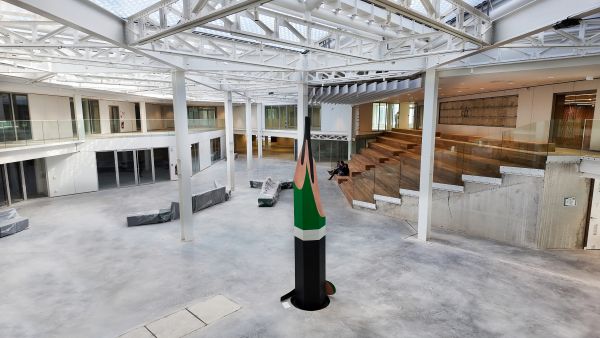
The Parc Campus will also host a work by the artist Julien Gudéa representing a monumental pencil, a nod to the educational vocation of the place. Integrated as part of the “1 building, 1 work” program, this installation completes a project which intends to bring together heritage, innovation and contemporary creation. © Sydney Zag Photography
With this delivery, Eiffage Immobilier marks the culmination of a complex project where urban rehabilitation, environmental performance and higher education converge within the same architectural ensemble, destined to become one of the new markers of the Nanterre-La Défense territory.
Sydney Zag Photography