
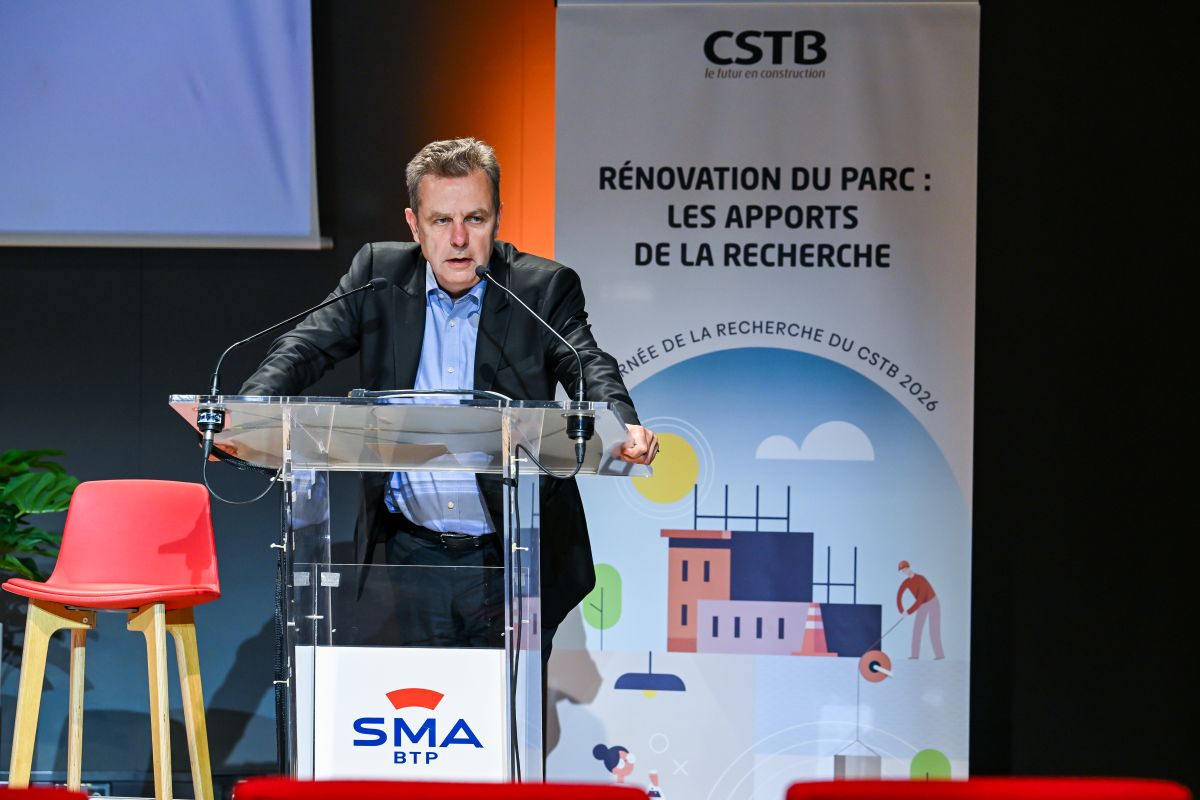
More than 700 professionals participated in the CSTB Research Day 2026, dedicated to the contributions of research to accelerate the renovation of the built stock.

Gathered in Paris on the occasion of the Research Day 2026, organized by the CSTBmore than 700 representatives from the construction world compared their work and feedback around the same observation: the renovation of the existing park will only be able to change scale by relying on applied research, capable of bringing together innovation, uses and realities on the ground.
There is no shortage of innovations
Long confined to energy issues alone, the renovation of buildings is now called upon to respond to a much broader set of requirements: adaptation to climate change, summer comfort, indoor air quality, preservation of resources, safety of occupants and even access to housing. These are all challenges that require rethink existing buildings as a whole and question design methods and economic models in the sector.
It is around this transformation that the CSTB (Scientific and Technical Building Center) organized its 2026 edition of Research Day on June 2 in Paris. More than 700 participants – researchers, communities, professional organizations, industrialists, design offices, project owners and project managers – took part in this event dedicated to scientific and technical levers likely to accelerate the renovation of the park.
When opening trade, Julien Hans, Director of Research and Innovation at CSTBrecalled that the knowledge necessary for this transformation is now widely available. The main challenge now lies in their diffusion and deployment on a large scale:solutions exist and are developing, the knowledge is there, there is no shortage of innovations“. However, he believes, the massification of renovation involves accelerating the transition from research to operational implementation. An ambition based on a pragmatic approach, built through contact with professionals.
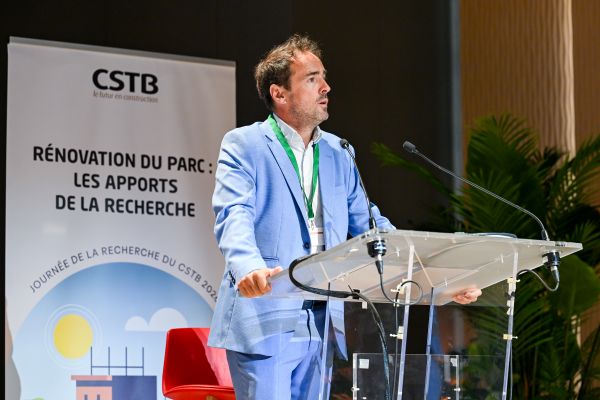
Julien Hans, pictured here, pleads for “applied, persevering research, fundamentally anchored in the field and connected to all stakeholders”. © Gilles Rolle
From data to biosourced materials
Throughout the day, the interventions illustrated the diversity of subjects today covered by applied research. Beyond energy performance, the work presented shows that renovation now mobilizes multiple skills, ranging from materials engineering to data analysis, including security, health and even the evolution of professions.
The debates focused in particular on:
– THE renovation strategies at the scale of the built stock and the use of available data;
– Adapting buildings to climate change and improving summer comfort;
– The quality of indoor environments and their effects on health;
– Innovations around biosourced and geosourced materials;
– Measuring the actual performance of buildings and guaranteeing results;
– Risk prevention, whether structural, natural or fire-related;
– The evolution of sectors, skills and economic models necessary for the transformation of the existing stock.
Throughout the conferences and round tables, the speakers also presented several works relating to therenovation decision supportmulti-criteria approaches making it possible to arbitrate between different work scenarios, methods intended to make renovation operations more reliable or even innovation support systems. Structural changes in the market were also the subject of several discussions, against the backdrop of the need to sustainably adapt the offer to the new expectations of project owners.
Research will not be enough without collective mobilization
Closing this edition, Étienne Crépon, the president of the CSTBwhose mandate is coming to an end, broadened the reflection by emphasizing that the challenges facing the sector go far beyond the technological question alone. If research constitutes an essential lever, it will only produce its full effects if it is part of a collective dynamic involving all construction stakeholders.
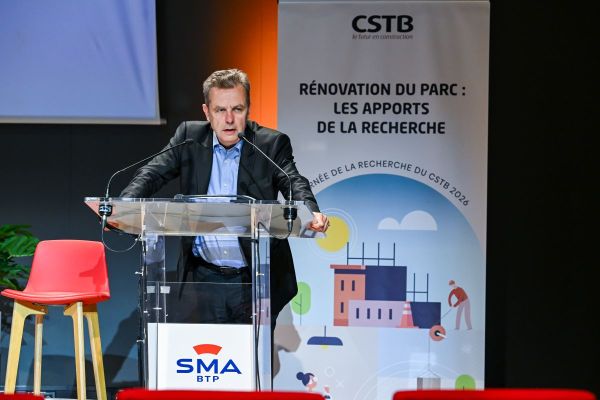
“What will make the difference is not an isolated innovation, but the progressive convergence of multiple contributions. And in this convergence, everyone has a place. A useful place. A necessary place. It is this ability to act together, by assuming everyone’s part, which will allow us to respond to the challenges that are before us” explains Étienne Crepon, here in photo. A message summarizing the spirit of this 2026 Research Day: faced with the scale of the expected transformations of the built stock, success will depend less on a succession of one-off innovations than on their capacity to be shared, appropriated and deployed collectively on the ground. © Gilles Rolle