In Évry-Courcouronnes, two recent public works, designed by trendy young agencies, combine wood and solid terracotta brick. Belgian option or genius of the place?

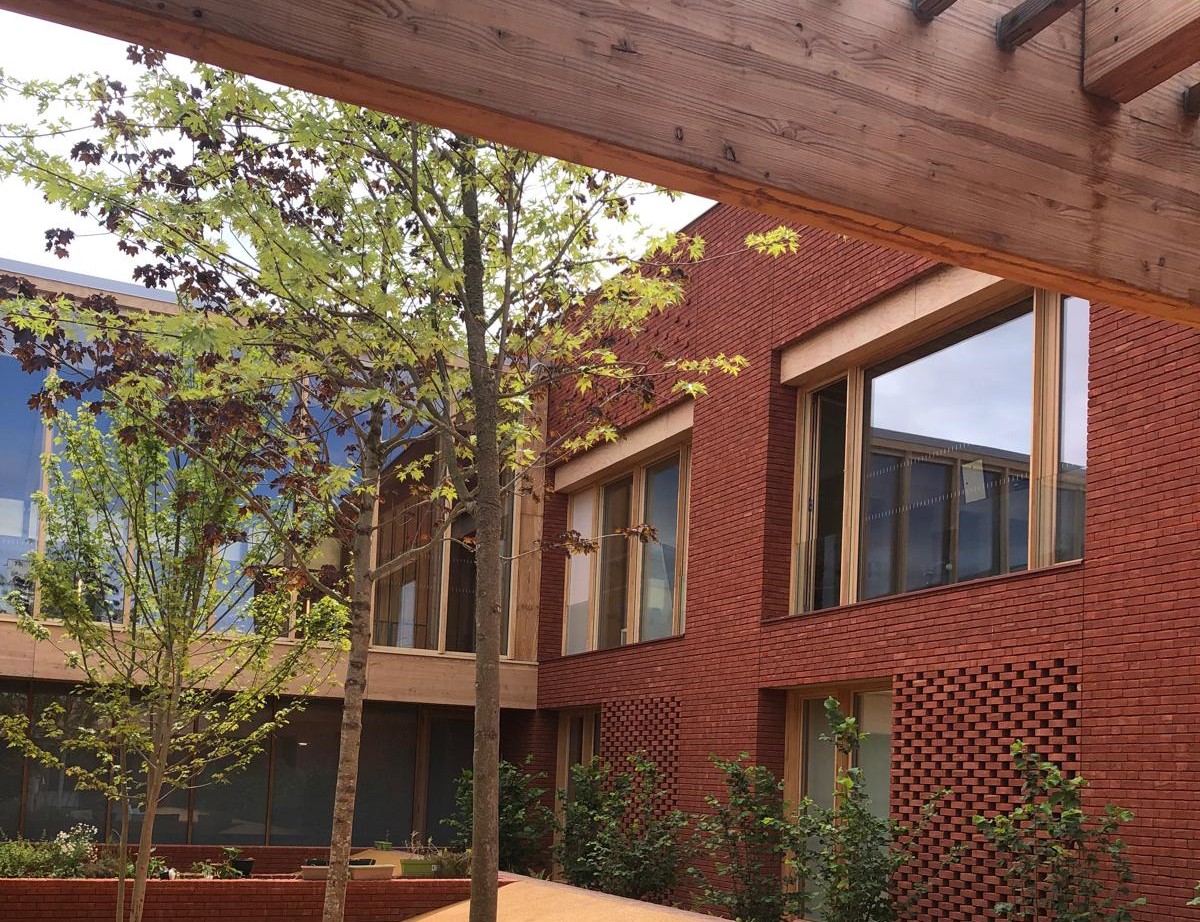
Under theinvocation of Mario Botta and his cathedralthe new town of Évry, and now Évry-Courcouronnes, has a particular affinity with brick. When the town hall wanted to decompartmentalize several neighborhoods withdrawn into themselves, by providing them with an inclusive and diversified public service, theHEMAA agency made the right choice by resuming, right down to the joints, a red brick which evokes the works of the central square of Èvry – cathedral, town hall, CCI. However, the use of brick on MOB is not common in Évry.
Contemporary approaches
In the neighborhood Horizons, the delivery of the Missak and Mélinée Manouchian school preceded by a few months the delivery of the Maison des Services Publics Jacques Prévert. The end of the project was accelerated to rehouse the damaged Coquibus school. L’Tracks agency also uses bricks on MOB, but in a different way, even in the layouts. Furthermore, the solid brick is white.
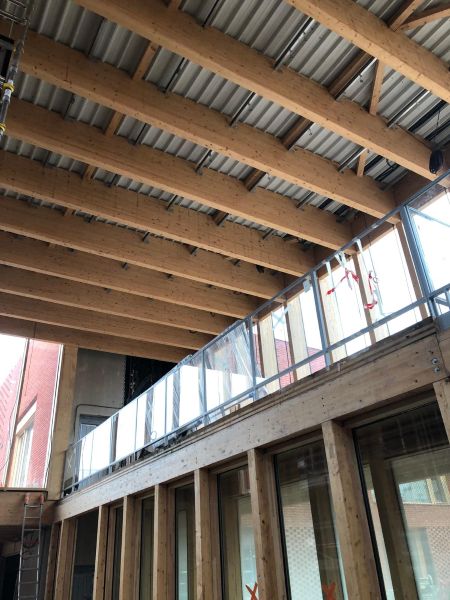
The columns of the upstairs circulation (retracted staircase) follow the framework of the curtain wall. The ceiling joists, the curtain wall and the columns interact with the red flat surface on the other side of the hall. © Jonas Tophoven
Brick on MOB, no common technique
Both agencies come up against the same technical issues. Like the brick facade on MOB is obvious in Belgium, it was part of current techniques in France. But it was no longer so when Kevin Guidoux, then for Artbuild, wanted to reuse the bricks from the facade of the Agora in Maisons-Alfort in front of a new wooden construction, in 2021. An Atex was needed and Kevin Guidoux even invented his anti-spill connectors, it is true in a context of reuse without grouting. In all cases, self-supporting solid brick walls must be connected to the supporting structure right through, but the latter, made of wood, does not act in the same way because of its material and its bending. It is therefore necessary to reinforce the wooden structure in relation to the current dimensioning. And it is necessary to provide fine vertical splitting joints.
The solid brick, back in favor after 30 years
The anti-roll rods create an air gap which allows the heated air to escape without heating up the interior. For the rest, wooden construction is ideally protected from rain and wind in a relatively inexpensive and durable manner. There brick interests frugal people because the base material is earthand that certain actors highlight the reduction of the carbon impact of cooking.
The raw earth brick, stabilized or not, and the rammed earth, attract the attention of architects towards the solid fired brick and its materiality. In the case of Évry it is also a question of preventing vandalism. This does not prevent use in a fence, but on one side of the Public Services House, glass bricks we had to fill the holes: pretty but expensive.
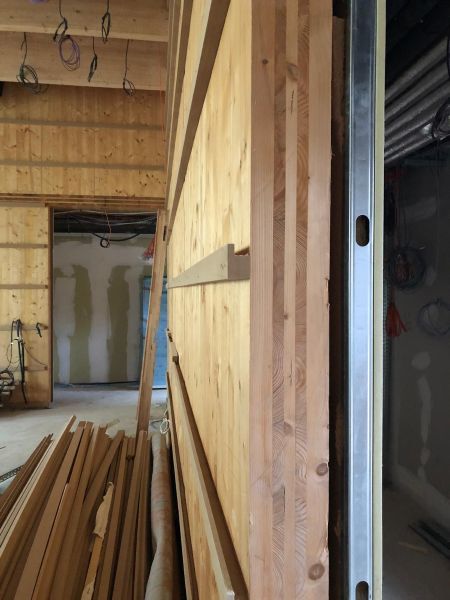
Use of vertical CLT on the current construction site in October 2025. © Jonas Tophoven
A total layout
As expected from Hemaa, the use of brick becomes a work of playful design both in the variation of the surfaces and in its relationship with the wood, which has such a different appearance, all in lines and not in pixels. From the outside, what strikes you first is theaffirmation of the brick over the entire height with slightly oblique ridged blocks to hide, also on the 5th facade from the view of the occupants of neighboring towers, the CTA specific to each of the three entities connected by a large hall. The play of the empty claustra dialogues with some patterns with raised bricks. We find the screens, sometimes on the same wall, alternating a total masking of the bay, or a partial masking. In this case, the wood is revealed as joinery and transom with rot board hiding the exterior blind. These “beams” are found in the glazed spans between the three blocks (curtain walls), particularly in the central connecting hall.
Acoustic screen
We find there in an inverted way the play between brick and wood. Wood dominates (Rubner) with its perpendicular grid orientations, the dialogue brick and the claustras allow, on an entire side wall of the hall, to hide the acoustic correction, and the ventilation openings. Between the joists, however, it will be necessary to add micro-perforated wooden panels to complete the correction. The art of HEMAA is to avoid interference in this graphic dialogue, in particular by forcing the flat red areas against thick and marked wooden frames. The oblique staircase is retracted, the guardrails and their fine frames become transparent.
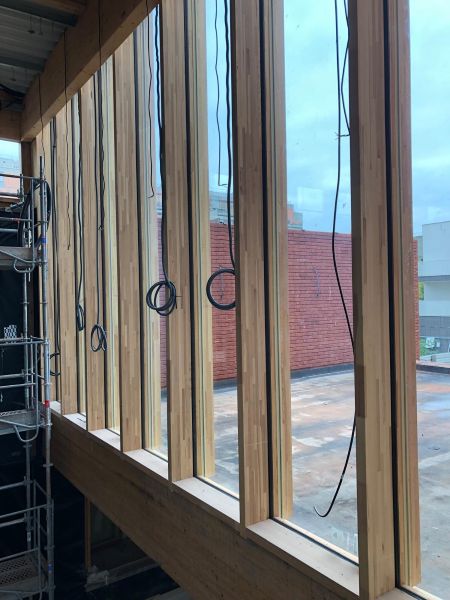
Curtain wall running in the large reception hall, emphasized verticality, or rather the horizontal and vertical linearity specific to wood. © Jonas Tophoven
Full, empty and everything in between
Added to this is the little touch of happiness of the interior courtyard dedicated to the crèche. Peripheral wooden pergolas project onto the brick/wood game linear and pixelated cast shadows which are at the same time line of woods and bricks. In the same way, the screens distribute the shadows cast inside. The shadow creates the third element, after the altered surface of the brick wallsand the parallel networks of wooden beams, yet another way of alternating empty and full spaces. When the walls are generally smooth, the structural frames regular, the play of light becomes controlled. This does not sum up the expertise of the agency which the client praises for its empathy and listening skills. But this places the work in this exceptional urban context of modern architecture, with a beautiful response to the brutalism of the golden days in our brutal world. It’s a shame that the original confrontation of materials is also that of two worlds that misunderstand each other, and that the brick is subject to uncontrolled saltpeter rising.
Jonas Tophoven / © Jonas Tophoven