
A Parisian elected official warns of the delay in the renovation of private housing while a collective estimates that 70% of housing could avoid air conditioning thanks to passive solutions.

While Paris is going through a new episode of extreme heat, two speeches are relaunching the debate onadaptation of the residential stock to climate change. On the one hand, the City of Paris denounces obstacles to the renovation of private housing, particularly in co-ownerships with many second home owners. On the other hand, a collective of sustainable city stakeholders believes that majority of homes could remain habitable without air conditioning thanks to targeted renovation.
The private park, the weak link in the renovation
If the energy renovation of the Parisian social park progresses, that of private housing remains far behind. This is the observation made by Jacques Baudrier, deputy (PCF) to the mayor of Paris in charge of housingon the occasion of a conference organized by the collective “Our cities at 50°C”. “Over the past 17 years, we have already financed 80,000 large-scale renovations in social housing.“, recalled the elected official.
On the other hand, the situation is much more worrying in the private stock, which represents nearly 1.1 million housing units. “There are a lot of thermal kettles, because a lot of housing was built before 1914 and this park is not at all adapted to the heat of the 21st century“, he underlined. Municipal aid is nevertheless starting to have its effects. In 2026, the City of Paris supported 10,000 renovations of private housingcompared to 1,500 two years earlier.
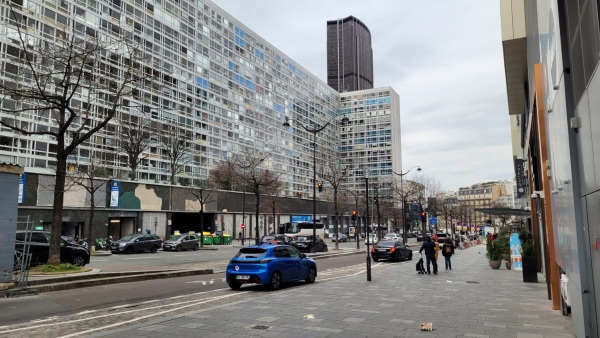
For Jacques Baudrier, however, this acceleration of Parisian renovation remains insufficient. The work mainly concerns condominiums built between the 1950s and 1970s, occupied by their owners, while the most energy-intensive housing – classified F and G in the DPE – remains largely excluded from renovation programs. © Les Montparnos
Secondary residence co-ownerships in the viewfinder
The elected official points to several structural obstacles. He considers Anah’s aid to be insufficient in volume and poorly suited to old buildings, which are particularly numerous in the capital. But it also highlights an obstacle less often mentioned: the governance of co-ownerships. “Our main problem is not the architects of French buildings, but the 28% of owners of second homes and vacant homes who always vote against renovations.“, affirms Jacques Baudrier. According to him, this situation is particularly marked in the central districts. “In the entire center of Paris, you have 35%, 40%, 50% of second homes and vacant housing. We’re not renovating anything, almost no private housing, and that’s where the thermal kettles are.”
The elected official believes that this configuration directly penalizes the occupying co-owners and tenants, often in the minority during general meetings, who meet “trapped by their neighbors“.
Air conditioning is not the only answer
These difficulties occur while several real estate and construction stakeholders call for favoring building adaptation strategies before generalizing the use of air conditioning.
One year after its creation, the collective “Our cities at 50°C”, which brings together social landlords, communities, developers and promoters, presented an operational doctrine aimed at improve the summer comfort of homes by favoring passive solutions. For its members, the debate too often pits the advocates and opponents of air conditioning. However, the “The question is no longer just whether or not to have air conditioning, but to understand whether a building is capable of evacuating the heat it accumulates in order to find conditions compatible with rest and recovery at night.“, explains the collective.
Insulation, concealment and ventilation at the heart of the recommendations
Based on simulations carried out by the CSTB on nearly 30 million housing units, the collective estimates that approximately 70% of the situations studied by 2050 could maintain a satisfactory level of habitability without systematic use of air conditioning. Its recommendations are mainly based on three levers:
– the generalization of exterior solar protection;
– The installation of ceiling fans;
– And, finally, the strengthening of roof insulation.
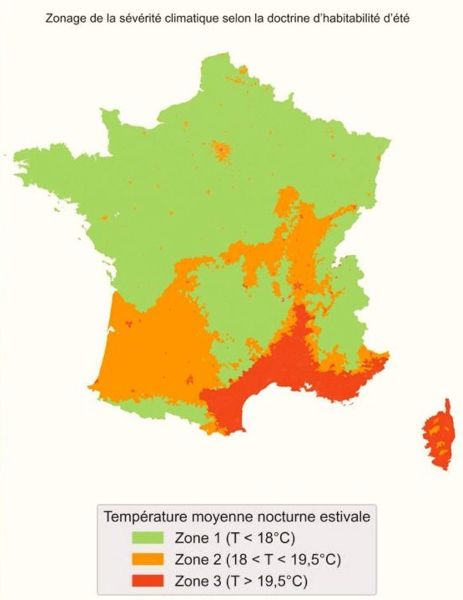
A map of “climate severity” distinguishes three large zones in France according to the nighttime temperatures observed during heatwave episodes. Paris is, with the Mediterranean coastline between Marseille and Perpignan, among the territories where summer comfort is the most difficult to maintain. © Collective “Our cities at 50°C”
According to the collective, the implementation of passive solutions would nevertheless significantly improve the situation in the capital. While nearly 75% of Parisian housing is considered “thermal kettles”, these developments would make it possible to move a large part of the stock towards a more satisfactory level of habitability during heat episodes.
The collective does not call into question the use of air conditioning when this becomes essential, particularly in the most exposed areas of the south of France: he pleads for targeted deployment, associated as a priority with interventions on the building envelope. The stated objective is toavoid uncontrolled generalization of air conditioning equipment while guaranteeing the protection of occupants in situations where passive solutions are no longer sufficient.