
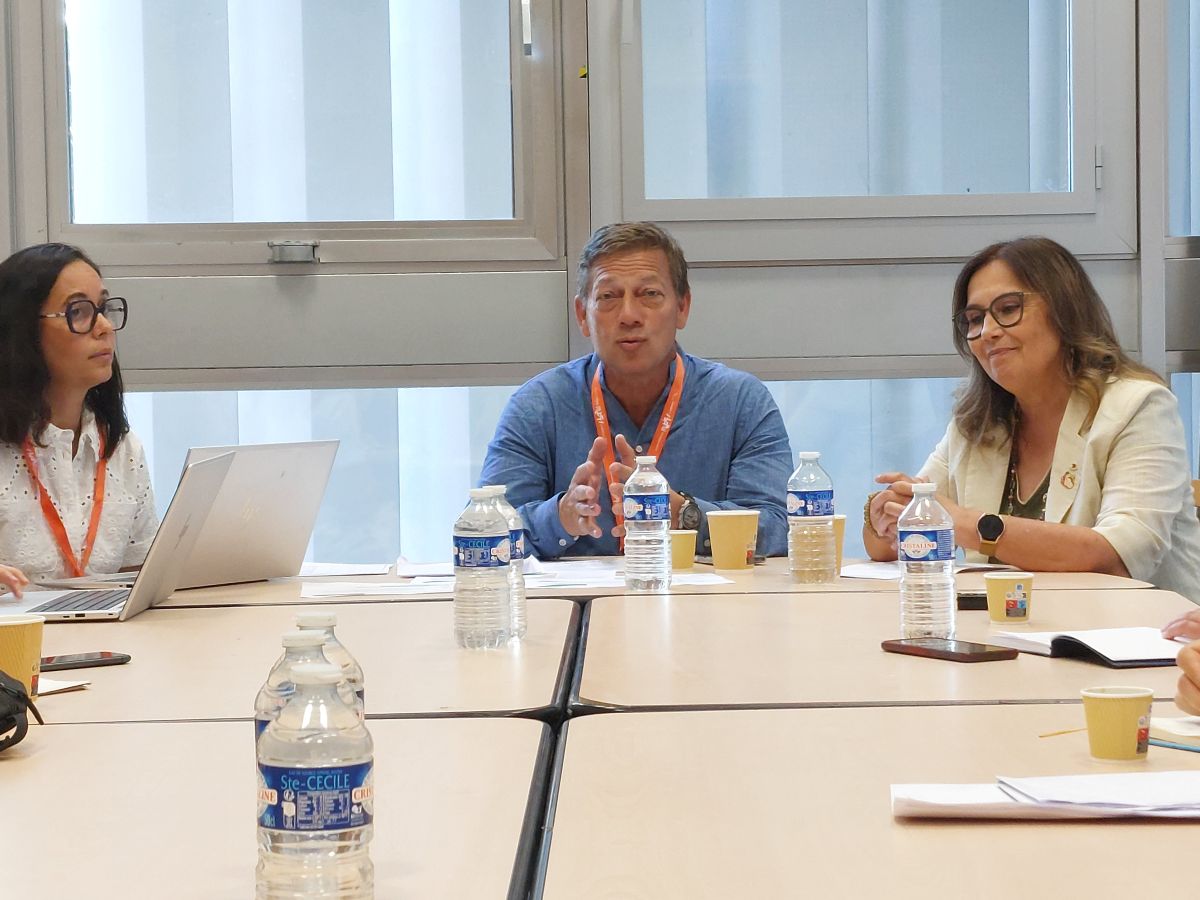
A CAPEB survey of 2,200 craft businesses shows that climatic hazards are disrupting the organization of construction sites and reinforcing the need to adapt the built stock.

On the occasion of the Building Trades Meetings by CAPEB 2026, which were held in Marseille, at Parc Chanot, on June 24, 25 and 26, 2026, and during a press conference, CAPEB reviewed the first results of a survey carried out among more than 2,200 craft businesses. If extreme heat directly affects working conditions on construction sites, it also accelerates the evolution of renovation needs in the building stock. For the professional organization, theadaptation of the building and that of businesses will now have to move forward together.
Heat, a major risk on construction sites
THE extreme climatic episodes no longer fall under the exception for building craftsmen. CAPEB believes that the heatwave currently underway illustrates a lasting evolution of the operating conditions of the sector, which sees in these events the revealing of limits of the French real estate stock as well as the current organization of construction sites.
The survey carried out between May and June 2026 among more than 2,200 craft businesses confirms this development. Next to 91% of respondents say they are exposed to heat episodeswhile seven out of ten companies believe that climate hazards have intensified over the last five years.
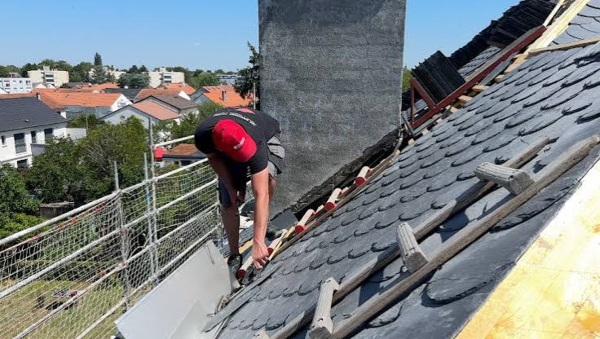
For CAPEB, these heatwave phenomena no longer constitute a one-off risk but a structural parameter to which businesses and buildings will now have to adapt. © Moselle TV
The organization of construction sites more affected than the equipment
The study shows that the main consequences of climatic hazards do not concern equipment or company premises: 81% of respondents indicate that they have not suffered any damage to their buildings or equipment. On the other hand, disruptions affect activity:
– nearly 58% of companies report having recorded construction delays linked to weather conditions ;
– More than one in two companies report changed working hours (55%) or increased team fatigue, which can lead to work stoppages or demotivation (53%).
– Finally, 62% of managers mention an increase in their level of stress and almost one in two believe that climatic episodes greatly disrupts his daily activity.
However, not all professions are exposed in the same way. Masonry and tiling activities appear among the most vulnerable, while electricity or plumbing-heating companies report more limited impacts.
Companies are already adapting their practices
Faced with these new constraints, artisans did not wait to change their working methods. Seven out of ten companies have already changed their schedules to avoid the hottest periods of the day. Many also rely on weather monitoring applications to anticipate response conditions.
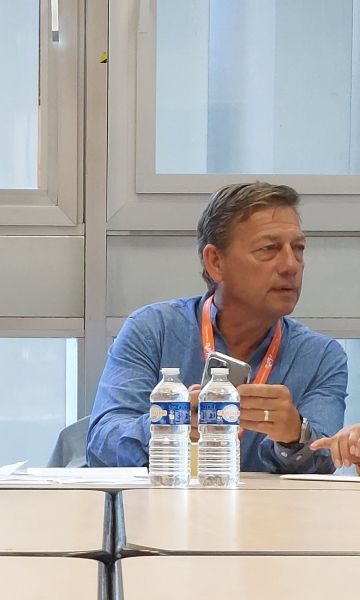
“We are not too stupid either,” explains Jean-Christophe Repon, the president of CAPEB during the press conference, “we have already thought about adapting our schedules.” However, according to him, the constraints remain because, for example, a prefectural decree is required to start a construction site at 6 a.m. Concerning the relevance of the heatwave decrees, the President of the Confederation specifies that “if we work part-time, it will be complicated, more than it already is”. © Laure Pophillat
In fact, CAPEB considers that a More structured support will be necessary to help VSEs sustainably integrate climate risk in their operation.
The needs of project owners are also evolving
The survey also highlights a gradual evolution in demand addressed to craft businesses. Interventions after disasters remain important, particularly for the restoration of roofs. But companies are also seeing a rising demands to improve the resilience of buildings to extreme heat. THE works intended to reinforce summer comfortTHE insulation operations or even interventions on heating systems are among the most frequently cited needs.
For CAPEB, this development confirms theemergence of a market for climate adaptation of buildingswhich will still need to be structured in order to transform these intentions into work programs.
Adapting business protection systems
If the protection of employee health remains, according to CAPEB, an absolute priority, the organization considers that economic consequences of construction site interruptions cannot be borne solely by craft businesses. Faced with the multiplication of episodes of high heat, it requires an adaptation of existing systems, in particular the regime of bad weather and partial activity, in order to allow VSEs to cover the hours not worked as well as to preserve their cash flow.

“The health of employees is not negotiable. When weather conditions require a construction site to be slowed down or interrupted, companies must be able to do so without jeopardizing their economic balance. If society imposes these adaptations, it must also share the consequences“, underlines Jean-Christophe Repon. The President of the Confederation specifies that “if we work part-time, it will be complicated, more than it already is”. © Laure Pophillat
For CAPEB, renovation involves progressive interventions
Beyond the management of climatic episodes, CAPEB sees in this development an additional argument in favor of accelerated adaptation of the real estate stock. The organization reaffirms its preference for a renovation carried out in stages, through coherent single-gestures – insulation of the roof, replacement of joinery, improvement of ventilation or thermal regulation – rather than through overall renovations which are often considered difficult to finance for some households.
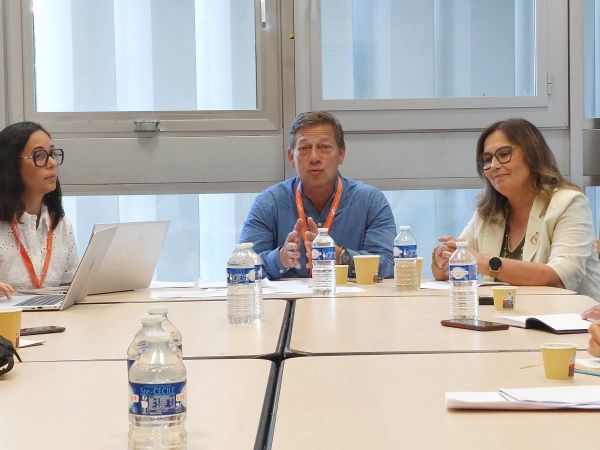
On this point, the president of the CAPEB of Bouches-du-Rhône, Patricia Blanchet-Bhang, on the right in the photo, takes as an example the new CAPEB 13 building, in the northern districts of Marseille, which was renovated without air conditioning and with noble materials, recalling that “artisans know how to do it” and that we must think of them for the “renovation of schools, for example”. She appeals to the city of Marseille to think of craftsmen for said renovations. © Laure Pophillat
For its part, CAPEB also recalls that technical equipment cannot fully produce its effects without preliminary improvement of the building envelope. “Faced with increasing climatic hazards, we must favor a step-by-step renovation, based on coherent single actions carried out in the right order. This approach, simple and effective, makes it possible to adapt housing sustainably by relying on building craftsmen. Heat pumps have their place, but they do not replace work on the building envelope, on which their performance depends“, concludes Jean-Christophe Repon.
RGE: the reform has been implemented, which (really) changes for artisans
The press conference was also an opportunity to return to the reform of the RGE labelentered into force with the publication of the decree of June 23, 2026. Long-awaited by craft businesses, the reform of the Recognized Guarantor of the Environment (RGE) system is now official: the decree of June 23, 2026, published in the Official Journal, introduces several measures intended to facilitate access to qualification, while maintaining a level of control over the work carried out.
A reform demanded for several years
There reform of the RGE system takes a decisive step forward with the publication, in the Official Journal, of the decree of June 23, 2026 modifying that of December 1, 2015 relating to the qualification criteria of companies. This development, defended for a long time by the Confederation, is the culmination of several years of consultation between public authorities, qualification organizations and representatives of the construction industry.
For the professional organization, this revision responds to a difficulty now widely identified: over the years, the RGE system had become more complex to the point of constituting a brake for many craft businesses wishing to access the energy renovation market. In a context where nearly five million homes are considered thermal sieves, CAPEB recalls that only 54,000 companies currently have RGE qualification, a volume considered insufficient to meet market needs.
The RGE qualification now accessible by the VAE
The main development introduced by the decree concerns the creation of a access to the RGE qualification through validation of acquired experience (VAE). Concretely, companies will now be able to obtain the qualification based on their professional experience, without following the traditional training course, provided they present three compliant projects which will each be subject to an audit.
For representatives of artisans, this development aims to better recognize the skills acquired in the field and to facilitate entry into the system for already experienced companies.
The construction site certificate is perpetuated
Another major development: theconstruction site certificate becomes a permanent device. So far tested, this procedure allows a company not holding the RGE qualification to occasionally carry out work qualifying for public aid. The system is maintained subject to a systematic audit of the work carried out, in order to guarantee their compliance.
This measure should allow more craft companies to intervene in the energy renovation market without having to immediately initiate a complete qualification process.
Lightweight audits for small businesses
The decree also introduces a adaptation of the control regime for companies carrying out a low volume of work. In fact, craftsmen carrying out less than ten projects per year in the same category of work will now only be subject to one audit over a period of four years, compared to a more sustained pace previously. For CAPEB, this simplification must reduce the administrative and financial burden weighing on very small companies, without calling into question the quality requirements of the work.
Beyond the technical measures, the professional organization believes that this reform must make it possible toincrease the number of RGE qualified companies and, therefore,accelerate the pace of energy renovations. She considers that access to the label constitutes a major issue for artisans, to the extent that it conditions access to most aid schemes intended for individuals. “The publication of this decree constitutes a very important victory for CAPEB and for artisanal construction companies. From the start, we have consistently and determinedly supported the need to simplify the RGE system so that it finally corresponds to the reality of small businesses. The RGE via the VAE transforms experience into effective recognition and concretely simplifies access for craftsmen to qualification, an essential condition for fully participating in the energy renovation dynamic.“, declares Jean-Christophe Repon.
However, if the reform is now enacted, CAPEB intends to remain attentive to its conditions of application.