

From January 1, 2027, the coefficient applied to electricity will increase from 1.9 to 1.7, a change which could improve the rating of 300,000 homes and remove them from energy sieve status.

The accommodation will not have changed. Neither does its insulation. And yet, his energy label could improve. As of January 1, 2027, the government will once again modify the DPE calculation by lowering the electricity conversion factor from 1.9 to 1.7. A decision, published in the Official Journal, which could remove approximately 300,000 main residences from categories F and G.
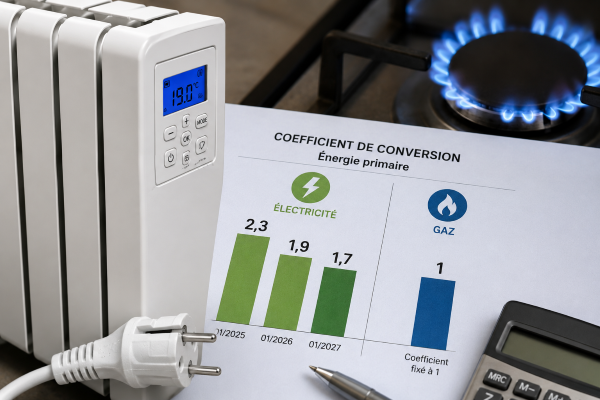
Until now, electricity remained at a disadvantage compared to gas, the coefficient of which remains fixed at 1. From 2027, this gap will therefore be further reduced. This will also be the second correction in two years. The electricity coefficient had already fallen from 2.3 to 1.9 on January 1, 2026. The new drop to 1.7 is part of the government strategy of electrification of uses and gradual exit from fossil fuels. © IA / Laure Pophillat
A better grade, but not necessarily better accommodation
According to the impact study mentioned during the examination of the text, approximately 300,000 main residences could escape energy sieve status thanks to this single modification of the calculation: almost 200,000 housing units classified F And 100,000 rated G.
In the private rental stock alone, the effect would also be considerable, with approximately 125,000 homes that could leave categories F and Gan estimated drop of 14% in number of energy strainers. The previous reform had already allowed around 275,000 private rental housing units to exit this status.
But be careful: the reform does not physically transform the housing concerned. It modifies the way in which their electricity consumption is taken into account in the regulatory calculation.
A boost to electricity… which reignites the debate on ECD
For the government and defenders of electrification, this development corrects a historical distortion. The FIEEC considers in particular that electricity was the only energy penalized by a specific coefficient and sees this reduction as a step towards better recognition of electrical uses in buildings.
Owners of electric homes close to a class change will therefore have every interest in looking at their situation closely. The decree also provides that DPEs and audits that are still valid can be the subject of a certificate indicating the new label, without having to carry out the entire diagnosis again. This certificate will be generated electronically by ADEME.
Beyond the battle of numbers, it is above all the readability of the DPE which is in play. With this new correction, several tens of thousands of homes heated with electricity could emerge from energy sieve status without any work having been carried out. Their label will improve, but neither their actual consumption, nor the comfort of their occupants, nor their bills will change.
A coefficient that is not unanimous
For Coénove, which brings together several players in the gas sector, the increase in the electricity conversion coefficient from 1.9 to 1.7 is above all a political choice. “After 2.3, then 1.9, here is 1.7. How far will we go?“, asks Jean-Charles Colas-Roy, president of the association. He denounces a succession of modifications which, according to him, makes it possible to artificially improve the statistics without transforming the real performance of housing. “Artificially changing a coefficient does not reduce consumption, bills or energy poverty. It is not the coefficients that need to be modified, it is the buildings that need to be renovated“, he insists.
Coénove also regrets that the Government has maintained its decision despite the unfavorable opinions of the Higher Council for Energy and the Higher Council for Construction and Energy Efficiency, as well as a largely critical public consultation. The association recalls that the Ep/Ef coefficient of electricity had remained stable for nearly 45 years before being modified three times in five years.
For critics of the measurement, this discrepancy risks further weakening confidence in the diagnosis. Because how can we make a DPE a real decision-making tool if the rating of a home can change, sometimes significantly, without the owner having undertaken any renovation work?