

Bilan Carbone and LCA are close but different concepts, which are based on similar approaches, and concern a large number of companies to respect standards, display and improve their carbon footprint
Publi-Information 


There RE2020 and, among others, THE declarations environmental of the products of construction grow THE companies has better measure their impact environmental. But between THE Balance sheet Carbon, Who evaluate THE broadcasts of gas has effect of tight of a organization, And L’Analysis of Cycle of Life (ACV), Who measure THE impacts of a product Or of a building on the whole of her cycle of life, THE methods And THE goals different. For THE manufacturers of materials And of equipment of building, master these two approaches becomes A stake has there times regulatory And commercial, notably For dispose of FDES Or of PEEP And give back their products eligible to calculations environmental of there construction new.
Balance sheet Carbon And LCA : two methods, two perimeters analysis
Although they are based on common technical bases, Carbon Footprint and LCA (Life Cycle Analysis) are different approaches. As noted Orki, LCA and Carbon Assessment software publisherthe main difference between the two lies in the object measured and the number of criteria retained. The carbon footprint concerns an organization, most often a company or a community, while the LCA concerns a product, a service or a process and is accompanied by a functional unit. In the case of an interior insulator, the functional unit is, for example “Cover 1 m2 of support ready for application, with a thickness of 12 mm, ensuring the performances described in standard NF EN 998-1 during the reference lifespan of the product of 50 years“.
The duration of the analysis is also different. A carbon footprint most often covers one yearwhile theLCA, as its name suggests, covers the entire life cycleencompassing the manufacturing of components, the manufacturing of the product, its transport, its operational life and its end of life. The criteria used, in the case of a carbon footprint, are greenhouse gas (GHG) emissions, converted into kgeqCO2. While LCA uses several criteria: contribution to climate change, water consumption and pollution, depletion of resources, effects on biodiversity, soil and air pollution, etc. LCA is based on the ISO 14040 and ISO 14044 standards, while the Bilan Carbone uses the “Bilan Carbone Method”, the GHG Protocol or the ISO 14064-1 standard.
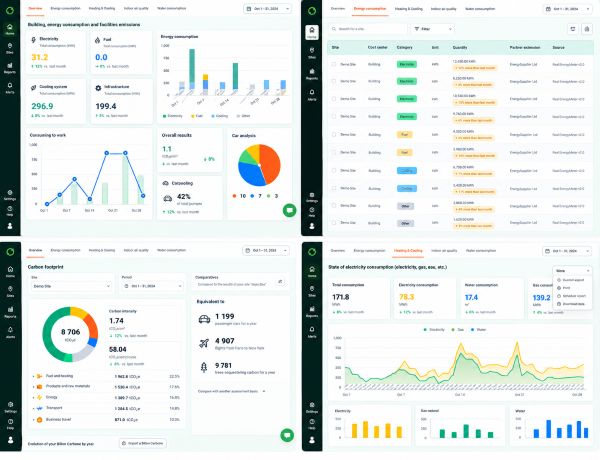
LCA restitution and carbon footprint of Orki software. © Orki
European directives and their transposition into French law
Finally, the goals are different. L’ACV aims to satisfy regulationssuch as RE2020 in the context of new construction or even environmental labeling for textiles. It allows you to eco-design a product and compare goods and products with each other from the perspective of their environmental footprint. THE Bilan Carbone is used more to manage an organization’s climate strategy and to build a plan to reduce its GHG emissionsbut it is codified by European texts and by French regulations.
THE reporting CSRD (Corporate Sustainability Reporting Directive) is a European obligation which requires companies to publish a standardized report on their impacts in terms of sustainability – environmental, social and governance. It strengthens the obligations of companies in terms of publishing information on environmental, social, governance (ESG) issues. This directive responds to the desire to create a harmonized normative framework at European level, guaranteeing increased transparency of data relating to sustainability. But the Omnibus I directive, adopted by the European Union on March 18, 2026, raises the CSRD liability thresholds to 1,000 employees and €450 million in turnover, compared to 250 employees, €50 million in turnover previously. This reduces the number of companies concerned in France to around 7,000, compared to 12,000 previously.
These new thresholds will only apply in our country after transposition into French law, expected no later than March 19, 2027. In France, the greenhouse gas assessment (BEGES) is a legal obligation for certain categories of companies and details of the obligations can be found on the CSR Portal maintained by the government.

The French Orki, which appeared in 2017, offers a whole range of services, both to arrive at the carbon footprint of an organization and improve it and to produce the basic building blocks of an LCA calculation in new construction, which are the PEP and the FDES. © Orki
Orki’s offers
All this remains complicated and changes regularly. Offers of support from subject companies have therefore developed. One of the most accomplished and extensive is that of the Frenchman Orki. Orki offers a suite of tools which includes:
– a assistance in developing a climate strategy ;
– THE calculation of product LCAs ;
– There centralization of CSR data and the simplification of their reporting.
For the world of construction, Orki notably offers to take charge of the entire process of obtaining the FDES (Environmental and Health Declaration Sheets) or PEPs (Product Environmental Profile): collection of production data, calculation of the LCA of the product, drafting of the FDES or PEP, verification by an independent third party, then publication in the INIES database.
It takes on average nine months to have an FDES or a PEP. Orki points out that all environmental calculations carried out within the framework of RE2020 are based on the FDES and PEPs submitted by manufacturers in the INIES database. Without an environmental declaration specific to a product, RE2020 calculation software applies environmental data by default, deliberately penalizing. Not having an FDES or PEP can therefore exclude a product from projects targeting the most demanding carbon thresholds.
And everyone keeps in mind that RE2020 has a tightening schedule. The first stage came into force in 2025 with a reduction in carbon impact of 10 to 17% depending on the type of building. A second tightening is planned for 2028 before the 2031 deadline which plans to reduce the carbon impact of buildings by 34 to 35% depending on their type, compared to the initial values of RE2020.
Orki works with manufacturers in a wide variety of sectors : joinery and closures, metalwork and foundry, plastics processing, mineral materials such as concrete, plaster or stone, sanitary ware and taps. For a manufacturer, the challenge is twofold: making its products visible in LCA software that designers use, and identify the most emitting manufacturing steps to improve its results. Orki also offers the calculation of the Carbon Footprint of companies and the formatting of their data within the framework of various environmental certifications.. Other entities, including Emersus and aktio, offer similar offerings.
LCA software in RE2020
The RT-RE-batiment site publishes the list of certified software for RE2020 calculation by distinguishing those which relate to the thermal part and those which concern the environmental aspect. There are currently fifteen of them. They are capable of carrying out an LCA calculation for a complete building, starting from the PEP and FDES of its components, and pushing this calculation, without re-entry, towards the overall calculation of compliance with RE2020.
In the order indicated on the site, these are ClimaWin 2020 from BBS Slama, SustainEcho from SustainEcho, U21Win V6 (Mi) and U22Win V6 (Mi and LC) from Software PERRENOUD, Vizcab Eval from Combo Solutions, Nooco from Nooco, One Click LCA from One Click LCA Ltd, Pleiadees from IZUBA Energies, ELODIE by CYPE, ArchiWIZARD from Graitec, Turbo-ACV from Fauconnet Ingénierie SAS, from Béa from Bastide Bondoux, Kompozite from Epiherm, Carbonz from Trce Software and finally Aglo from BAM.