
The reference regulatory framework
The Technical Standards for Construction approved with Ministerial Decree 17 January 2018, accompanied by the explanatory Circular 21 January 2019 n. 7 and subsequently modified by the Ministerial Decree of 9 March 2023, dedicate Chapter 11 to materials and products for structural use.
For ordinary reinforced concrete, only two steels are allowed: B450C (§11.3.2.1), hot rolled and high ductility, and B450A (§11.3.2.2), cold drawn and low ductility. A non-negotiable requirement applies to both: they must be qualified by the Central Technical Service of the Superior Council of Public Works, which issues the qualification certificate and where the identifying marks of the individual plants are deposited.
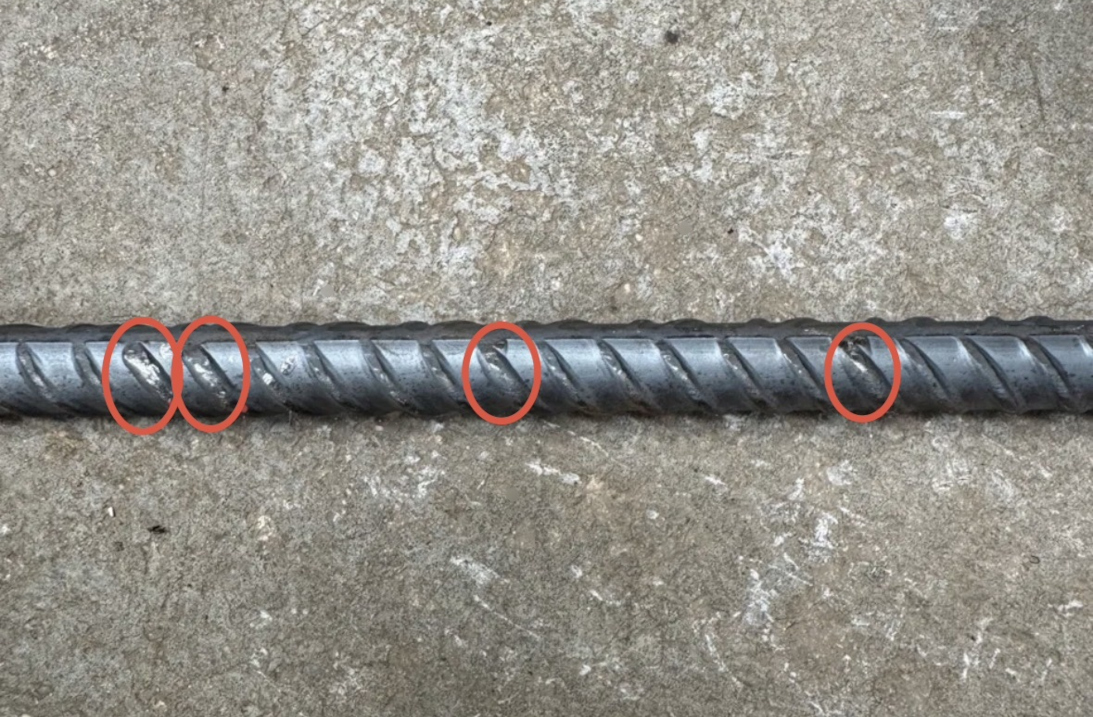
Absent or illegible brand: the product cannot be used
Paragraph §11.3.1.4 regulates the identification and traceability of qualified products and contains a provision that is worth reading in full, because it is the most stringent of the entire system: failure to mark, non-correspondence to what was deposited or its illegibility, even partial, make the product unusable.
This is not a theoretical prescription. The operational consequence is immediate and falls on the laboratory: the certificates relating to the mechanical tests must indicate the identification mark, detected on the samples by the laboratory in charge of the checks. If the samples do not have it, or if the mark is not among those registered with the Central Technical Service, this must be explicitly noted on the certificate, which does not take on value under the regulations. The batch must be rejected and the non-conformity reported to the Central Technical Service.
In other words: an unmarked iron is not an iron worth checking more carefully. It is an iron that cannot be put into operation.
The documentation accompanying the supply
Paragraph §11.3.1.5 establishes that steel supplies without the CE marking obligation must be accompanied by a copy of the qualification certificate issued by the Central Technical Service and the type 3.1 internal control certificate pursuant to UNI EN 10204, referring to the specific lot supplied. Added to these are the label on each bundle of bars and, indeed, the brand imprinted on the product.
There are also conservation obligations: ten years for producers and intermediaries, up to static testing for the manufacturer, who also retains markings and labels.
Acceptance checks on site
Pursuant to §11.3.2.10, acceptance checks are mandatory for all supplies, complementary to and not replacing documentary verification. They must be carried out in a laboratory referred to in the art. 59 of Presidential Decree 380/2001, within thirty days from the delivery date and in any case before implementation, in the amount of three samples for every thirty tons of steel of the same type coming from the same factory or processing center, even if achieved with subsequent supplies.
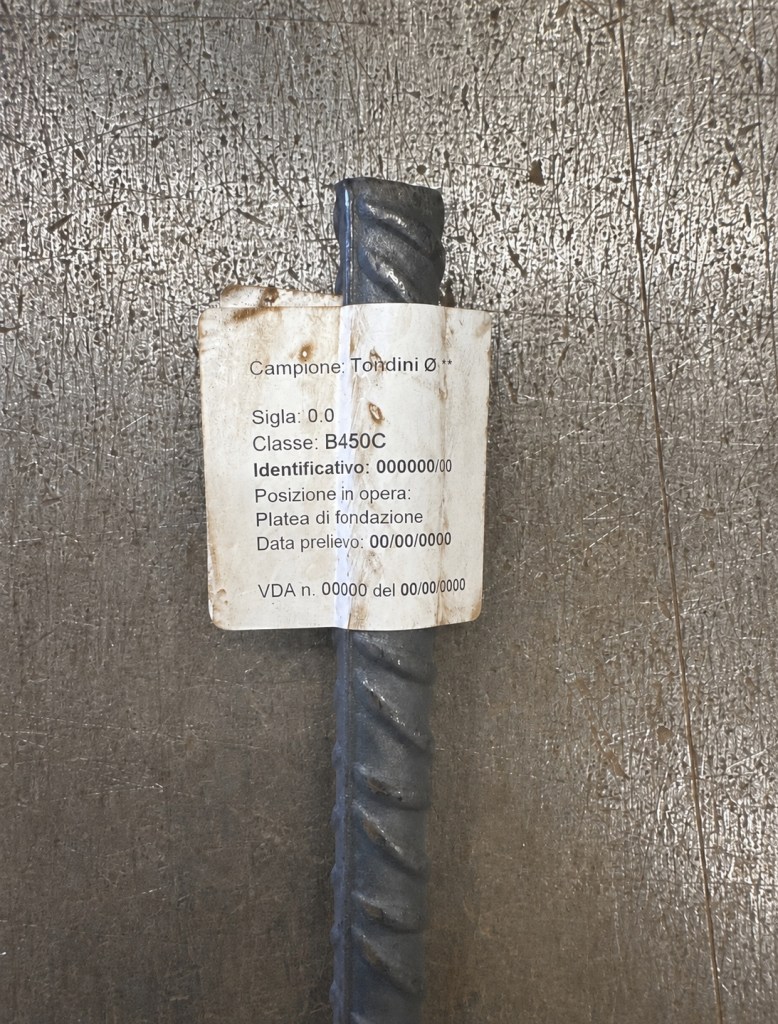
Two aspects concentrate most of the critical issues. The first concerns the sampling: it must be carried out by the Works Director or by a trusted technician – the 2018 NTC also allows it to be entrusted to the laboratory in charge of the tests – with a report and identification of the specimens using acronyms or indelible labels, then referred to in the certification. The request for evidence must in any case bear the signature of the Works Director.
The second concerns the brand: the samples must be obtained from bars of the same diameter and bear the brand of origin. A piece taken from a section without legible marking causes the chain to jump downstream, when the material is already in place.
Where the chain breaks
In construction site practice, some critical points occur regularly:
- Misalignment between brand and documents: the attached certificate refers to a different establishment from the one printed on the bars. It is the simplest check and one of the most often omitted, because reading of the mark and document verification take place at different times of the day.
- Qualifications no longer valid: certificates are subject to maintenance and renewal pursuant to §11.3.1.3. A certificate that was valid at the time of production is not automatically valid today.
- Passage from the processing center (§11.3.1.7): the documentary chain is lengthened and checks can also be carried out at the centre, but the identification of the samples and their traceability to the laboratory remain the responsibility of the Works Management.
- Subsequent reconstruction: the report on checks and acceptance tests must be submitted during the works, not recomposed when the bars are already in place.
A checklist for the arrival of the supply
- Read and note the marking on the bars, don’t stop at the transport document.
- Compare the mark detected with the establishment indicated in the qualification certificate.
- Check that the certificate is valid on the date of supply.
- Check the presence of the internal control certificate 3.1 referring to the batch.
- Schedule the sampling within thirty days, with a report and indelible identification of the specimens.
- Make sure that each sample bears the legible mark, because the certificate will have to bear it.
It is not a formal fulfillment
On construction sites, the temptation to treat the reading of the mark as a formality to be completed between one delivery and another is understandable. It’s the opposite: it is the first link in a chain that allows you to go back from a bar embedded in the concrete to the casting that produced it.
When that chain is really needed – a dispute, a contested test, a check on an existing structure – the only information still available will be that imprinted in the steel.