
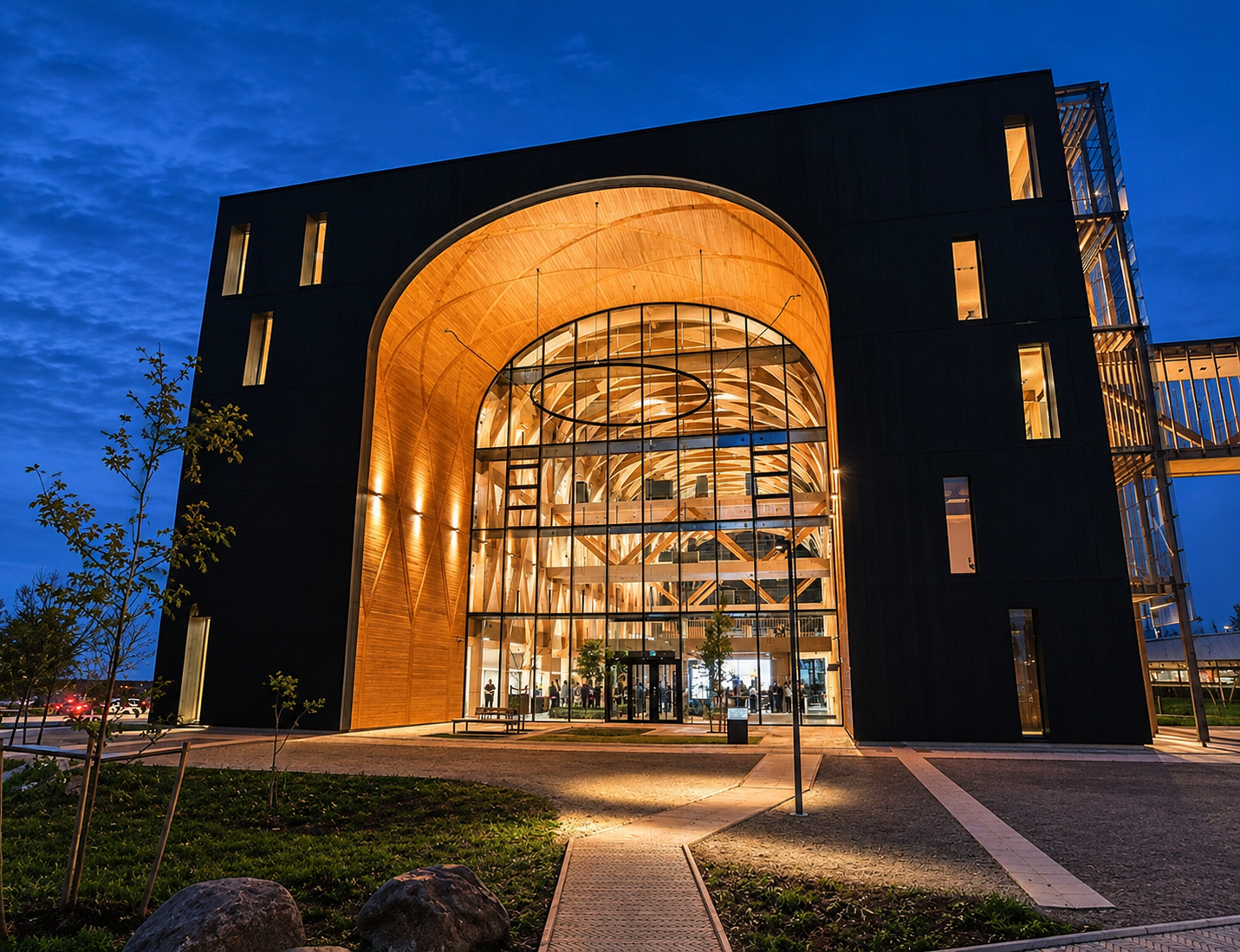
The inauguration of the TARU Nature Museum in Tallinn is the culmination of decades of effort to reconnect with the national tradition of wooden construction and assert itself as an emerging country of climatic architecture.
Publi-Information 

Estonia, 1.3 million inhabitants, became independent again in 1991 and joined the European Union in 2004. From 2006, a child from the country raised in Canada and repatriated, Erik Konze, launches annual meetings on wood construction. In fact, at the beginning of the 20th century, Tallinn was arguably one of the largest cities in Europe with wooden houses and the wood is the first local constructive resource always, except for the magnificent limestone used in rubble.
The forest, decimated during the first independence then managed by the Soviets, today occupies half of the territory with 50% public forests, and currently around 10 million m3 harvest, 1 million m3 of lumber, 3 billion euros in turnover. The processing industry, stimulated by the nearby Finnish neighbor, has become a supplier of prefabricated products for Scandinavia (including log houses), but also of quality blanks, particularly in pine, which dominate the Scandinavian market.
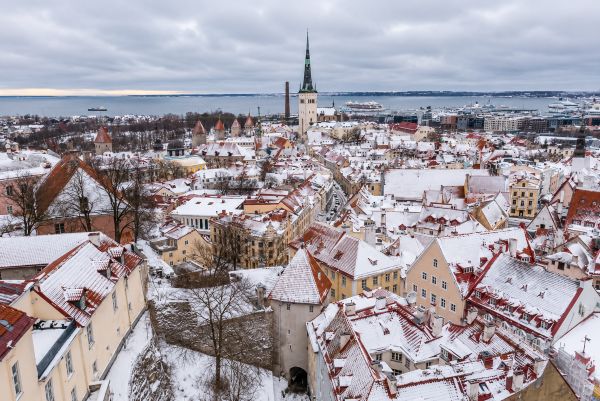
Tallinn in the winter of 2022 when Russia invaded Ukraine and the country suffered 25% annual inflation. © Estonia
The icon of Estonian glued wood
In addition to Forum bois type meetings, with Erik Konze, there are constant group trips to see what is being done elsewhere in Europe, a bit like in the days of Afcobois and the CNDB in France. THE Estonians, architects, engineers, buildersgo in particular to the Forum bois in Garmisch, then Innsbruck, and learn quickly. The result of these decades of initiation efforts is theinauguration on November 5, 2026 of TARU building (Tallinn House of Nature)which will welcome the new Estonian Museum of Natural History (Estonian Museum of Natural History), precisely preceding the 20th edition of the Meetings orchestrated by Erik Konze on wood construction (Wood, the key to a better living), on November 6.
THE TARU immediately pockets 3 National Wood Construction Awardsincluding the one sponsored by the manufacturer of CLT Arcwood which rewards works from the angle of the use of glued wood, and therefore often its own references. It was not a good idea to apply this year in the face of wooden colossus of TARUwhich would undoubtedly also have won in France if, as in Tallinn, a ministry of the environment – or whatever we want to call it in France – had decided to invest in a virtuous and emblematic ministry, changing its mind later.
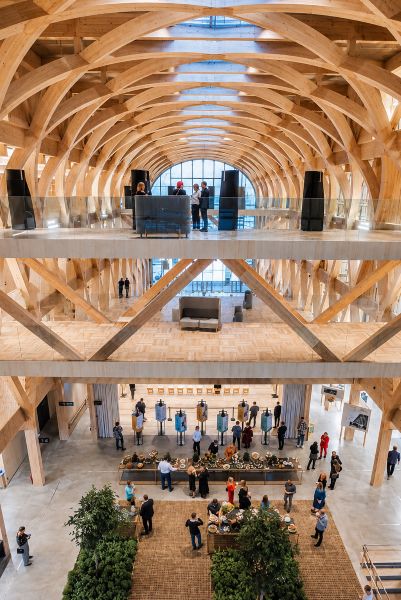
A multi-purpose space that has sparked controversy but is becoming the icon of the new Estonia. © Estonia
Bars and schools place of life
At the beginning, this ministry was to be established in a residential and peripheral district (Pelgulinn), where the Russian occupation left countless bars of prefa concrete housing, with increasingly lower ceiling heights going down to 2.20, while the kitchens were reduced to 2.6 m2 and living rooms at 12 m2. The question of the rehabilitation of these bars arises, and not only in thermal terms. The Academy of Fine Arts has a department dedicated to wooden architecture, headed by Sille Pilhak, who strives to find solutions. Erik Konze is skeptical, just regarding the thermal renovation of the gables: “at the time, everything was built with stolen materials, we don’t really know what these walls are capable of supporting”.
At least, in place of this ministry, Estonia built a high school (Pelgulinna Riigigümnaasium, public secondary school, Arhitekt Must), largest wooden building in Estonia when it is winner of the National Prize in 2023. Buildings marked by a three-dimensional tartan facade of glued laminated pine bars made from slats heat-treated by the leader European specialty, Thermory, the bars then having made a round trip to Sweden for the application of retardant.
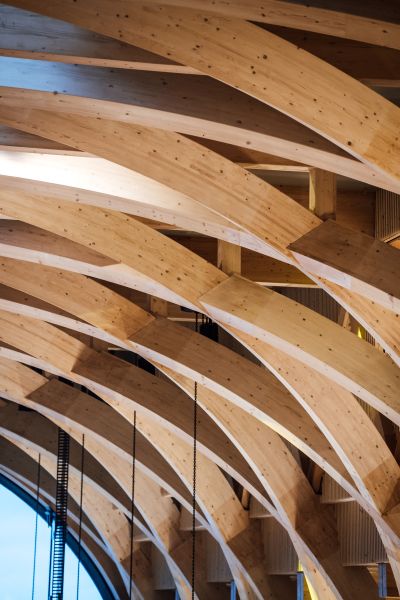
The major performance of TARU is to combine a showroom approach to Estonian know-how in wood, and undeniable architectural quality. © Estonia
Hangar dialogue
The environment ministry project logically made of wood was eventually moved to the neighboring coastal district Noblessner, next to the Nobel seaplane hangar, at the time of its construction, at the beginning of the 20th century, the largest reinforced concrete domes ever built. The building survived the Soviet period, when the port and coastal areas of Tallinn were a reserved military zone and a sinister prison stood next to it, since destroyed. The hangar currently houses a maritime museum, the specimens of which are partly on the dock as if it were still a military port. One of the major constraints of the project was not to obstruct the view of this historic landmark building.
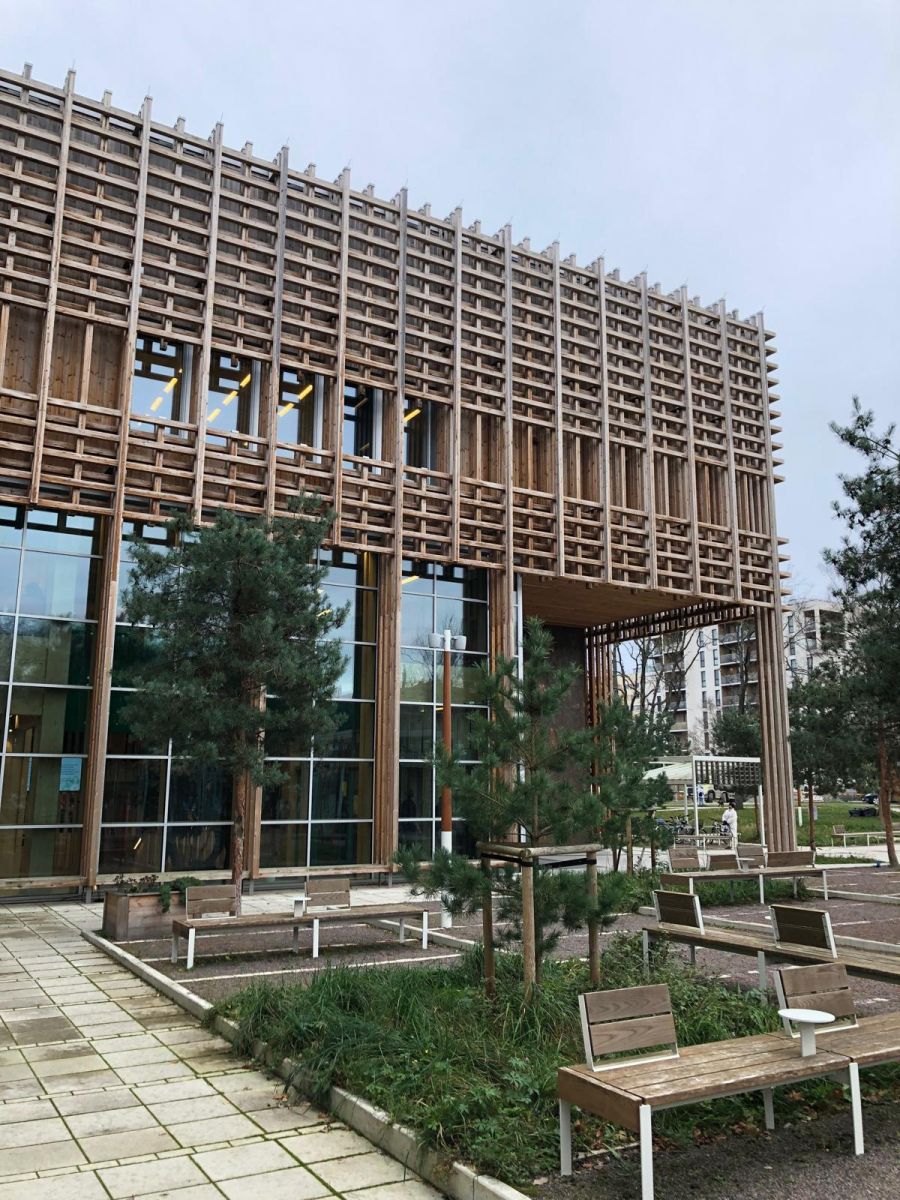
Another subject of controversy, the also iconic sur-façade of this new high school in Tallinn, which cost 3 million euros alone and which does not resist, despite the heat treatment, the mold on the horizontal faces where water can stagnate. But this can be repaired by gradually replacing certain moldy bars with elements whose profile prevents any water retention, to the wise, hello! © Jonas Tophoven
Toned Estonia
In 2014, the small Estonian agency Kavakava comes 3rd in the competition for the composer’s archives Arvo Pärt. When this center was completed by the winner Nieto Sobejano (Madrid and Berlin), Kavakava unanimously won the competition to virtuously house the Ministry of the Environment.
At different stages of the project, two BEs are associated, Estkonsult with the engineer Jürgen Einpaul on one side, and theMakespace agency on the other. Makespace is at work for a good part of the emblematic contemporary creations in Estonian woodsuch as the Saku Gymnasium school and sports complex by Salto Arhitektid, also designed with local CLT manufacturer Arcwood and winner of its sponsored glulam works award last year.
Better than concrete
It’s a small world, manufacturer Nordecon will also be at work for the TARU. But the project will extend over seven years, commonplace in France where the Covid years are also cited. In the meantime, the Ministry of the Environment withdrew, the project became the new location of a nature museum, additional functions were sought and the ensemble oriented towards nature institutions was finally made 24,000m2. The construction cost remains miraculously stable despite the period of 25% inflation experienced by Estonia following the invasion of Ukraine. Its construction cost per m2 is extremely low, between 2100 and 2200 euros/m2and appears all the more clearly as discussions around this enormous project and its cost have punctuated all the stages – undoubtedly leading to the withdrawal of the ministry -, and that the wood solution asserts itself as equivalent to a concrete option with the added speed of implementation.
Jonas Tophoven / © Estonia