
The Ministry of Ecological Transition is suspending new requests for aid from the heat fund. The cause is the drop in ADEME’s allocation and a portfolio of projects estimated at 1.8 billion euros.
Publi-Information 

There will the energy transition have to wait due to lack of credits ? The Ministry of Ecological Transition announced the suspension of new financing requests from the heat funda system managed by ADEME and created in 2009 in order toaccelerate the development of renewable heat and cold, as well as heating networks. This measure comes in a context of strong tension between the financing needs of projects and available public resources.
The ministry’s office justified this decision to the AFP by saying “significant number of projects submitted in 2026“, but also by the “budgetary constraints“related to the drop in ADEME funding provided for in the finance bill for 2027.
An Ademe envelope reduced by 300 million euros
THE 2027 finance bill plans to provide ADEME with 500 million euroscompared to 800 million in 2026. At the same time, the portfolio of projects identified by the agency represents 1.8 billion euros in aid requests; in fact the gap between expressed needs and available means becomes difficult to absorb.
The ministry believes that the adjustments already made to the heat fund are no longer enough. “Despite the optimizations already made on the heat fund to improve the effectiveness of its intervention, it is necessary, given the significant gap between the assistance needs expressed and the State’s budgetary availability, to strengthen the rules for prioritizing files and granting aid.“, he explains.
This suspension thus reflects a tightening of conditions of access to public financingin a system which supports, in addition to the development of renewable heat and cold networks, renewable heat production projects in the collective residential, tertiary, industrial and agricultural sectors.
Communities are demanding guarantees on the projects undertaken
The decision raises concerns among local elected officials, some of whom investments in the energy transition depends on this aid. Antoine Armand, the vice-president of Intercommunalités de France in charge of Energy Transition and president of Greater Annecy, calls on the State to preserve the credits necessary to bring operations to fruition. “It is essential to guarantee, at a minimum, the maintenance of the necessary credits“to the realization of the projects, he believes. The elected official also insists on the need to keep the commitments made to the communities: “the State’s word must be kept: it is a question of trust and visibility for the communities which invest in the energy transition of our country“.
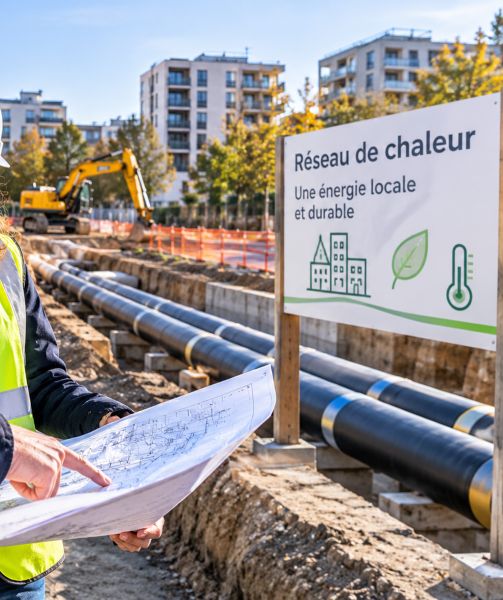
Budgetary uncertainty risks complicating the programming of local investments, while heat network and renewable thermal production projects often require several years of preparation and implementation. © IA / Laure Pophillat
ADEME specifies, however, that not all financing possibilities are closed. The multi-year agreements already concluded with the communities within the framework of territorial renewable heat contracts (CCRT) will not be called into question andProject leaders wishing to prepare future operations will also be able to continue to request aid for preliminary studies.
A new interruption in energy transition systems
This decision comes in a broader context of reduction or interruption of several public programs dedicated to the energy transition and renovation of buildings. THE Actee program, dedicated to the energy renovation of public buildingsas well as several measures to combat energy poverty must also be interrupted by the State in 2027 and 2028; dhe announcements which fuel criticism from those involved in renovation and the fight against precariousness. Thus, Christophe Robert, of the Housing Foundation, denounces a “serious social and ecological decline“.
There suspension of the heat fund raises the question of the continuity of public decarbonization policies. While communities and industries must invest to reduce their dependence on fossil fuelsthe reduction in support envelopes and the strengthening of prioritization criteria could slow down the transition of many projects to the operational phase.