
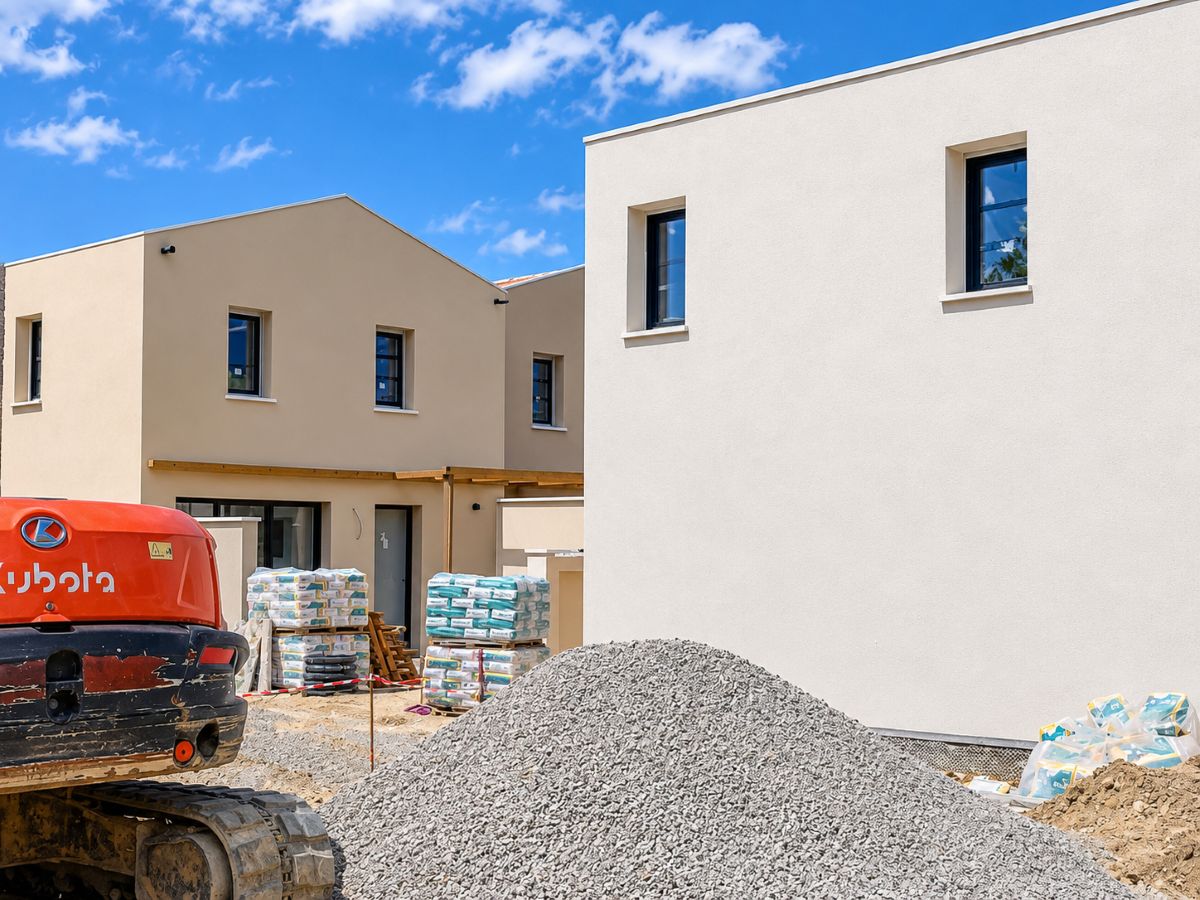
The new housing market in France continues to plummet. In the third quarter of 2026, accommodation reservations fell 24.4% year-on-year, reaching their lowest level in 2009.
Publi-Information 

THE new housing market in France continues its decline. In the third quarter of 2026, accommodation reservations fell 24.4% over one year, reaching their lowest level since statistics from the Federation of Real Estate Developers (FPI) began in 2009.
THE put on sale are also declining sharply, and the crisis has already wiped out more than a third of jobs in the sector. For promoters, the wait for a restart is becoming increasingly difficult to bear.
The market is still stalling
“I tell you every quarter that we are going to hit rock bottom“, launched Pascal Boulanger, president of the FPIduring the presentation of the latest figures for the profession. The third quarter of 2026 once again gives him reason to worry. In fact, between July and September, promoters who are members of the federation recorded only 15,102 accommodation reservationsa drop of 24.4% compared to the same period of 2025. The market has never fallen this low since 2009.
Over the first nine months of the year, the number of reservations stood at 55,964 accommodations, down 16.6% year-on-year. The market thus falls below the 60,000 sales mark, confirming that the crisis that began in mid-2022 shows no sign of running out of steam.
For Pascal Boulanger, this degradation goes far beyond the mere difficulties in the real estate sector : there “real reason, it’s the context, it’s international, there is no morale, but in addition, there is not a sufficiently effective system (tax or purchasing assistance)”, he analyzes. president of the FPI mentions in particular the war in the Middle East, the pre-election climate which maintains a wait-and-see attitude among households and the return of inflation, rising to 3.4% over one year in October. Household confidence also fell to its lowest level since June 2013.
Nobody restarts the machine
THE retail sales fell by 13.8% year-on-year in the third quarter, with particularly marked decline among owner-occupierswhose purchases decreased by 16.7%. THE private investors are no longer there since their acquisitions contracted by 3.7%, to 2,483 housing units.
But it is on the side of bulk sales that the fall is the most brutal. Reservations intended in particular for social landlords and intermediate housing operators plummeted by 39.6%, to only 4,082 housing units. However, these acquisitions often play a determining role in the financial arrangement of operations, by providing promoters with the first commitments necessary for launching the programs. “It is the investor who makes it possible to trigger the program. They are the ones who come to buy first. (…) And so, since we don’t have these investors, everything else doesn’t follow“, underlines Pascal Boulanger.
Promoters are no longer content to wait for better days. Due to a lack of sufficient reservations and visibility on demand, they are reducing their commitments and refusing to put certain programs on the market. In the third trimester, the sales thus fell by 32.1%, to 9,140 housing units, a new historic low. At the same time, 28% of operations were withdrawn from marketing.
Employment is already paying the price of the crisis
The crisis is also reflected in a sharp contraction in employment, with the sector only having 22,650 employees compared to 35,000 in mid-2022, i.e. 12,350 positions eliminated since the start of the crisis and more than a third of the workforce disappeared. Pascal Boulanger fears that this spiral will worsen further if no measures support the recovery. “The longer we wait (…) the less land we have, the less equity we have“, he warns, before summarizing the consequence on employment: “and the more we lay off“.
It is clear that as programs are abandoned or postponed, companies lose financial and human resources, which also reduces their ability to prepare for new operations when demand returns.
Budget 2027: the FPI’s proposals on the Matignon table
It is in this context that Pascal Boulanger must meet the government in Matignon to defend the measures demanded by the federation as part of the 2027 budget. FPI is banking in particular on strengthening the status of the private lessorthe famous Jeanbrun system, with an increase in the rate and the depreciation ceiling in order to make rental investment more attractive.
The federation also wishes to authorize rental to ascendants and descendants who are not part of the owner’s tax household, as well as extend the zero-rate loan (PTZ). Three levers intended to support investment and access to property, while individuals and institutional investors are particularly wait-and-see.