
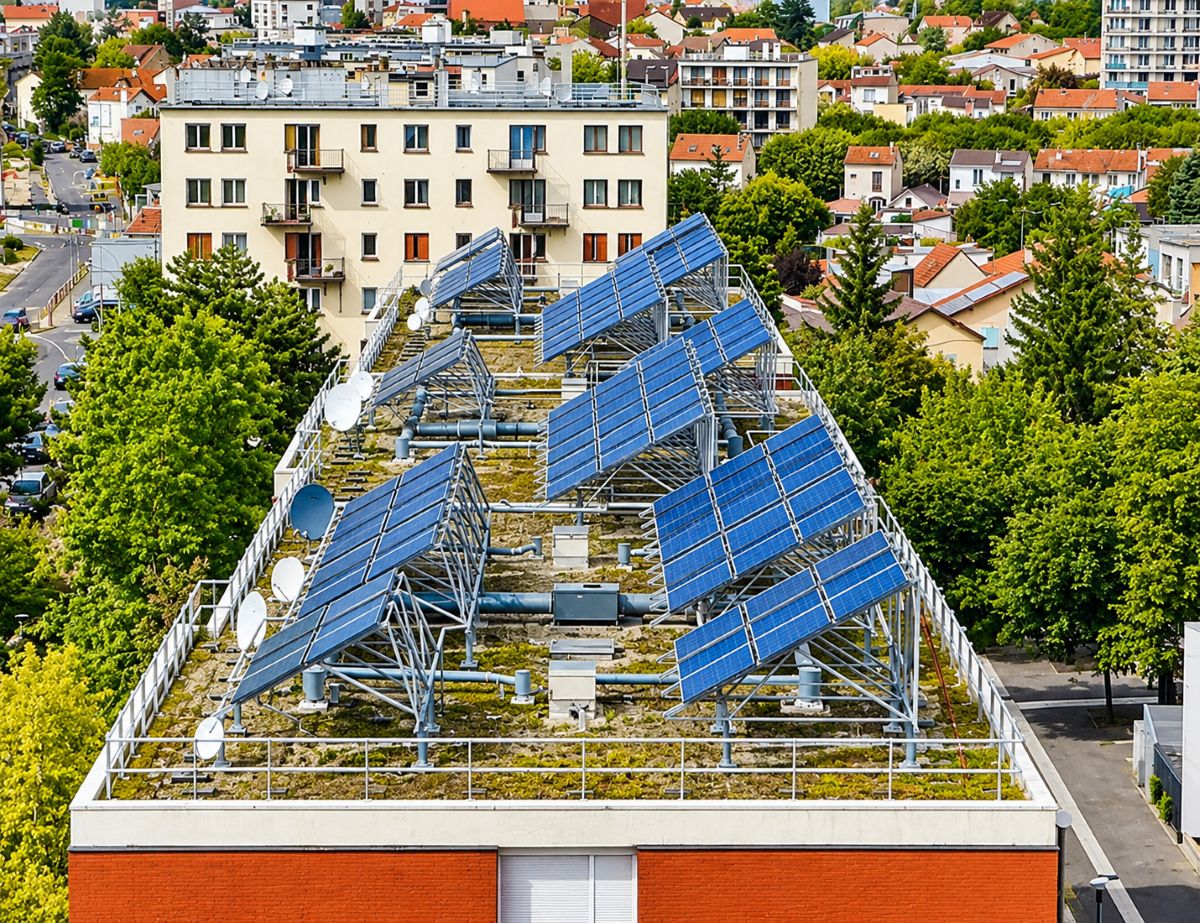
The efficiency of solar thermal is up to 4 times higher than that of photovoltaics and can produce water up to 120°C. But it’s hydraulics: it requires skills and maintenance.
Publi-Information 

The government finally realizes that the solar thermal is the Renewable Energy (EnR) with the highest efficiency. A flat thermal solar panel displays an optical efficiency of approximately 80% for a flat sensor and can reach 90% optical efficiency for a tubular vacuum sensor. A solar collectordepending on its location, can produce water between a temperature of 80 and 120°C. A vacuum sensor, thanks to the vacuum, maintains this possibility even in negative outside temperatures, as long as the sun shines. For comparison, the best photovoltaic solar collectors on the market today reach 24% efficiency, even if we are on the eve of a technological revolution which, with the use of perovskite in photovoltaic cells, will make it possible to approach 30% efficiency within two to three years.
Suddenly, pushed by all solar thermal sector months ago, on November 13, the government presented a national action plan to develop the solar thermal sector in France and contribute to the reduction of fossil fuel consumption.
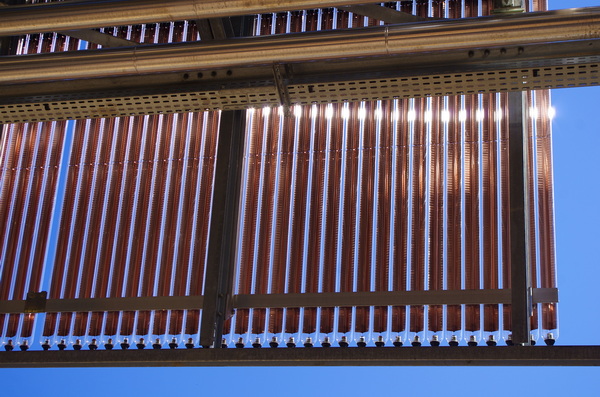
Vacuum solar panels provide water at over 100°C even in negative outdoor temperatures. © PP
A positive trade balance for France
Certainly, as indicated in the press kit of the Ministries of Ecological Transition, Regional Planning, Transport, Cities and Housing, the trade balance of the solar thermal is positive in France. In 2022, the latest year of available data, the French thermal solar market represented 460 million euros and 3,080 direct jobs. The sector posted a positive trade balance of 57 million euros, with 120 million euros of exports for 63 million euros of imports. The reason for this positive trade balance is quite simple: the Viessmann factory – now Carrier – in Faulquemont, near Metz, is the group’s competence and production center for solar thermal. THE flat thermal solar panels from the Vitosol range manufactured in Faulquement supply all Viessmann subsidiaries in Europe and beyond.
Furthermore, we only know of five other water thermal solar panel manufacturers in France :
– Heliofrance, in Bérat near Toulouse;
–SolisArt in Saint-Hélène du Lac in Savoie (73);
–Syrius Solar Industry in Lavérune near Montpellier in Hérault;
–Vaillant in the Saunier-Duval factory in Nantes;
– and Giordano R Energy in Aubagne (13).
Dualsun manufactures hybrid solar panels – photovoltaic on top, heat exchanger below in Jujurieux in Ain. Another application concerns the solar drying of agricultural products: aerothermal solar panels heat the air which is then blown into the dryer of vegetables, fruits, wood, etc. This same process can be used in housing and in the tertiary sector to preheat fresh air blown by a ventilation system. In addition, with good maintenance, thermal solar installation lives 20 to 30 years without difficulty, consuming free solar heat and electricity for its circulators.
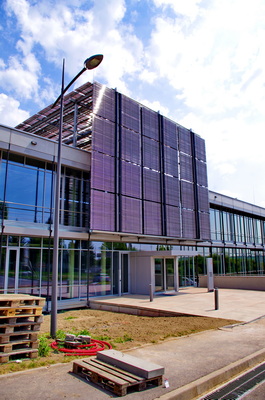
The Viessmann factory in Faulquemont near Metz alone ensures the French commercial surplus in the solar thermal photovoltaic sector. © PP
A national plan for the development of solar thermal
The national plan presented on November 13 has five axes.
First axis
Under the leadership of the DHUP (Directorate of Housing, Urban Planning and Landscapes), better adapt the regulatory framework to facilitate the development of efficient and sustainable projects, particularly in further promoting solar thermal in regulations and by facilitating the mobilization of land and available surfaces. It doesn’t seem like anything, it’s important. In new housing, the solar thermal had become the rule, in addition to a gas boiler room under the RT2000. The RT2000 calculation method killed this development.
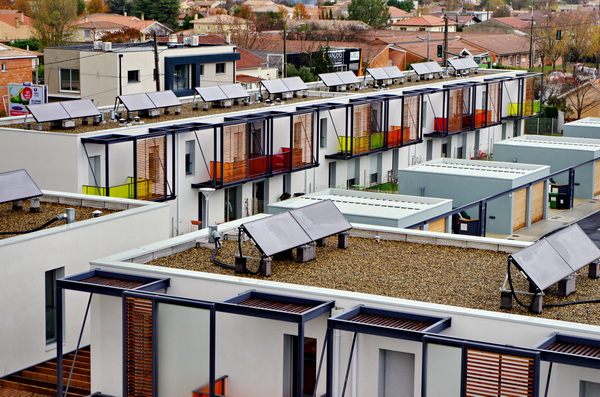
RE2020, which does not particularly promote ENR and includes a carbon component on building construction, penalized thermal and photovoltaic solar energy. © PP
But Directive (EU) 2024/1275 on the energy efficiency of buildings, in its article 10, sets out a whole schedule for equipping new buildings and existing buildings with solar equipment, without specifying whether it is thermal or photovoltaic.
For new construction in France, there is no chance of this happening without a modification of RE2020 and in particular of its IcConstruction indicator. With the announced tightening of IcConstruction in the coming years, we are even taking the opposite path. The ZAN regulation on Net Zero Artificialization also does not favor the creation of sensor fields for industry and district heating.
Second axis
Support project leaders and the industrial sector by developing support systems, promoting new financial and contractual arrangements and strengthening the competitiveness of the French solar thermal industry.
Third axis
Develop skills, with a plan dedicated to employment and skills and the increase in qualification of design offices, installers, operators and maintainers.
Fourth axis
Develop tools to accelerate projects, including simulation and decision support tools, identification of suitable areas and monitoring of installations.
Fifth axis
Strengthen communication and visibility of the sector, by developing arguments and tools adapted to different audiences: industries, communities, individuals and prescribers.
Particular attention, adds the press kit, will be paid to development of solar thermal in sectors that consume a lot of heatparticularly industry and heat networks, in order to accelerate the replacement of fossil fuels with renewable heat. Targeted actions will also be carried out in sectors such as laundries, aquatic centers or washing stations. The plan does not really mention all the buildings that consume large amounts of hot water: swimming pools, collective buildings, hotels and other accommodation centers, gymnasiums and sports centers, etc.
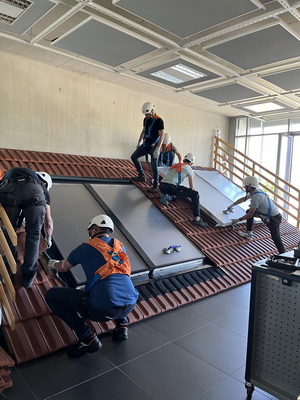
As the solar thermal market has shrunk significantly in France, skills have also declined and training will be required to support any recovery. © PP
We have some catching up to do
After two years of growth, the thermal solar market in France marked time in 2024. With only 108,150 m2 of solar thermal collectors installed in 2024 including 53,610 m2 in mainland France and 54,540 m2 in the overseas territories, France is less equipped than Germany (216,500 m2 installed in 2024; 376,000 m2 in 2023) or Italy (156,500 m2 installed in 2024; 244,500 m2 in 2023) according to the EurObserv’ER barometer.
However, after a clear decline between 2012 and 2020, the deployment in mainland France of solar thermal collectors for individual installations had started to rise again; this dynamic was driven by combined solar systems whose installed surface area had reached 21,850 m2 in 2023 (+125% compared to 2020). In the segment of collective installations in mainland France, the dynamism of installations of more than 1,500 m2 also made it possible to maintain a slight growth in the annual surface area of sensors installed until 2023 (+ 54% compared to 2020).
In the segment of large solar thermal installations (GIST), the National Institute of Solar Energy (INES) lists 37 power plants of more than 100 m2 surface area of sensors in service or under construction, dedicated to industrial processes or heat networks. This set represents an installed power of 33 MW for an annual production of 0.05 TWh in June 2026. The Lactalis power plant in Fromeréville-les-Vallons (55), supported by the Newheat company and commissioned in 2023, constitutes the largest industrial solar thermal installation in Europee, with a sensor surface of 15,367 m2 for an annual production of 8.2 GWh. The dynamic continues with the Eurial company in Herbignac (44), which has launched work on a 21,590 m installation2 designed to produce 10.7 GWh/year – commissioning planned for the first half of 2027.
THE PPE 3 objectives for solar thermal are a production capacity of 6 TWh in 2030 (compared to 1.5 TWh in 2020) and 10 TWh in 2023. The Plan presented on November 13 provides for 18 tasks and as many working groups.
We will report back as their work progresses. One of the groups, however, concernsimprovement of monitoring and operation of solar thermal installations. We sincerely hope that it will draw on the experience of Monsieur Solaire, a recognized specialist in solar thermal maintenance.
© PP