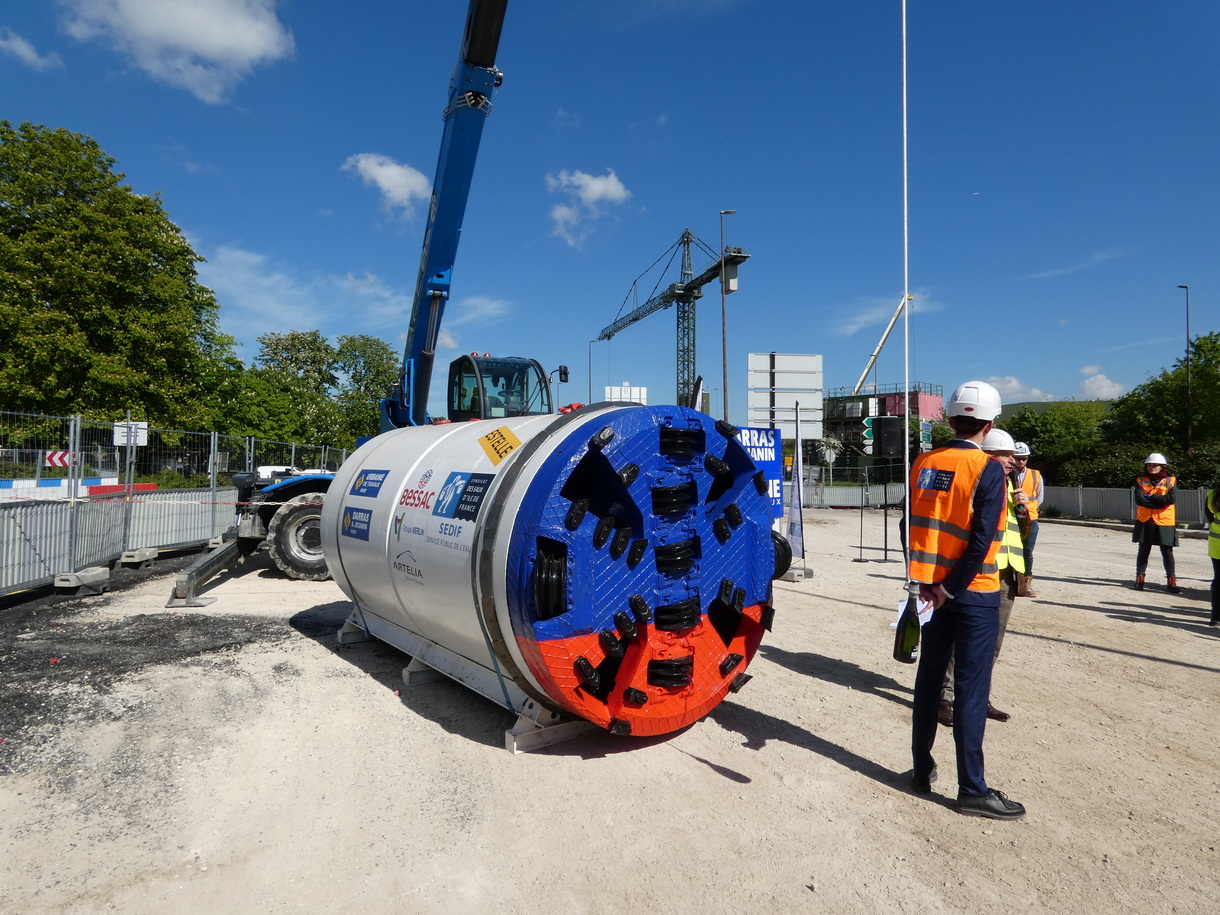
Two 20 m deep wells to lower and raise a mini-tunnel boring machine, lay an 800 mm diameter pipe and two 400 mm pipes 15 m below ground, over a length of 117 m.
Publi-Information 


The SEDIF or Île-de-France Water Unionconstrained by the redevelopment of the road interchange in front of the Manufacture de Sèvres, reorganizes its drinking water distribution network which, at this location, supplies 60,000 homes in Sèvres, Chaville and Viroflay. The Hauts-de-Seine Departmental Council is undertaking major development work on the Manufacture de Sèvres interchange, to improve the quality of traffic around the Sèvres bridge: widening of the Sèvres bridge, creation of an open-air basin under the Flood Risk Prevention Plan and road earthworks at rue Troyon.
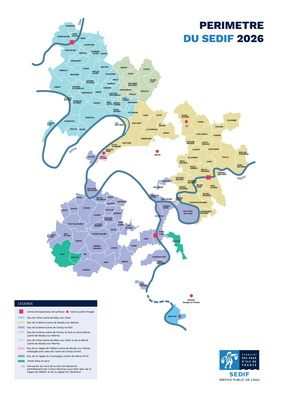
This is the territory of the SEDIF. © SEDIF
410 m of pipes, including 117 m dug by a micro-tunneling machine
Due to the constraints of the site – six lanes heavily used by thousands of vehicles every day – the new pipe to be installed represents a total length of approximately 410 meters, over three work zones:
– installation of 800 mm diameter pipe in reinforced concrete, with a sheet metal core with welded joints, in a conventional trench over approximately 260 meters, with the creation of an underground technical space equipped with a water flow measuring device;
– Modification of installations on rue Troyon, the street along the quay on the Sèvres side, with demolition of the old technical room housing the valves and replacement with new buried equipment;
– And, what interests us, intervention of a micro-tunneling machine over 115 meters to lay two steel drinking water transport pipes diameter 400 mm. Two additional 800 mm diameter pipes of 35 meters in total, made in trenches, will connect with the existing pipes. Finally, on the Seine side, 6 meters of pipe with a diameter of 800 mm will be fixed along the structure of the Sèvres bridge to connect to the existing pipe.
This work is constrained by ongoing road improvements, but SEDIF is taking the opportunity to modernize this segment of its network. In 2025, the SEDIF invested around €27 million to modernize water transport pipes and more than €33 million for distribution, thus renewing 41 kilometers of pipes. These investments are bearing fruit, since the SEDIF network displays a return of 91.6% in 2024, well above the national average of around 80%. This means in concrete terms that less than 9% of the water produced is lost in the SEDIF network, compared to 20% on average in France.
Within 3 years, the SEDIF wants to reach 93% yield – Only 7% loss – across the entire network it serves.
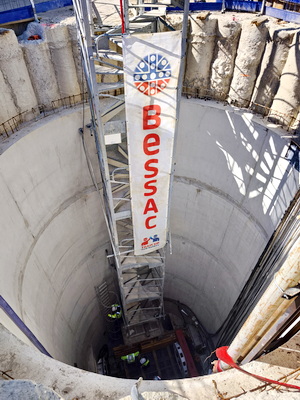
To lower the mini-tunnel boring machine, a 20 m deep well was dug. Its walls are made of concrete sheaths which, filled with concrete and protected by a reinforced concrete wall on the shaft side, constitute a structuring sheath descending 20 m. The concrete used is low carbon, made with CEM III cement to reduce the carbon footprint of the site. © PP
Two wells for descent and ascent
This project, with a total cost of €11.7 million excluding tax, began in September 2025 and will end in mid-September 2026. We visited it on April 13, the day of baptism of the mini-tunneling machine before its descent into the access shaft. His name is now Estelle, the first name of one of the SEDIF network services assistants.
THE two wells were perfectly sealed in relation to the surrounding ground : they go down to 20 m and cross the shallow water table on the banks of the Seine. The terrain is limestone and very fractured. THE tunnel boring machine is placed 15 m deep in the access shaft. It is propelled by cylinders which develop 500 t of thrust. Its horizontal path is sealed as it progresses.
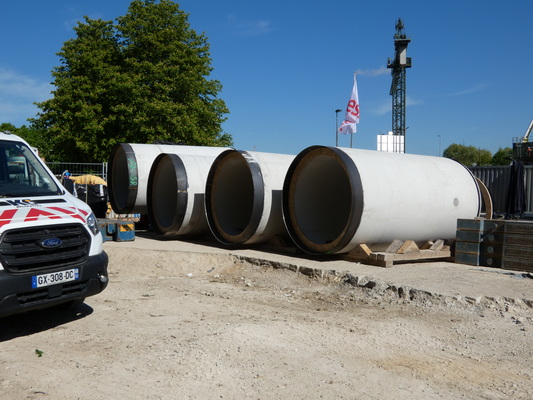
Every 3 m, as the tunnel boring machine advances, a segment of concrete pipe 800 mm in diameter is laid. These segments will be connected to each other so as to constitute a watertight gallery in which two 400 mm diameter pipes are installed which will distribute the water under a pressure of 6 to 8 bars. © PP
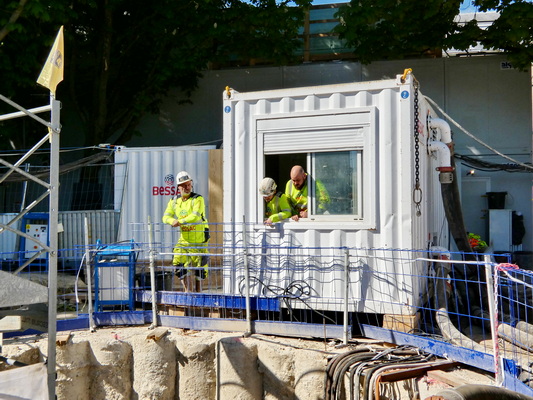
The mini-tunneling machine is wire-guided from the surface by an operator in this site cabin. © PP
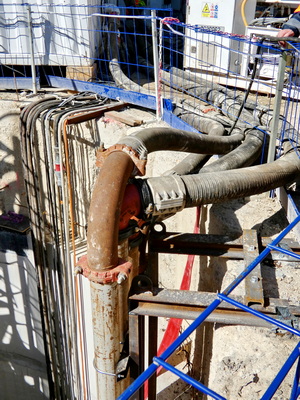
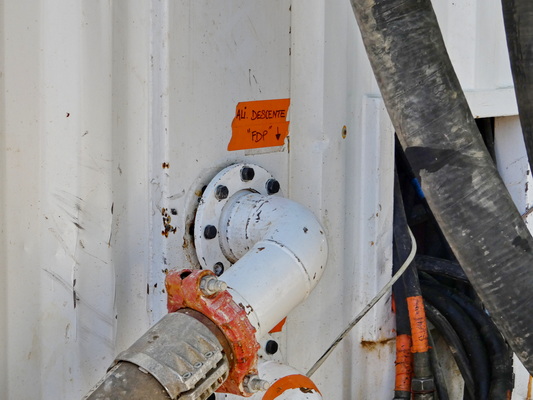
The cuttings from the gallery are extracted by hydraulic pickling: water under pressure is sent into the tunnel boring machine and forms a liquid mud. © PP
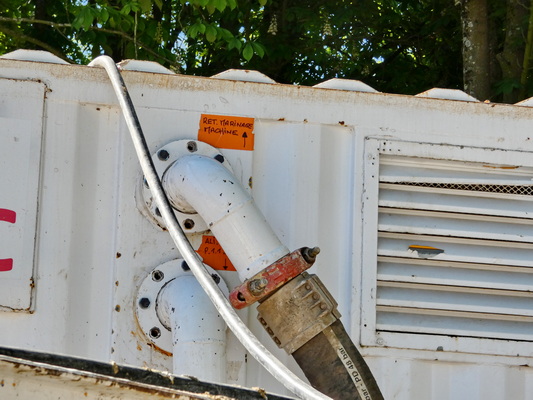
The pickling sludge is first sieved, then passes through a centrifuge which extracts particles down to 40 μm, before the fluid is reinjected into the mini-tunneling machine. © PP
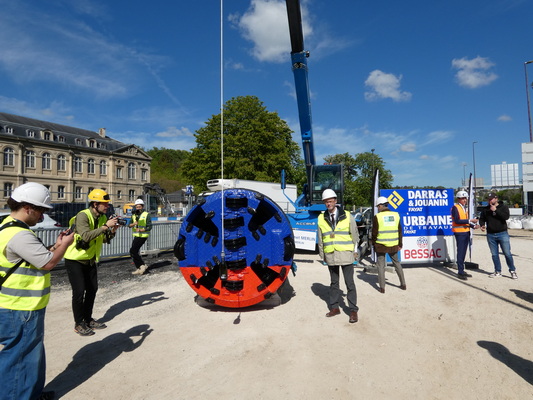
The mini-tunnel boring machine is supplied and operated by Bessac, a specialist in tunneling and micro-tunnels which belongs to the Soletanche Bachy group, which also dug the tunnel for the new 15 of the Grand Paris metro, in the immediate vicinity of the site. © PP
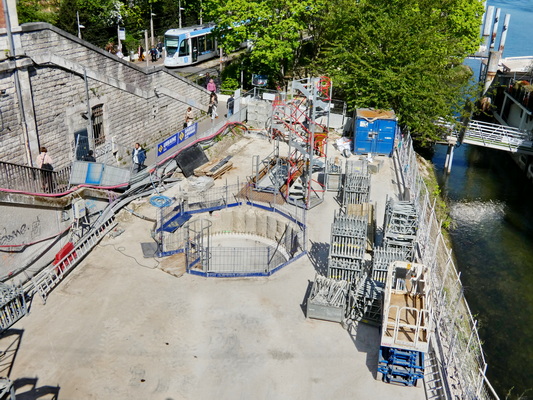
Once the 117 m of drilling is completed, the mini-tunnel boring machine will be raised through the arrival shaft, examined and rehabilitated and it will leave for another site. The purchase price of a mini-tunnel boring machine like Estelle reaches €1.5 million, according to Nicolas Didion, site manager for the group of companies. © PP
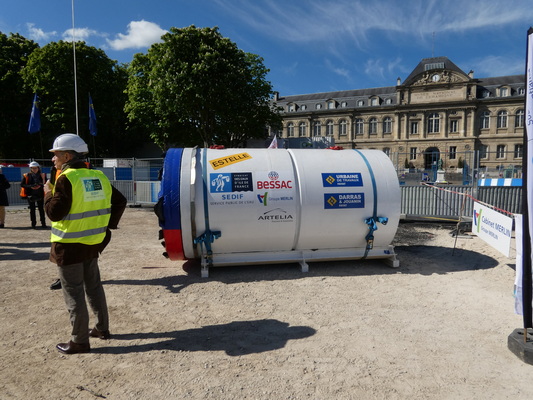
Several companies participated in this project. The Artelia/Merlin group carried out the displacement and sizing studies for the water network and provided project management, while Urbaine de Travaux and Darras and Jouanin, both from the Fayat group, plus Bessac, were responsible for the work within the framework of another group. © PP
As Nicolas Didion, site manager, reminds us, digging without disrupting surface activity, moving forward without unpleasant surprises – Darras and Jouanin took charge of the preliminary search for forgotten explosives – is a collective challenge that the work group has fully succeeded in. There drilling part of the site took two weeks to install, 2 to 3 weeks to dig, and it will take 1 to 2 weeks to dismantle and check. The work took place 8 hours a day at the beginning, then increased to 16 hours a day and 6 days a week during the digging.