
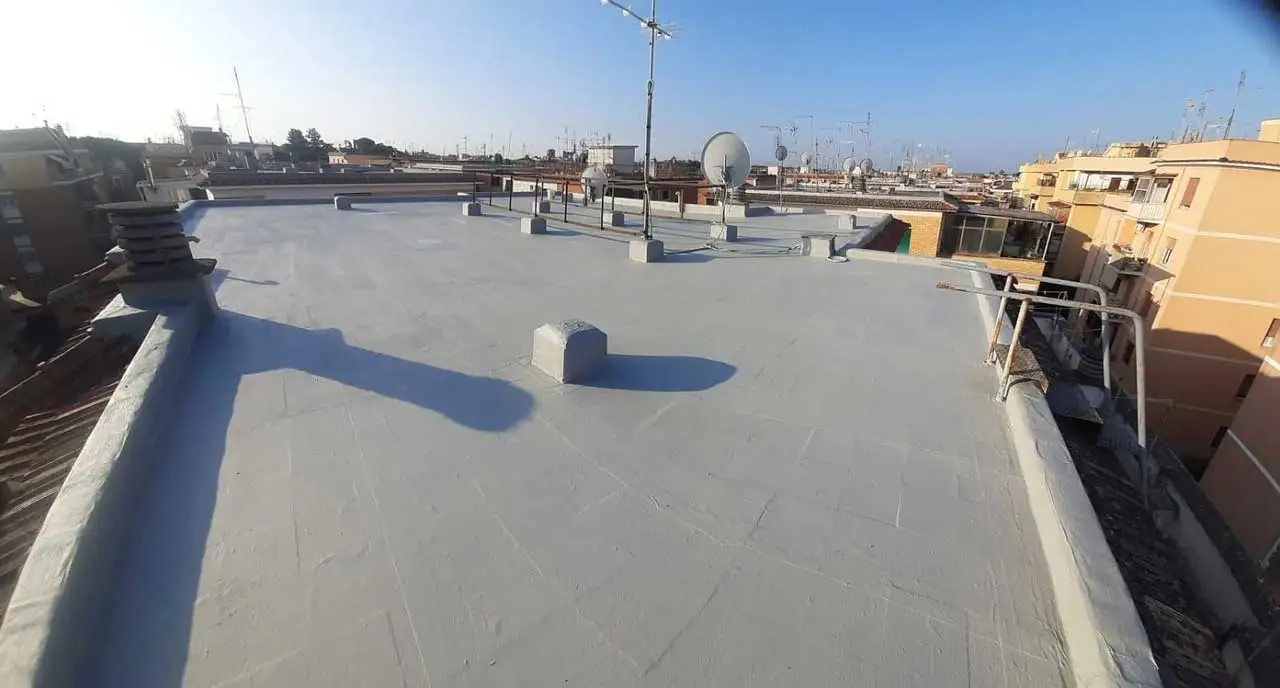
The causes of roofing degradation
Building roofs undergo constant degrading action due to various factors. Among the main agents responsible for the deterioration of waterproofing systems are meteoric precipitations, prolonged solar radiation, freeze-thaw phenomena and mechanical stresses induced by meteorological and environmental loads or movements of the structure. These factors, acting in synergy, induce progressive microcracks in poor quality or incorrectly applied waterproofing coatings.
Added to this is the problem of water stagnation: in flat roofs or with insufficient slope, stagnant water exerts prolonged hydrostatic pressure on the covering, accelerating its deterioration. The resulting infiltrations are often insidious: they initially appear as widespread humidity in the internal layers of the structure, becoming visible only when the damage has already spread deeply.
Characteristics of an effective waterproofing system
An optimal system for waterproofing roofs and coverings must meet precise and verifiable technical requirements also within the UNI 11928 standard. The fundamental properties expected from a quality liquid waterproofing include:
- Continuity: ability to form a membrane without joints or overlaps, eliminating the critical points typical of prefabricated membranes.
- Adhesion to the support: it must guarantee chemical or mechanical bonding over the entire surface to avoid the circulation of water under the membrane.
- Crack-bridging capacity: the ability to maintain integrity and waterproofness even in the presence of micro-cracks in the support.
- Resistance to atmospheric agents: in particular to UV rays (if visible), to freeze and thaw cycles and to extreme temperatures.
- Vapor permeability: ability to allow the support to breathe to avoid swelling or detachment.
- Resistance to mechanical loads: resistance to static and dynamic punching based on the intended use (e.g. walkable or drive-over).
- Durability: maintenance of performance over time, usually classified according to the ETAG 005 guide (now EAD)
Icobit systems for waterproofing roofs and flat roofs
The Icobit company has developed a range of application systems to meet the different design and construction site needs related to the waterproofing of roofs. The systems comply with the UNI 11928 standard and mostly consist of single-component liquid membranes in aqueous emulsion, a technology that guarantees ease of application, environmental compatibility and certified performance. Icobit solutions for roof waterproofing differ from each other in terms of type of technology, performance over time and specific field of use.
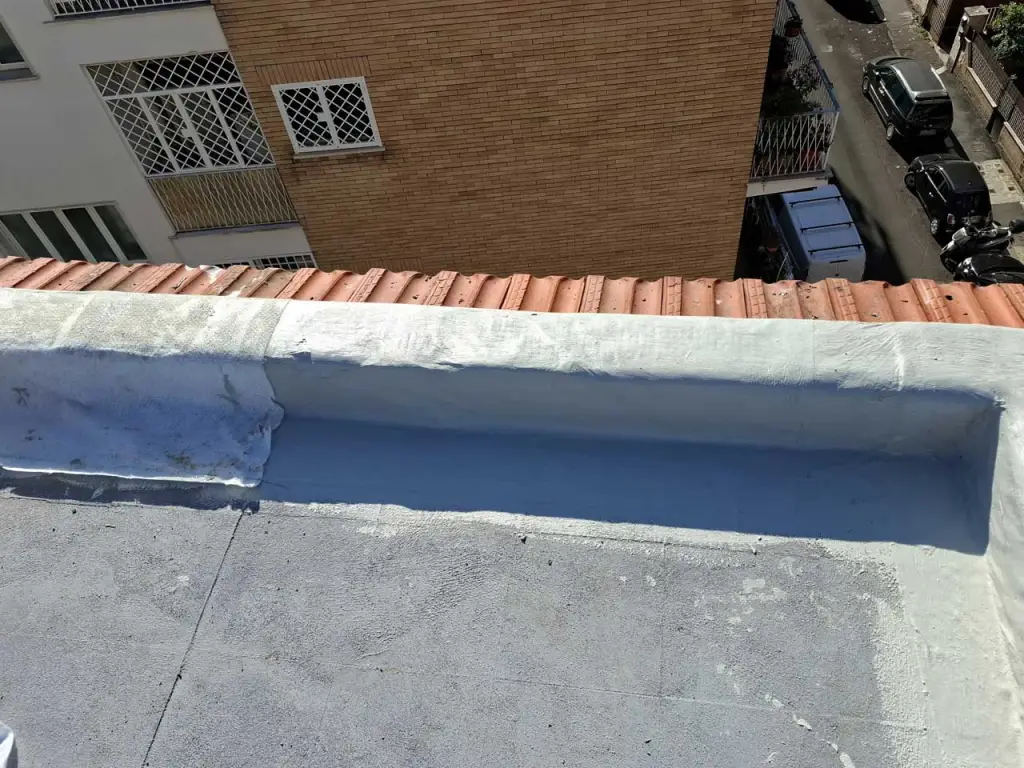
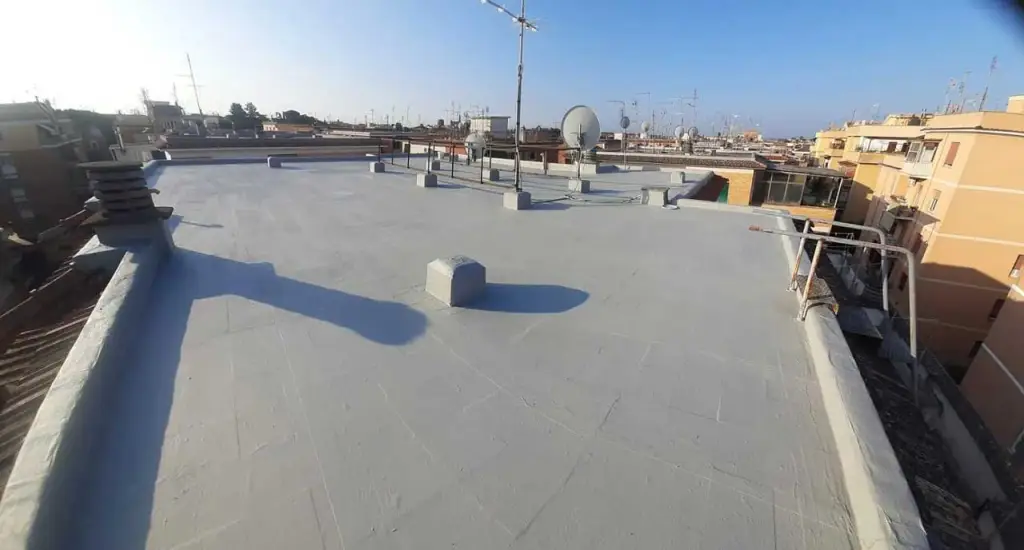
Fibre-reinforced membrane: the Icoper HP system
The Icoper HP fiber system is designed for interventions where a waterproof covering with high mechanical resistance is required without the use of additional reinforcements. Icoper HP is a continuous single-component fibre-reinforced membrane in aqueous emulsion, designed to guarantee high elasticity, resistance to crack bridging and prolonged resistance to water stagnation. The application cycle includes:
- Primer of the support based on the type of surface to be treated, to ensure perfect adhesion to the substrate.
- Double-coat installation of Icoper HP without the need for additional reinforcement, using a smooth trowel or rubberized rake.
This system is suitable for interventions both above and below the floor with direct gluing of tiles.
Quick-drying technology: Keep Dry
Keep Dry is the latest generation thermoplastic copolymer with quick-drying technology, characterized by high flexibility up to -40 °C. This property makes it particularly suitable for interventions carried out even in cold seasons or in environments with severe climates, where the flexibility of the covering at low temperatures is a critical performance requirement. The application cycle includes:
- Primer, where necessary (depends on the type of support), to optimize adhesion to the support.
- Double coat of Keep Dry applied with roller, brush or airless spray.
- Installation of Icoarm TNT Roll: interposition of non-woven reinforcement fabric between the first and second coat, where the support is subject to mechanical tension.
Keep Dry technology is specifically designed for the recovery and restoration of old deteriorated surfaces on which old bituminous sheaths in rolls exist.
Water-based multipurpose system: Icoper Multiuso
Icoper Multiuso is the reference single-component continuous membrane in aqueous emulsion for the multifunctional waterproofing of roofs and flat roofs. The water-based formulation guarantees compatibility with different substrates and facilitates application through the use of a brush, roller or airless spray. The application cycle includes:
- Primer, where necessary (depends on the type of support), to optimize adhesion to the support.
- Double coat of Icoper Multiuso applied with roller, brush or airless spray.
- Installation of Icoarm TNT Roll: interposition of non-woven reinforcement fabric between the first and second coat, where the support is subject to mechanical tension.
Icoper Multiuso is suitable for any type of surface, even on complex geometries and allows the creation of continuous waterproof coverings with high resistance to UV rays, water stagnation, fire and hail, qualifying itself as a solution suitable for both new constructions and for the renovation of existing roofs.
EAD certified waterproofing: Icoper Gold
Icoper Gold is the first single-component liquid membrane in aqueous emulsion certified EAD according to ETAG 005 — Guideline for European Technical Approval of Liquid Applied Roof Waterproofing Kits. This certification, issued according to the European ETA guidelines, attests the system’s compliance with rigorous performance requirements and allows its use in contexts that require certified technical documentation. The application cycle includes:
- Primer, where necessary (depends on the type of support), to optimize adhesion to the support.
- Double coat of Icoper Gold with roller, brush or airless spray and interposition of Icoarm TNT Roll as a reinforcing fabric between the first and second coat.
Obtaining the CE marking through the ETA standard makes Icoper Gold particularly suitable for high performance interventions or those subject to technical specifications that require the use of materials with European conformity documentation.
Criteria for choosing the correct system
The choice of the most suitable system for waterproofing a roof depends on a preliminary technical analysis that takes into account specific variables: the type of surface to be treated, the complexity of the work, the costs, the specific design needs, the surrounding conditions of the work, etc. Further main evaluation parameters are:
- State of the existing support: presence of active cracks, humidity conditions and type of substrate determine the choice between fibre-reinforced systems and standard membranes.
- Environmental requirements and construction timescales: for contexts with particularly cold winter temperatures, the cold flexibility and rapid drying of the system Keep Dry are discriminating criteria.
- Regulatory requirements of the project: public tenders or interventions on buildings subject to specific regulation may require the use of systems certified according to EAD, or which respond to environmental criteria, such as EPD, high SRI values, such as systems Icoper.
- Intended use of the roof: walkable solar roof, green roof or non-accessible roof for example, imply different mechanical resistance requirements.
During the design phase, the definition of the stratigraphy must be carried out in coordination with the verification of the existing sealing layers and the interface conditions, as indicated in the UNI reference standards for continuous roofing.
A systemic process
Roof waterproofing requires a systemic technical approach, which starts from the analysis of the causes of degradation and leads to the selection of an application cycle consistent with the required performance and construction site conditions. Liquid membranes today represent the reference technology for the protection of roofs thanks to their application versatility, high performance and management of construction details of different nature.
The systems developed by Icobit, such as Icoper HP, Icoper Gold, through the Keep Dry technology and the versatility of Icoper Multiuso, cover the entire spectrum of application needs and performances, from the maintenance of existing roofs to the creation of new waterproof coverings certified according to national and European standards. The correct execution of the application cycles, the adequate preparation of the support and the choice of the system based on the project variables are the determining factors to guarantee waterproofness, technical compliance and therefore durability of the work.