
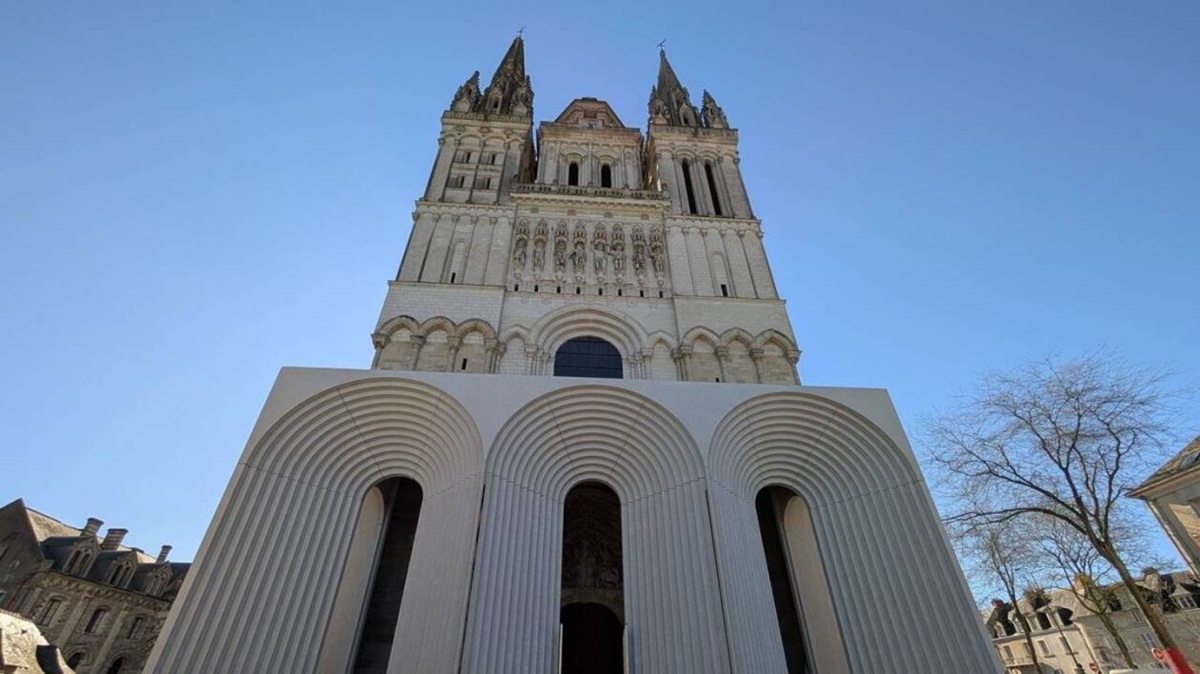
Inaugurated on April 9 in Angers, the contemporary gallery designed by Kengo Kuma continues the restoration work on the polychrome portal of the cathedral while being part of the centuries-old history of the building.
Publi-Information 


HAS Angers, Saint-Maurice Cathedral is enriched with a contemporary gallery designed by Kengo Kuma. Inaugurated on April 9, 2026, this discreet but structuring intervention is part of the long history of a building shaped by several centuries of architectural developments.
In 2020, the DRAC (Regional Directorate of Cultural Affairs) is launching an international architectural competition to designate thearchitect responsible for designing the new gallery of Angers Cathedral. At the end of the first selection phase, five candidates were selected: the French architects Philippe Prost, Rudy Ricciotti, Bernard Desmoulin and Pierre-Louis Faloci, as well as the Japanese Kengo Kuma. An internationally recognized figure, he has distinguished himself with major achievements such as:
– the Tokyo Olympic Stadium (2020);
– The Hans Christian Andersen Museum in Odense (2022);
– Or the Albert-Kahn museum in Boulogne-Billancourt (2022).
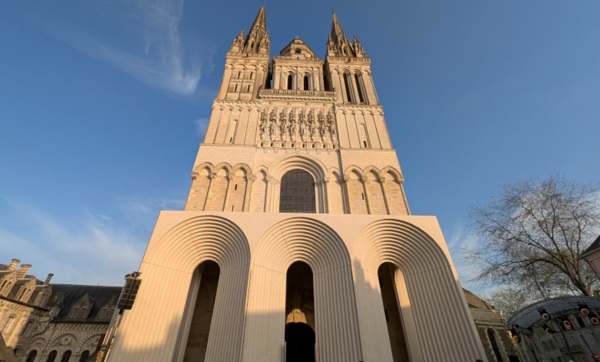
Kengo Kuma was appointed in October 2020 to design this contemporary gallery, whose primary purpose is to ensure the protection of the polychrome sculptures on the west portal of the cathedral, dating from the 13th century. © Angers.Villactu.fr
A building shaped by five centuries of evolution
No cathedral is homogeneous, and that of Angers constitutes a particularly readable illustration: on its facade elements built in different periods, from the 11th to the 16th century, are superimposed, reflecting a succession of architectural and stylistic strata. From this perspective, the addition of a contemporary gallery does not constitute a break, but is part of the continuity of a building whose history is written by successive additions.
There gallery, built in light concrete and composed of three archeswas designed as a “extension” of the Saint-Maurice-Notre-Dame cathedral to protect its sculpted 12th century portal.

“Through this new gallery, we wanted to create a connection between the past of Angers and the Angers of today,” declared Kengo Kuma, here in the photo, accompanied by a translator in front of the building. © Federico Martins / © KKAA
A contemporary architectural response constrained by history and function
Designed by theKengo Kuma agencythe gallery – a gallery existed in the 13th century in the same place, in front of the cathedral – adopts a deliberately sober style in order to “not to compete with the existing“. A bias dictated as much by aesthetic considerations as by the very function of the work, intended to protect the polychrome portal of the 12th centuryrestored in 2019, which is one of the rare testimonies of the polychromy of cathedrals in the Middle Ages.
THE concrete is made from sand taken from the bed of the Loire neighbor, said the Japanese architect. “I believe in the link between the past and the present and between heritage and creation. I even think that one does not go without the other“, declared the Minister of Culture, Catherine Pgard. cleaning work had revealed vestiges of medieval and modern polychromywhich have since undergone restoration.
There protective gallery designed by Kengo Kuma “integrates harmoniously into a major heritage building and more broadly into its urban context“, then affirmed the Ministry of Culture – moreover, the minister at the time, Roselyne Bachelot, was present at the inauguration.
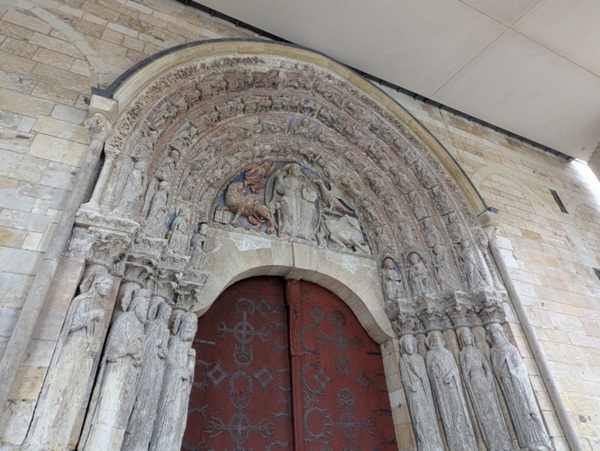
A gallery to protect the polychrome sculptures. © Angers.Villactu.fr
A discreet integration between heritage protection and contemporary use
The selected project is characterized by a contemporary style made of sober lines, arches and arches which dialogue with the facade without reproducing it.
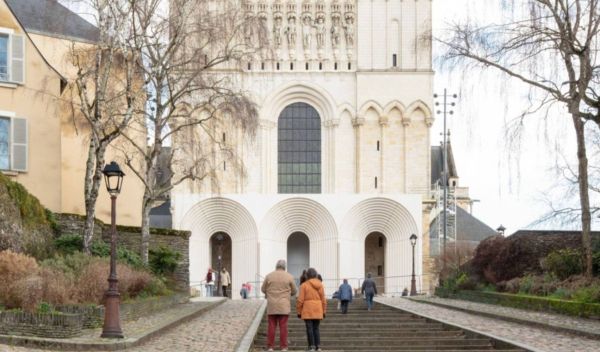
Entirely financed by the State for an amount of 4.4 million euros, the construction was inaugurated then blessed before being fully integrated into the operation of the cathedral. © Paul Hamelin
Beyond its protective function, the gallery introduces a new space of transition between the exterior and interior of the building, between urban space and sacred space. For Christophe Béchu, the mayor of Angersthis achievement is part of a long historical logic, where each era has made its contribution to a building designed as an architectural palimpsest.
To the voices that were raised to criticize the choice of a contemporary building, Christophe Béchu reminded that there is no “reliable testimony“on the appearance of this vanished gallery.”This cathedral is a palimpsest. We rebuilt on stones, on eras“, added the mayor.