
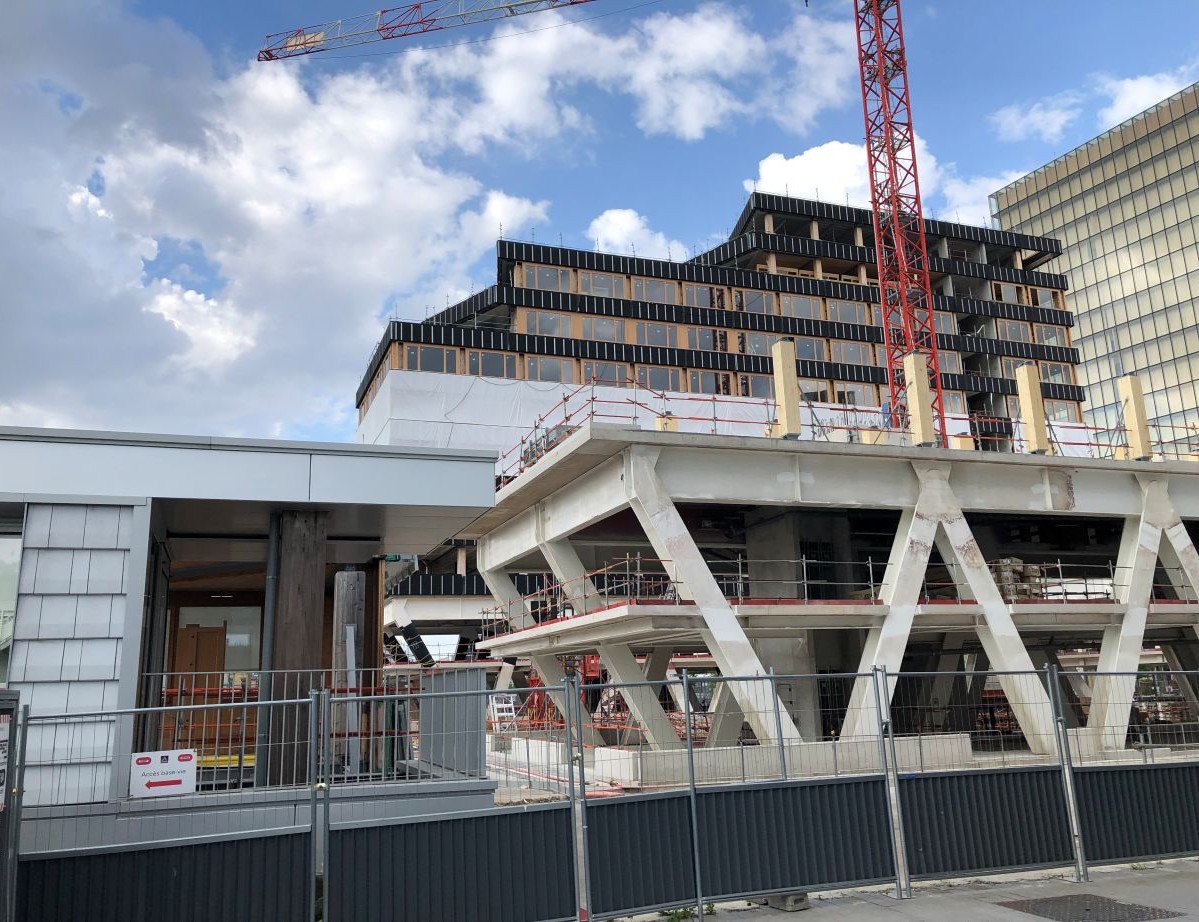
The new soft mobility infrastructure of Greater Paris allows the construction profession to take a different look at the development of the new climate architecture.

There are few places in the world like Greater Paris, where a construction professional has a concentrated wealth of past and future buildingsin a framework as abundant in terms of urban planning, with climate survival issues as obvious, and with an investigation tool as practical and soothing as the bicycle rented for 20 euros a day for generally flat surfaces and secure cycle paths which allow you to concentrate on the works and their context.
Cycling, an emerging media
However, to date there is no proposal for a press tour of a new work by bike. No tour of Frugality or the International Wood Construction Forum (with partners) by bike. No initiative from the ten ENSAs for systematize the discovery of Ile-de-France architecture by bikeno initiative from the Maison de l’architecture or the Arsenal, or not yet.
There are certainly these “Parcours Philléas” started in September 2024 with the support of the International Bois Construction Forum, to connect the new biosourced projects. On May 2, 2026, the 10th course took place, with seven Estonian architects. An 11th course is planned with the same stages on June 4 with around twenty architecture students from Lübeck in Northern Germany. A drop of water, but also an experiment.
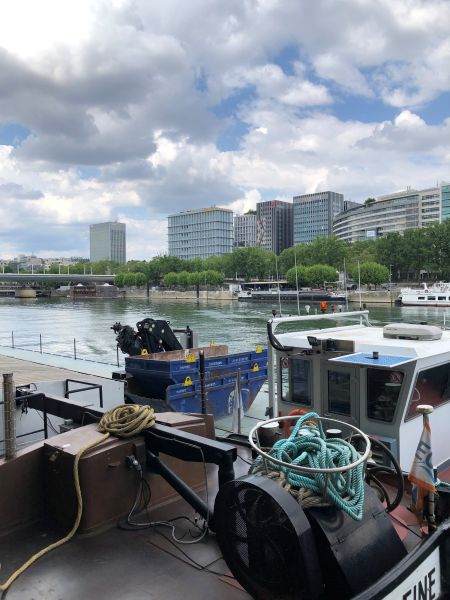
You need to take a look: near the Cité de la mode, in the second row, a Zulu, these flat barges with integrated cranes which could explode the river transport of wooden construction in Greater Paris. © Jonas Tophoven
The bicycle, Hausmann of the 21st century
THE Estonian architects have chosen Paris as a stopover on their long architectural journey towards the Venice Biennale, via Switzerland and Austria, not because of the Eiffel Tower or the Triangle Tower, but because the host Erik Konze knows how to offer a architectural bike ride.
Foreign architects and engineers are happy to see biosourced projects, but also the revegetation of the capital and its pacification. They can now, withextension of cycle pathsapprehend not only the facade of Paris, but the real Paris, the Greater Paris, with its contrasts and its hopes. Little by little, the development of bicycle rental companies opens up an infinite field of investigation to these professionals from all over the world.
Everything is on komoot
There is the tour of Paris which allows you to complete the loop in 60 km : quite sporty, it can be divided into segments. There is also the tour of Montmartre without climbing, the Olympic route including the Dugny footbridge, a first eastern suburbs route between Vincennes and Saint-Denis, and now a hybrid route starting from the Marais to reach the Maisons-Alfort veterinary school via the banks with a return via the Bois de Vincennes, the 12th and 11th.
Among other things, there remains great development potential around Isle Saint-Denis, and also around the Beaugrenelle slab and its Keller pavilion. As for the RERs accessible by bicycle between 9:30 a.m. and 4:30 p.m. or on public holidays, they open up a unique field of exploration in all directions, in the nearby suburbs or in the second or even third rings.
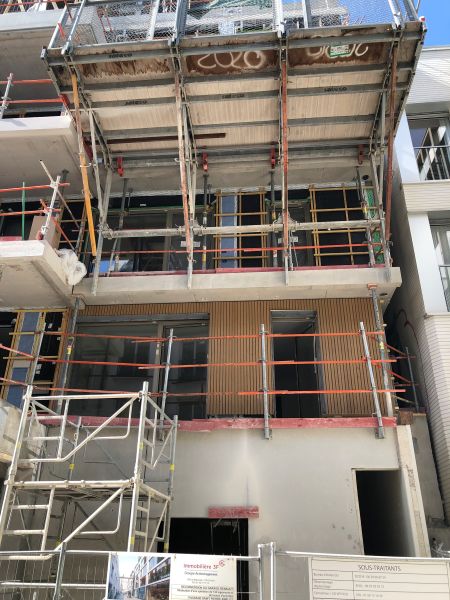
Passage Amelot, huge heavy renovation transforming, among other things, a garage into an apartment and climbing site, by Le Penhuel and SAM with Bouygues. © Jonas Tophoven
Raise your head
The bicycle is not a tiring means of transport subject to bad weather, but a means of understanding contexts. It does not mean excluding the inner look from guided tours of projects, nor especially the breaks during downpours which allow us to talk to each other. THE cycling is an architectural practicebut Parisian agencies still prefer the cart. It is also because architecture is focused on place and not enough on movement. To raise your head from the handlebars, you still need one.
Estonia so European
THE Estonian architects like to build with wood to distinguish themselves from Soviet brutalist architecture, but currently, Estonian and Russian populists have reconquered the municipality of the capital and want to transform “Parisian-style” cycling projects into death rows. The young Estonian nation is immersed like no other in European climatic architecture – Scandinavia, Alpine Circle, Venice Biennale, etc. – and appreciates Paris in its extreme diversity which includes current urban developments. Pacify and green the street leading to a school; raise to create social housing; limit the car and transmute the parking lots; build above railway tracks without overloading; imagine other types of conviviality.
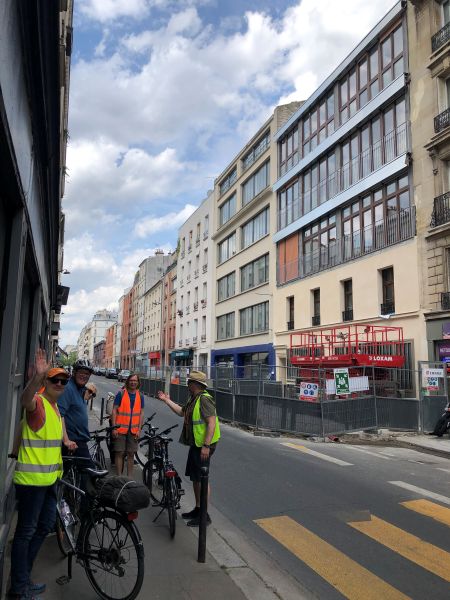
The Estonian group in front of 2 rue Richard Lenoir, increase to 6000 euros/m2 for social housing. © Jonas Tophoven
River route
In leaving Paris by bike rue Alphonse Baudoin, this time, no contemplation nearby at Charlie Hebdobut at the end of the route the memory of the Bataclan by taking the Amelot passage. The Marais is not just the Place des Vosges, it is also, precisely in this season, the hidden splendor of Square Saint-Gilles and its roses. The journey from the Bastille to the Bibliothèque de France, along the banks, is always a wonder. In addition, there is a Zulu docked there, the Sogetrans flat barges with integrated crane, which in principle make it possible to deliver wooden construction elements almost anywhere.
Under the invocation of Roland Schweitzer
The surroundings of the Bibliothèque de France are, as always, undergoing transformation. We are waiting for Kengo Kuma’s hotel to complete the covering of the slab on the Austerlitz side, while the first of the two Air du temps towers, by Data Architectes, is lifted. This is also Wewood’s piece of bravery. It is always moving to remember that Roland Schweitzer, now with his daughter Marie Schweitzer, is the pioneer of wooden residential buildings in the new Paris, rue Domrémy, but that he is also the town planner of the buildings surrounding the Library, certainly without wood, but with a consistency that is no longer found elsewhere on the ZAC Rive Gauche or Bruneseau.
ZACs without souls
On the Ivry side, the latest actions of the ZAC Rive Gauche and Bruneseau are desperate. In the absence of a brilliant invention on the last covering by the Masséna station, Parisian urban planners have once again created a stillborn neighborhood, where bicycles are stolen from the dedicated Nudge shelter of AAVP and Catherine Dormoy, to the point that the owners are cowering, destroying the architectural approach and killing the neighborhood in turn. It’s still incredible because the APUR is just an extension, in its glass cage under the shade of the Duos towers. All the same, each time, the participants of the Parcours Philléas are impressed by the gardens of Babylon around the Biodiversity Tower.
Ghotmeh’s intuition
That the University of Chicago, the Louvres, the Nudge, the elevation of the Watt tower, the adjoining wooden facades, the small elevation of the Masséna station, the three towers of Avenue Simon 50 m away are made with a lot of wood, so be it. But it is the aporia of this urban planning project above the rails that is most intriguing. 35 years of profligate carbon emissions. With good intentions and beautiful things, all the same. And always the hope of seeing life settle in despite everything. If the last corner of the slab does not become a supermarket, but a healthy food market with direct river transport, for all residents of the tram and line 14. In short, take up Lina Ghotmeh’s intuition, resupply Masséna.
The unbearable lightness of beech
When in front of the Wood Up the elevator works, we go down to the banks and we can make a deviation towards the CROUS canteen by KOZ now AAgroup, later, to reach the Daumesnil crèche, the Messager and Ground Control. This time we go back to the concrete plants and their creations along the Seine towards Alfortville and Maisons-Alfort for the ONF and possibly the Agora, then the Marne and the climb towards the Bois de Vincennes, rue Claude Decaen, rue de gravelle, rue de picpus, la Nation, rue Richard Lenoir, Avenue Parmentier: five examples of biosourced elevations (Ecuador, Maud Caubet, Pélegrin, Boman, Téqui). If we pass rue Léon Frot with the CBS-CBT operation we have 6. Because the Paris of elevations is a bit like the cycle paths of the last mandate. This is the big challenge, with a target of 2,500 by the end of the mandate, intramural.
Jonas Tophoven / © Jonas Tophoven