
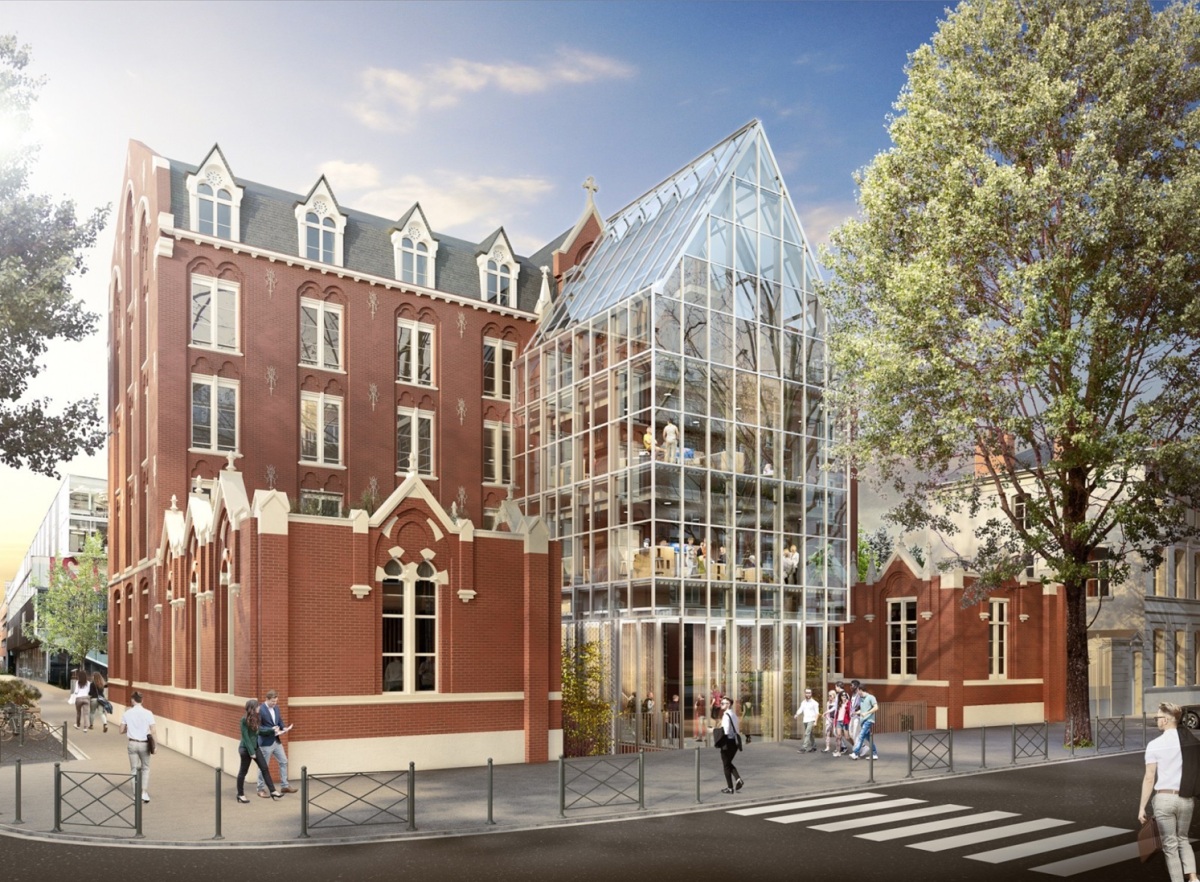
Interrupted for two years after a fire, work on the Maison Albert Le Grand has resumed. This historic building, the future headquarters of JUNIA, must be delivered at the end of 2026.
Publi-Information 


After a sudden interruption following the fire of May 2023, the construction of the Maison Albert Le Grand has resumed in the summer of 2025: this historic building, set to become the future headquarters of JUNIAmust be delivered in the fall of 2026. Beyond a simple real estate project, the operation is part of a broader transformation strategy carried out by the school by 2035, in the center of Vauban-Esquermes district, in Lille.
Attached to the Catholic University of Lille, JUNIA is a major engineering school generalist, historically anchored in training for major transitions. Founded in 1885, it today operates on three campuses – Lille, Bordeaux and Châteauroux – for 4,500 students.
Maison Albert Le Grand: between heritage restoration and campus project
There decision to restart the workenacted in the spring of 2025, was not only an operational imperative, but an assumed choice: that of carrying out a structuring project, both for the users of the school and for the surrounding urban fabric. Since the takeover, the project has progressed at a sustained pace, with the backdrop of the desire to restore its place to a building anchored in local history.
Because the Albert the Great House goes far beyond its future function as headquarters: its restoration is part of a more global approach to promoting heritage and requalifying the district.
As Céline Ohnenstetter, real estate project manager at JUNIA, points out: “the Maison Albert Le Grand is the future headquarters of our establishment, but it is also a building which has been part of the history of the district for 150 years. Seeing him reborn is a source of pride for the whole school“.
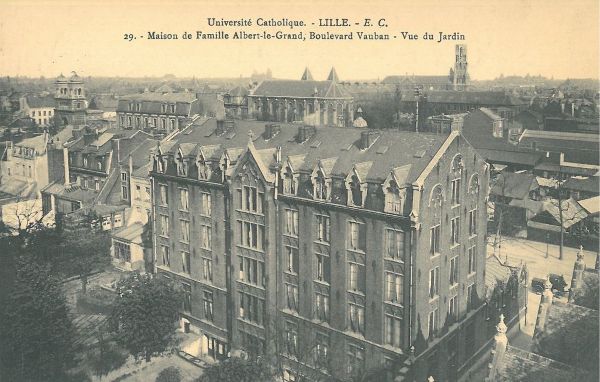
Built in 1881 by the architect Henri Meurillon, the Maison Albert Le Grand was the first building constructed in the “Catho” district, attached to the Catholic University of Lille. Listed in the architectural and landscape heritage inventory (IPAP) of the European Metropolis of Lille, the building occupies an important place for the school and town planning of the city. Here, the building around 1900. © Edmond Cailteux, via Cchaillou
A project in two stages
There resumption of work is structured around a two-phase program, where heritage requirements and environmental objectives are combined. The first sequence, carried out between July 2025 and March 2026, focused on the enclosed and covered areas, with a faithful restitution of the elements destroyed by the fire. There wooden frame was thus rebuilt identical to that of the 19th centuryjust like the slate roofingrespecting the original architectural provisions.
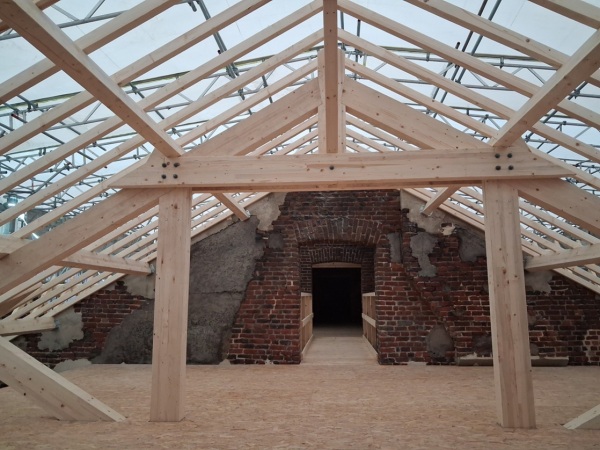
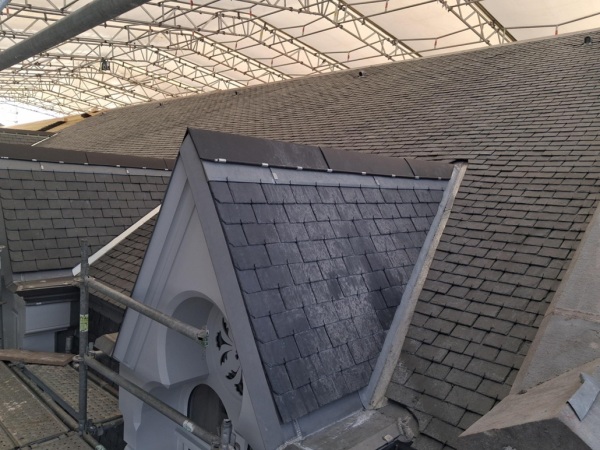
The first phase, carried out from July 2025 to the end of March 2026, consisted of redoing the enclosure and the roof, restoring the wooden frame destroyed by the flames in 2023, identical to those designed in the 19th century, as well as the slate roof in accordance with the original composition. © JUNIA
This project mobilized several local companies – Chevalier Nord for masonry and stone, Battais Charpente and Battais Couverture – illustrating a clear desire to rely on local know-how. As the scaffolding is removed, gradually allowing the volumes of the building to reappear, the heritage dimension of the project regains its full clarity.
The second phase, initiated in early 2026, concerns all interior fittings and exterior spaces, the project aiming to combine contemporary functionality and quality of use:
– joinery;
– Technical networks;
– Finishes;
– But also creation of pedestrian paths, landscaped areas and a pond.
Its transformation into a head office is accompanied by particular attention paid to environmental issues, such as the use of healthy materials, rainwater management, the installation of photovoltaic panels and connection to the urban heat network. The project also includes a logic of reuse of materials, while respecting regulatory constraints.
A key link in the reorganization of the campus
This operation is part of a broader program undertaken by JUNIA since 2018aiming to rethink the organization of its campus and to adapt its infrastructures to new uses of teaching and research. Several structuring projects have emerged – including the rehabilitation of the Palais Rameau –, and the Maison Albert Le Grand is today one of the last major projects..
Entered into the school heritage following a construction lease signed in 2020 with the Catholic University of Lillethe building is intended to bring together all of JUNIA’s administrative and strategic functions. Ultimately, it will house student services, operational departments and support functions, in a place that is both steeped in history and adapted to contemporary requirements.
Delivery, expected at the end of 2026, will thus complete a cycle started several years earlier – and mark, beyond the construction site itself, an additional stage in the recomposition of a campus in full transformation.