
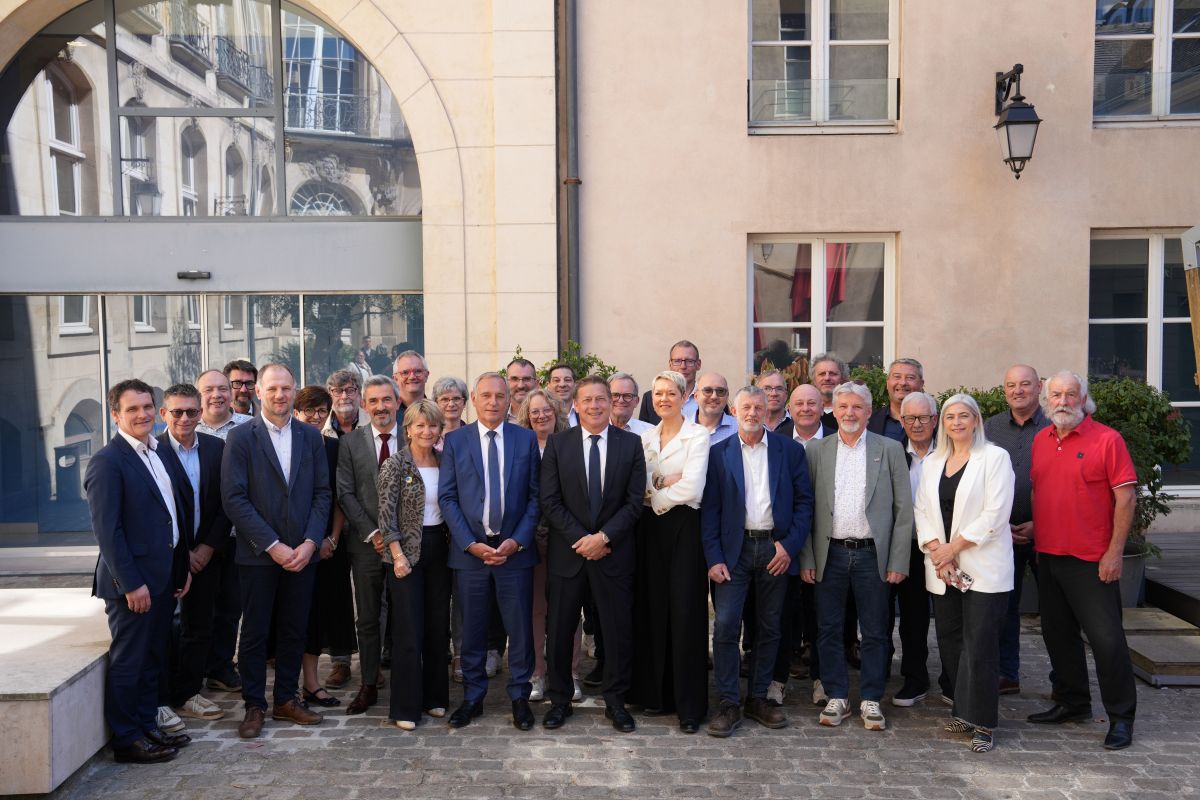
Re-elected as head of CAPEB, Jean-Christophe Repon begins a third term in a context of a lasting crisis in the construction industry and calls for urgent measures for VSEs.

This April 23, 2026, unsurprisingly, the board of directors of the Confederation of Crafts and Small Building Companies (CAPEB) has renewed his confidence in Jean-Christophe Repon. This re-election for a third consecutive term is part of a pivotal period for the craft construction companiesfaced with a lasting crisis weakening their economic model.
After two mandates marked by increased recognition of the role of very small businesses (VSE) in the public debate, the challenge is now to obtain concrete progress. An ambition displayed in a context where economic signals remain oriented downwards.
A re-election in a climate of structural crisis
A sector in continuous decline
There economic situation of the artisanal construction sector shows no signs of recovery in the short term. “We were already in recession (…) and after the conflict in the Middle East the dynamic of activity is very negative“, said Jean-Christophe Repon this Thursday during a press conference. There war in the Middle East caused a surge in the cost of fuel and construction professionals are starting to see the prices of materials increase too, up to 35% for certain products.
According to the first figures from CAPEB, theactivity of building craftsmen is down 1.5% in the first quarter of 2026, including -1.5% in energy renovation and -2.5% in new construction. This contraction is explained in particular by the persistent rise in the prices of energy and raw materials, which increases production, transport and logistics costs. The consequences are direct: cash flow under pressure, eroded margins and employment in sharp decline, with 30,000 job losses recorded in two years.
In this context, the CAPEB warns of a risk of lasting stagnation and calls for an immediate safeguard plan in order to support activity and preserve the local economic fabric.
First responses deemed insufficient
Although certain measures have recently been taken by the public authorities, they remain, in the eyes of the organization, below the real needs of the sector. Among the advances obtained:
– the establishment of a compensatory measure on the GNR for VSEs in the building sector;
– The creation of a price observatory within the framework of the interministerial crisis committee;
– The opening of a consultation on supplier notice periods;
– Examination of easier recourse to partial activity.
So many positive signals, but not enough to reverse the trend in a context of continued deterioration.
VAT at 5.5%: a central demand to revive activity
A major economic lever
At heart of CAPEB’s advocacy figure the generalization of the VAT rate to 5.5% on all renovation work. Carried out as part of the 2027 finance bill, this measure is presented as structuring for the future of the sector. According to the organization, it would generate 2.4 billion euros in additional turnover, create between 10,000 and 11,000 jobs and directly support household demand.
An investment for the transition and the economy
Beyond its economic impact, this provision is considered as a strategic lever to support the energy transition of the real estate stock. There CAPEB insists on the need for public support for renovationcomparable to that granted to new construction, given the scale of needs.
A third mandate oriented towards action and recognition of VSEs
For this new mandate, Jean-Christophe Repon intends to concentrate its action on three axes: transforming listening into concrete decisions, fully recognizing the economic and territorial role of VSEs, and defending a local business model.
THE craft businesses alone represent 96% of the sectorensuring local employment, the transmission of know-how and the vitality of territories. A weight that CAPEB considers still insufficiently taken into account in public policies.

Jean-Christophe Repon, here in the photo, reaffirms his commitment: “it is with great determination and pride that I continue my commitment alongside building artisans. VSEs in the building sector are the backbone of our economy. I am convinced that the business model that CAPEB defends makes a lot of sense and is necessary for the balance of our society. I will work throughout my mandate to give the 526,000 artisanal building companies a horizon clear, fair and lasting. This will inevitably involve better consideration of their voices, which will constitute a key focus of my presidency.” © CAPEB
In a regulatory environment still considered far from realities on the ground, he pleads for the establishment of a real “TPE reflex” in each public decision.
A CAPEB mobilized at the dawn of its 80th anniversary
Faced with economic and structural challenges, the CAPEB affirms its determination to defend the interests of artisanal businessesparticularly in the face of distortions of competition and developments in the sector.
The year 2026, a symbolic year, will mark the 80th anniversary of the organization. A deadline that CAPEB intends to take advantage of in order to strengthen its influence and recall its historic role of representing building craftsmen.

For Jean-Christophe Repon, “small craft construction companies can no longer be forgotten by public policies. They represent the vast majority of the sector and ensure its daily vitality. Our responsibility is to have their specificities recognized and to obtain appropriate decisions. The reality is simple: without structural change, the sector sinks into a lasting crisis. Today, only CAPEB fully defends the interests of small construction companies, consistently and without ambiguity.” © CAPEB