
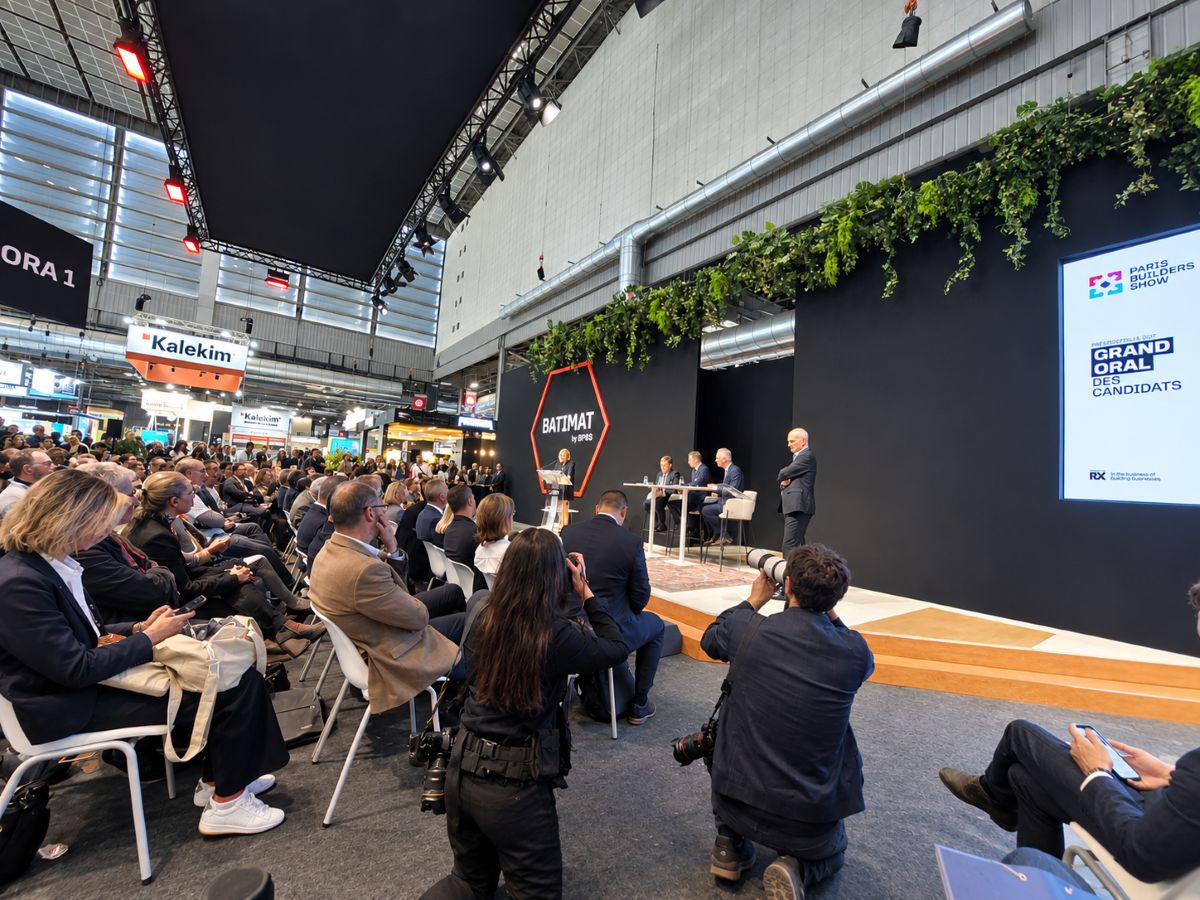
In Batimat, Marine Le Pen, Gabriel Attal and Jean-Luc Mélenchon detailed their proposals for the building. Housing, renovation, standards, employment and training were at the heart of the discussions.
Publi-Information 


There presidential campaign was invited to the heart of Batimat. Monday September 28, Marine Le Pen, Gabriel Attal and Jean-Luc Mélenchon took turns at the Paris Builders Show for a Grand Oral dedicated to housing, construction and renovation. In front of them, in addition to a large audience, the representatives of the FFB, CAPEB and Uniclima asked the questions that concern businesses today: standards, visibility, financing, recruitment, energy renovation and relaunch of construction.
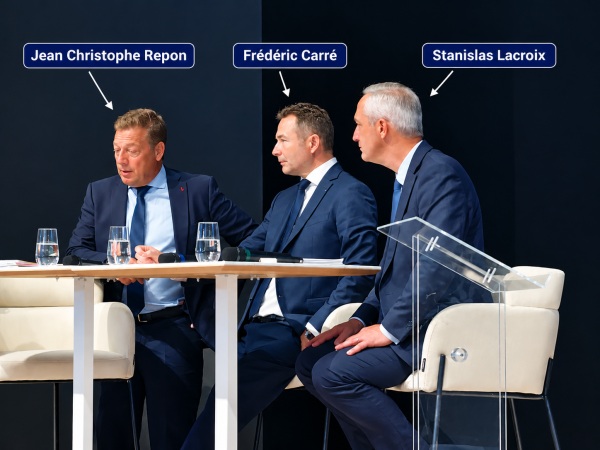
From left to right: Jean-Christophe Repon, Frédéric Carré and Stanislas Lacroix, three leaders representing major organizations in the construction sector: CAPEB, FFB and Uniclima, the thermal, aeraulic and refrigeration industries union. © Laure Pophillat
An exercise without contradictory debate, but which will have made it possible to measure the differences in approach of the three candidates to a sector which above all requires visibility and sufficient activity to invest, hire and build.
Marine Le Pen wants “free the act of building“
First to speak, Marine Le Pen placed her intervention under the sign of simplification. There candidate of the National Rally insisted on the need tofree the act of building” and to loosen the regulatory grip which, according to her, weighs on professionals. She spoke in particular of her family experience and her contact with artisans through the renovation of his father’s fisherman’s house in La Trinité-sur-Mer. She paid tribute to these “professions of passion, know-how and precision“, before summarizing their role with a particularly strong formula: “your job is to give your contemporaries their place to live. Just that“.
His ambition lies in another formula: I “want the era of builders to open among us“. To achieve this, it structures its program around three axes:
– “see far“, to anticipate and prepare;
– “Act close“, with the objective of engaging”a powerful and robust recovery of the sector” ;
– And “alleviate” the standards and restrictions which, according to her, slow down construction.
Land and town planning rules thus constitute one of the main axes of its program. Marine Le Pen intends in particular to abolish the ZAN, review the SRU law and alleviate various regulatory constraints. Above all, she defends greater territorial autonomy: “needs are decided on the territory, and not in Paris“. An approach which meets one of the concerns regularly expressed by professionals: how to produce more housing while land, regulatory and environmental constraints are increasing?
On the energy performance diagnosis, the tone is just as direct: “the DPE is absurd“. The candidate also proposes an in-depth review of the system of aid for energy renovation. Its system “100% Renovation” must replace the logic of subsidies with that of loans, with a mechanism backed by housing. She thus intends to break with the MaPrimeRénov’ model, the complexity of which she criticizes – in particular -.
But his intervention was not limited to housing. Marine Le Pen also insisted on manual labor, the upgrading of professions and the reindustrialization of the country. And in this area, she believes that the chambers of trades and crafts are best placed to support businesses and professionals alike.
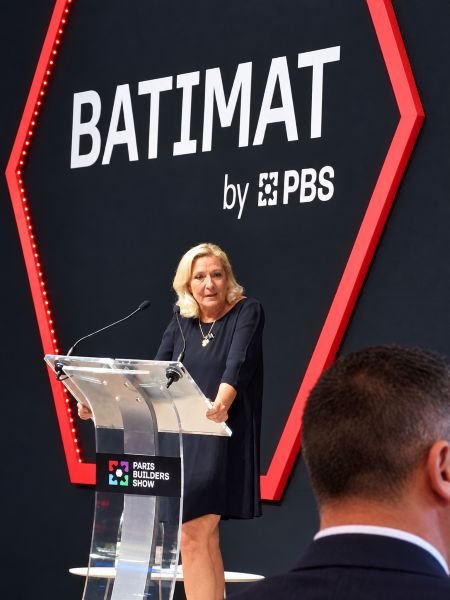
“I want to liberate the act of building,” says Marine le Pen, here in the photo, with the stated objective of relaunching construction that is currently at a standstill. © Laure Pophillat
Gabriel Attal: “I came to speak to you with my guts“
Gabriel Attal took another approachmore focused on the measures he claims to have wanted to take when he was Prime Minister. “I came to speak to you with my guts“, he says straight away. His diagnosis is severe, but he refuses to make it inevitable: “I am convinced that political choices can reverse a bad position“. The former Prime Minister spoke at length about the work undertaken with Guillaume Kasbarian, whom he had appointed to Housing: “I had appointed a minister who broke the codes, Guillaume Kasbarian“. In the process, he then rolled out the list of measures undertaken under his government but interrupted by the dissolution of the National Assembly, the common thread of which was to facilitate construction as well as to restore movement in a blocked housing market.
Its program is based on three priorities:
– the first is that of a “supply and demand shock“intended to simultaneously revive construction and the housing market;
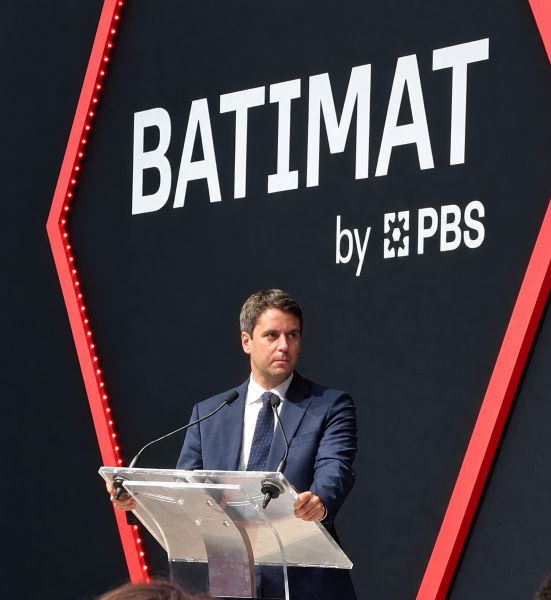
Gabriel Attal, pictured here, defends in particular a simplification of the ZAN and measures intended to facilitate construction. It also proposes to integrate intermediate housing into the social housing quotas imposed on municipalities. © Laure Pophillat
– The second priority concerns energy renovation, “a top priority“ – but rather than multiplying rule changes, he defends a policy”sustainable and long-term“, with a programming law intended to give households and businesses visibility over five years.
– Third priority, skills – Gabriel Attal wants to put in place “a pact on skills” in particular to better train young people for construction trades.
The candidate also points out the cost of the work: “the building suffers from too high labor costs“, defending in this context the “right to gross“, that is to say an approach aimed at allowing employees to directly benefit from certain reductions in deductions in the form of remuneration.
Finally, he announced an investment plan in geothermal energy.the scale of what has been done on nuclear power” in order to develop heating and cooling of housing and public facilities.
Despite the scale of the crisis, he wants to believe in a turnaround: this “very difficult situation has an impact on everything but we have the capacity to get through it“.
Mélenchon: “If I am elected, you will have someone who knows something, already“
For Jean-Luc Mélenchon, the passage to the Grand Oral is part of a sequence devoted for several days to housing, construction and professional training. On Friday September 25, three days before his intervention in Batimat, the candidate of La France insoumise went to the CFA BTP in Noisy-le-Grand, in Seine-Saint-Denis. Roofer jacket on his back, he met apprentices, teachers and representatives of the sector. “I return to my old passions“, he said, in reference to his time in Lionel Jospin’s government as Minister for Vocational Education between 2000 and 2002, which he also recalled during the Grand Oral. This visit was not only symbolic. It allowed him to bring the issues of training, qualification and recruitment to the forefront, before developing them in front of the professionals at the Paris Builders Show.
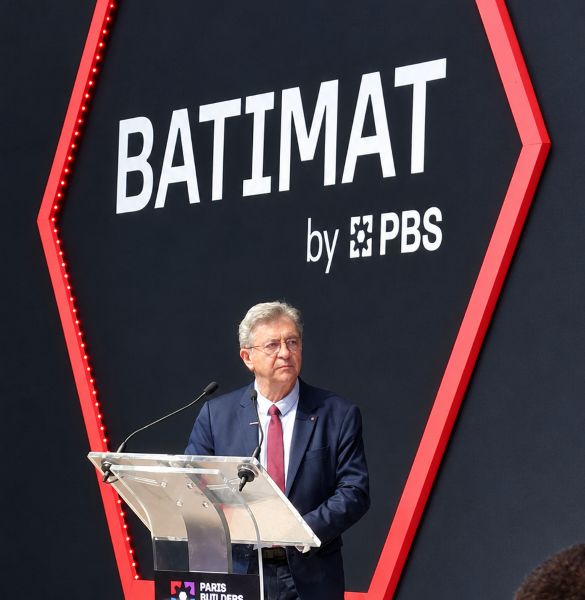
Jean-Luc Mélenchon, here in the photo, arrived with a document under his arm: his “BTP/Housing productive investment plan”. His first message is aimed directly at professional organizations. “I know the construction industry and your organizations because I was minister of vocational education.” © Laure Pophillat
His diagnosis is based on a criticism of the current functioning of the housing market: there is “had the idea that housing was a market and only that“For LFI, the answer involves a massive return on public investment and production planning: “as a government, we want 400,000 homes, 700,000 rehabilitations, 300,000 jobs“Faced with the question of financing, Jean-Luc Mélenchon informs us that there is “mountains, silver icebergs“.
However, he insists on the method: “I don’t make promises, I want to enter into contracts with professional organizations“. The objective is therefore to establish more contracts with representatives of the sector as well as to give visibility to companies on the volumes of work to come.
Jean-Luc Mélenchon also addressed the subject of PMCB REPcalling it “this thing“, Who “will be completely recast“. The subject of waste and the cost of its collection remains particularly sensitive for craftsmen and businesses, faced since the establishment of the sector with operational and networking difficulties. This is why Jean-Luc Mélenchon insists on “collection points“, one of the axes of its program with the planning and creation of a new state tool, in order to allow companies to access a true circular economy circuit and “no longer experience it as an abuse of power“.
On apprenticeship, the candidate does not question the principle, but wants to fight against training that he considers to be insufficiently qualifying. “I have nothing against learning, I have everything against scams“, he says. For him, “good training is the one that guarantees that by working, we will go from one stage to another“.
Three visions of the building, the same question: how to revive activity?
Behind the differences in method, the three interventions revealed the same urgency: get construction and renovation back in motion. However, beyond the programs, the building representatives asked the same crucial question to the three candidates: how to give work to companies that are currently weakened? Because behind the debates on ZAN, DPE, MaPrimeRénov’, REP, labor costs or housing finance, reality remains that recalled at the opening by the FFB and the CAPEB : a sector which is experiencing another year of decline, businesses disappearing and jobs threatened.
THE Grand Oral of Batimat will at least have had the merit of place the building at the heart of the presidential campaign.