
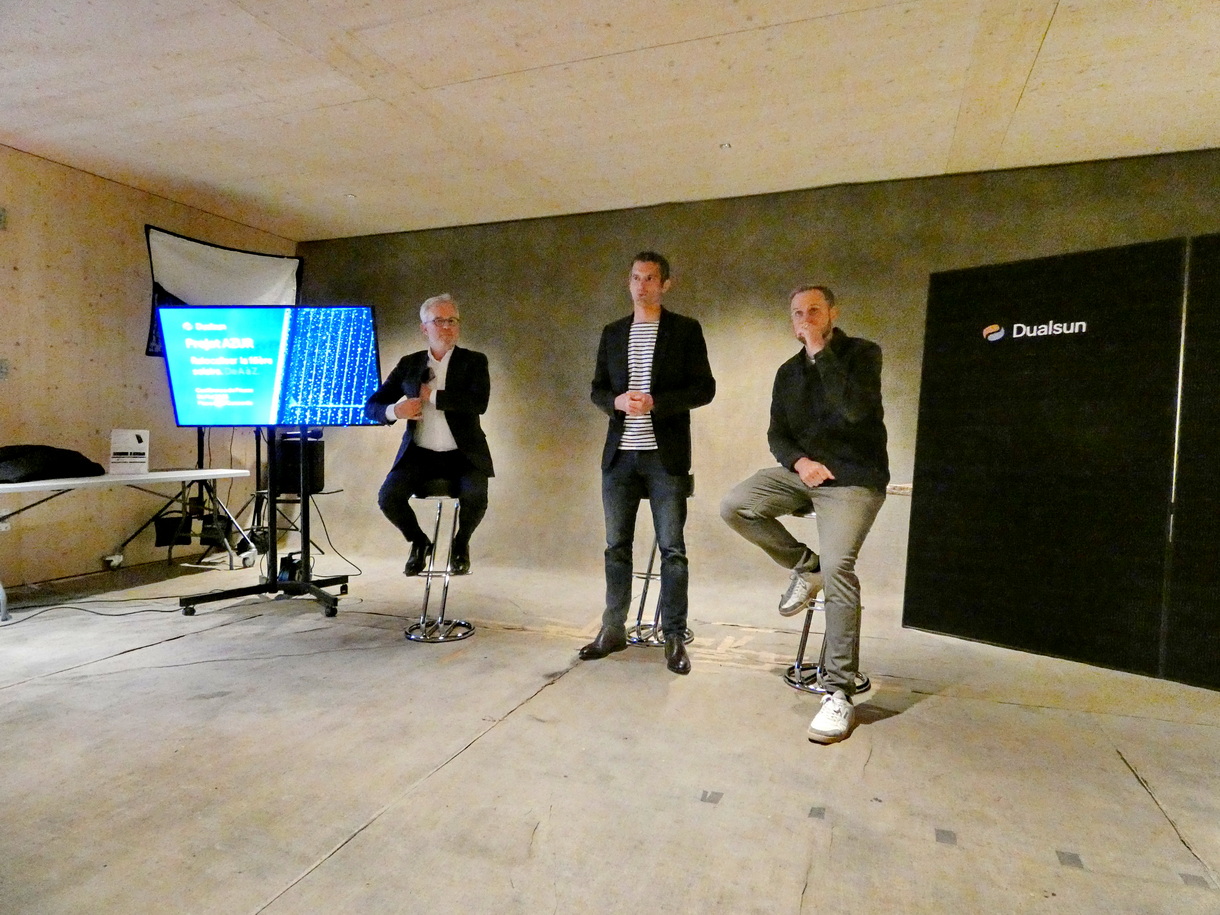
Dualsun manufactures a new range of photovoltaic panels in Europe, and it is the Sonnenkraft factory (Austria) which will produce 100 MW of photovoltaic panels per year, including 100 MW reserved for Dualsun for the moment.
Publi-Information 


THE French Dualsun is the leader residential solar in France with 20% market share. It is also theinventor of the SPRING hybrid panel assembled in Jujurieux in Allier: photovoltaic on the top, thermal on the underside. Dualsun, which has a factory and two training centers in France, as well as 300 installers who implement its solutions, also distributes the Flash photovoltaic panel sourced in China.
For several years, Dualsun had been looking for a way to supply itself in Europe. The company has just announced an association with the Austrian Sonnenkraft and is launching the production of its new AZUR photovoltaic panel in the Sonnenkkraft factory in Wies.

Dualsun was founded in 2010 by Laetitia Brottier and Jérôme Mouterde. The head office is located in Marseille. © Dualsun
500 MW of annual production capacity
The expansion of the production capacity of the Wies site in Austria was co-financed by the European Union. The now highly automated line has an annual production capacity of 500 MW, of which 100 MW is reserved for AZUR panel from Sonnenkraft.
For achieve a competitive price in photovoltaicsit is in fact necessary to have a relatively large production capacity that Dualsun and Sonnenkraft were not able to sell each one separately. Pooling production capacity – two brands, but a single factory – makes it possible to overcome this obstacle. There supply chain photovoltaics, however, remains global. In the case of new AZUR panelthe silicon wafer is produced in Germany, the photovoltaic cells are then manufactured in China and Vietnam, before being assembled into a panel in Austria.
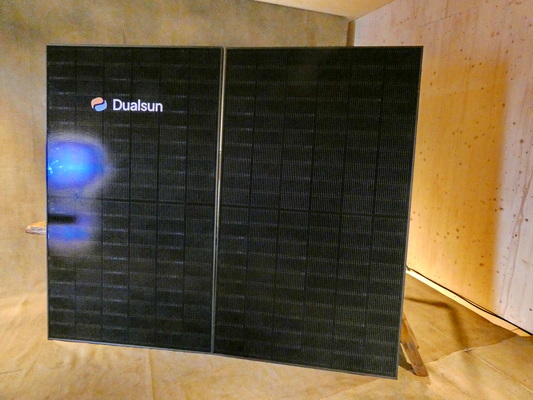
Dualsun’s new AZUR photovoltaic panels use TOPCon technology to maximize its efficiency and will be available at the end of May 2026. © PP
500 Wp of power
THE new AZUR photovoltaic panel displays a nominal power of 500 Wp and a guaranteed minimum efficiency of 22.38%. It is made up of 120 cells of TOPCon or Tunnel Oxide Passivated Contact technology which maximizes the efficiency of converting light into electricity.
Intended for roofs, an AZUR panel offers dimensions of 1935 mm in length, 1143 mm in width and 35 mm in thickness, for a weight of 24.9 kg. It operates between temperatures of -40°C to +85°C. Its carbon footprint of 504.9 kg CO2eq/kWp – currently being certified by the Certisolis laboratory – will give it access to VAT at 5.5% for residential installations up to 9 kWp.
Dualsun offers a 25-year product warrantyincreased by 5 years upon activation of guarantees to encourage customers and installers to register their installations with Dualsun. The return is guaranteed for 30 years, with 99% of the nominal return at the end of the first year and 87.4% at the end of the thirtieth year.
Finally, the hail resistance of the AZUR panel is classified RG4 – i.e. resistance to the impact of hailstones of 4 cm in diameter – thanks to its 3.2 mm thick glass. Hail resistance classes range from RG1 to RG5 for hailstones of 5 mm in diameter.
THE AZUR panels will be available at the end of May 2026.
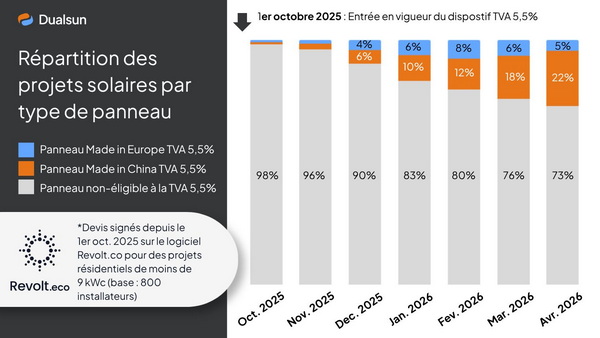
The 5.5% VAT mainly benefits eligible panels manufactured in China. © Dualsun
VAT at 5.5%, it worked
At the same time, Dualsun studied the effects of the 5.5% VAT applicable since September 2025by analyzing the results of quotes actually taken using the Revolt.eco tool, used by 800 installers. The VAT-inclusive quotes for the end consumer are approximately equivalent when using a European panel benefiting from 5.5% VAT or a Chinese panel, whose price excluding VAT is lower, but whose installation is subject to 20% VAT.
According to Laetitia Brottier, projects eligible for 5.5% VAT represent 31% of quotes signed in April 2026, or 1 in 3 after a few months of the reduced VAT launch. According to the Certisolis laboratory, five panels are currently eligible: four from the French Voltec and one from the Chinese Jinko. There certification of the Dualsun AZUR panel is in progress.
But, looking more closely, underlines Laetitia Brottier, in February 2026, 40% of TVA 5.5% projects used laminated modules in France. In April 20026, on the other hand, they were only 16%, or only 5% of the total due to the increasing volume represented by Jinko modules. And, she continues, if we extrapolate this trend over the year, this gives – starting from 117,000 residential projects planned in 2026 and for an average installation cost of €11,500 to €12,500 – a tax advantage of €43 million for Chinese panels and only €9 million for laminated panels in Europe. In short, without modification, this aid will mainly benefit Chinese panels. Dualsun therefore requests that the criteria for this aid be supplemented by the requirement for European production, in accordance with the Net Zero Industry Act (NZIA) of 2024, reinforced by the Industrial Accelerator Act (IAA) of March 2026.