
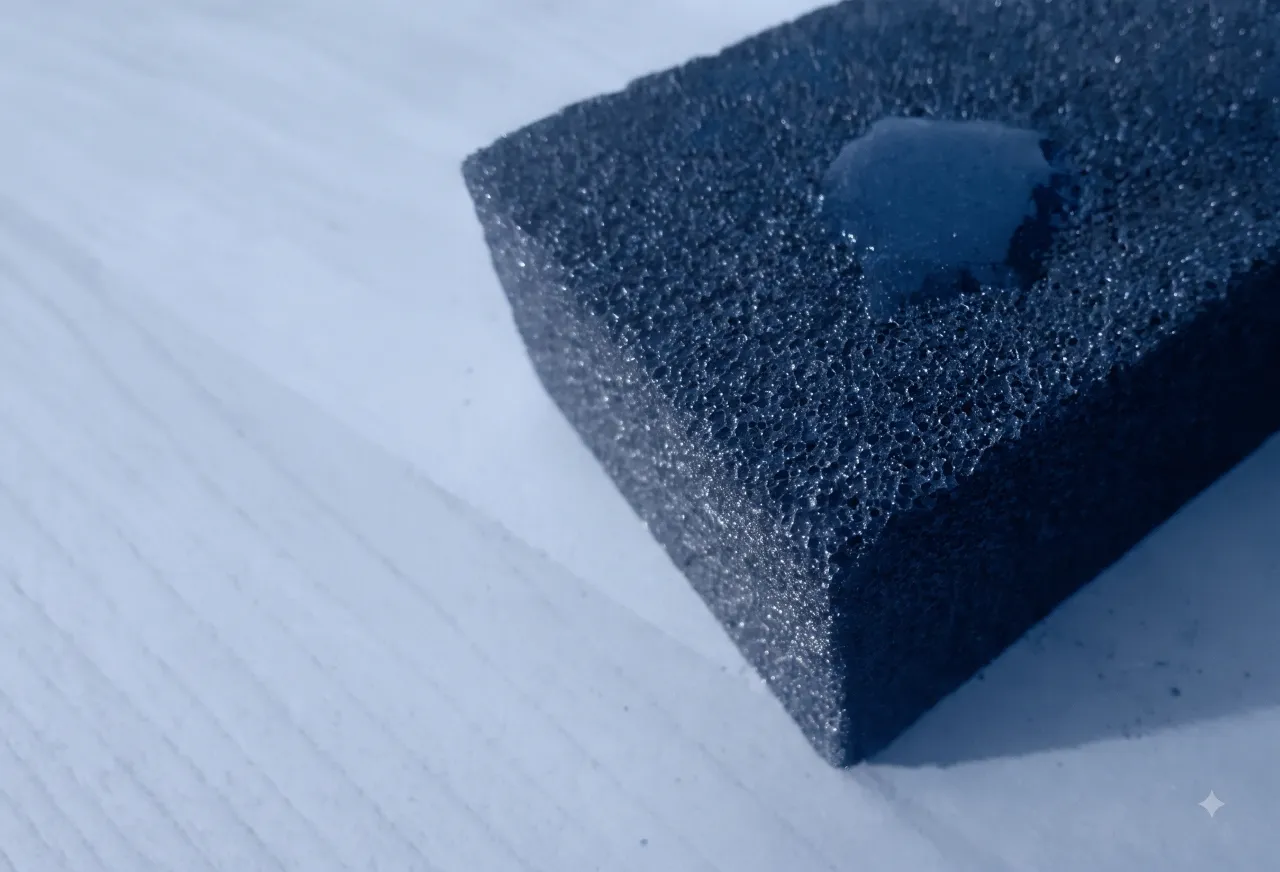
The panel production process
The production process starts from the formation of the basic mixture, made up of a few elements, partly natural, such as silica derived from quartz sand and coal dust, and partly from recycled finished products, including for example, car windshields and television screens purged of other components other than glass. The proportions for the production of insulating panels generally respect 1/3 natural silica, together with sodium carbonate, iron oxide and dolomite, and 2/3 recycled glass, with 0.5% natural carbon (coal dust or carbon black).
All the components, ground and reduced to a very fine powder, are placed in industrial ovens, where they melt at a temperature of approximately 1500°C. The molten glass is then rapidly cooled, ground into powder and uniformly mixed with carbon black, in controlled doses and distribution.
The resulting mixture is placed in special metal molds and placed in tunnel ovens where, through the action of heat at temperatures oscillating between 850°C and 1000°C, it returns to its molten state, but with an important variant: the carbon black, uniformly distributed, reacts to the heat by oxidising, expanding and generating billions of hermetic micro voids, where the gas produced remains trapped. Carbon, as an expanding agent, is therefore the extra element that determines the increase in the volume of the molten product, giving the glass plate that typical light consistency, where the airtight voids give the finished product its inherent insulating power.
The final phase is the most critical of the entire process: the still incandescent expanded glass is cooled gradually, to prevent internal tensions from developing which could weaken the structure as a whole, causing localized or generalized breakages. The cooling time, also known as the “annealing cycle”, is a slow and gradual process that can last up to a whole day. The slabs that come out of the tunnel oven, now cooled, are then cut into the required size with the help of wire saws and then packaged on pallets to be marketed.
The size of the bare (uncoated) slabs comes in two standard formats of 600×450 mm or 600×800 mm, depending on the factory of origin, and with various thicknesses which generally follow a progression of even measurements. A special case are the covered panels, which are formed by the assembly of bare sheets, hot glued together with a bituminous mixture, and covered on both sides with a glass veil, cut in the 600×1200 mm format.
Performance and technical characteristics
The cellular glass sheet is, to all intents and purposes, an insulating material that has particular and unique characteristics, which differentiate it from other insulating products on the market. It is made with different densities, between 100 and 200 kg/m³.
It is the only insulator that is impermeable to water, vapor and gas-tight, with an infinite resistance value to the passage of water vapor (µ value = ∞). It has high compressive strength values, from 500 to 1500 kPa, which make it a reliable product for insulating the foundations of a building, resisting evenly distributed loads more than the ground. Given its mineral consistency, it is resistant to insects and rodents; it is fireproof (Class A1 in the bare format and class E in the covered format); It has a compact consistency and reliable dimensional stability, with easy workability that allows precise cuts, even curved ones, and core drilling without lateral cracks.
The conductivity value does not undergo alterations over time, therefore, in the thermotechnical calculation, the lambda value must not be modified for the worse, transforming it into lambda design. It cannot be attacked by acids, apart from hydrofluoric acid which is the only one that also corrodes glass, just as it does not undergo alterations from the corrosive action of salts, with particular regard to sea salt, which makes it a reliable and long-lasting material even when immersed in sea water.
When is it best to use cellular glass?
With these characteristics, so where is it most convenient to apply it? Considering its cost, which is most often indicated as a limit, the convenience lies not so much in the insulating material itself – given that in normal conditions it boasts many more economically advantageous competitors – but in the use that can be made as a system, as it simplifies many more complex applications, where the elements of risk are predominant by applying other materials.
Its use, in the various possible functions, can take place either by using dry sheets or by gluing them together. In the first case, by simply placing the sheets together, a thermal insulating surface can be obtained, but not impervious to steam, water and gases, a condition which can only be achieved by gluing the individual panels together to form a homogeneous surface.
To obtain the latter result you have two possibilities: use bitumen spread hot, or prepare a mixture of bitumen and Portland cement mixed and cohesive together, so much so as to constitute a sort of adhesive mortar, but with the characteristic of being waterproof. With hot spread bitumen, the slabs are joined together both at the joints and on the surface, but only in horizontal installation. Otherwise, with the application of cold-stabilised bitumen mortar, insulated and waterproof surfaces, even vertical ones, can be created for multiple applications.