
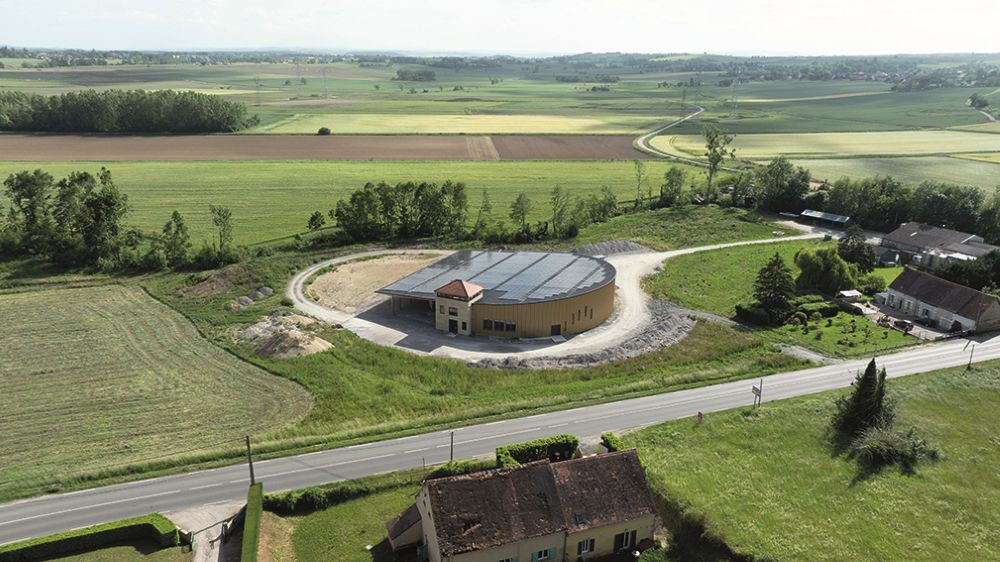
In Allier, the new winery at Domaine Nebout combines BIM design, biosourced materials and a circular wood-straw facade. An exemplary biosourced construction project.

In Saint-Pourçain-sur-Sioule (Allier), a 1,800 m building2 is becoming a reference for players in biosourced construction. Delivered in November 2025 for Domaine Neboutthis new wine cellar combines wooden structure, straw insulation, massive stone and collaborative digital design around a clear objective: reduce the carbon footprint without sacrificing technical performance or economic control of the project.
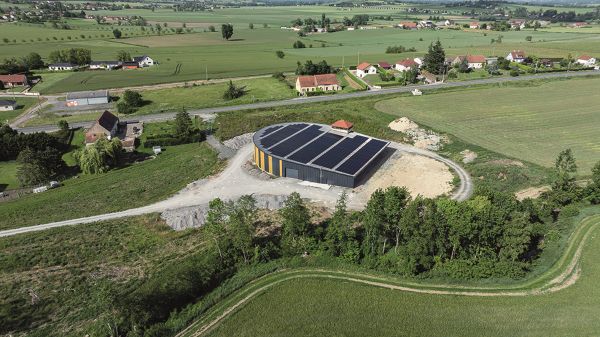
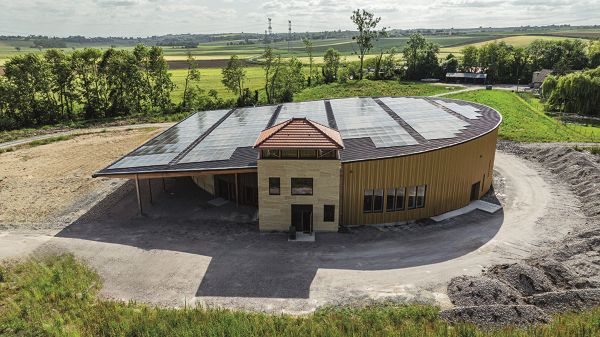
Designed by Charles Coulanjon, founder of the Alice Architecture agency, the building hosts the production and sales activities of the estate’s organic wines, but also a local products store and a multipurpose room that can accommodate up to 150 people. © Spurgin-ActivHome
Behind his architecture inspired by the silhouette of a wine glass above all hides a life-size demonstration of the possibilities offered by the large-scale wood-straw construction.
When BIM becomes a collective construction tool
The project was born from an investment of €1.8 million carried by the owners of Domaine Nebout with the accompaniment of theMassif Central Wine Territory Association (TVMC). From the first sketches, the choice was made to rely on a collaborative approach bringing together the project owner, architect, design offices and companies around a common digital model. For Charles Coulanjon, this approach profoundly changed the trajectory of the project. “Pooling skills from the start brings enormous added value in optimizing costs. Originally, the project was limited to a rectangular cladding building. Today, with an equivalent budget, we were able to meet all of the customer’s needs.” he explains.
The architect recognizes that several technical subjects animated the discussions during the design phase, in particular the management of structural reinforcements in the highest areas of the building or the creation of curved facades from prefabricated elements. “Collaborative co-engineering made it possible to find reassuring solutions for each stakeholder and guarantee controlled costs.” he specifies, an approach having notably made it possible to realize a largely biosourced envelope while maintaining an economic logic compatible with the constraints of an agricultural and event building.
A wood-straw envelope designed for summer comfort
From the beginning, Charles Coulanjon wanted to limit the use of concrete as much as possible.
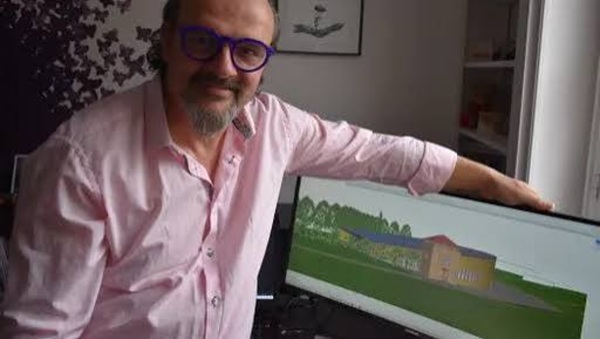
From the design stage, Charles Coulanjon, pictured here, sought to reduce the building’s carbon footprint as much as possible by favoring biosourced materials and confining concrete to its essential functions. © Julien Pepinot
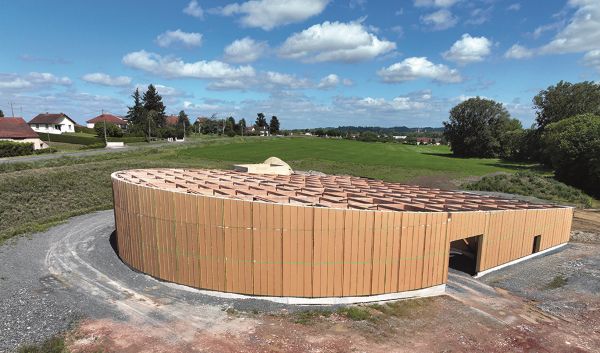
The concrete is thus confined to the foundations and paving, while most of theenvelope rests on wooden frame walls filled with straw bales. In total, the project mobilizes 871 m2 of Activ’Home wood-straw walls arranged on a circular facade 44 meters in diameter. For the owners of the estate, this choice is part of an overall logic of environmental coherence, as they explain: “nWe wanted a warm, functional place that was consistent with our winemaking profession. When we imagined this new building, we wanted it to resemble our way of working the vineyard: something sustainable, living and anchored in our territory“.
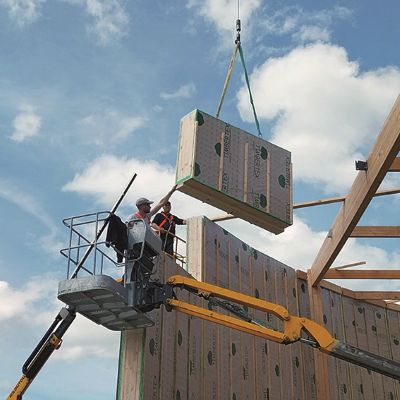
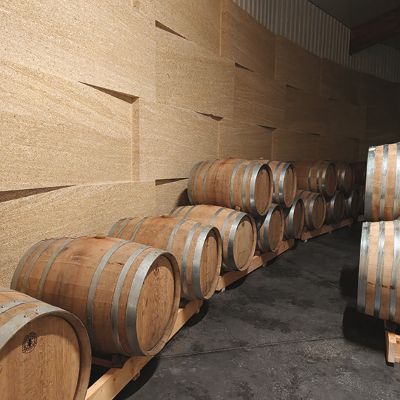
If the initial idea was to recycle the straw produced directly on the farm, logistical constraints ultimately led to favoring supplies from Limagne, in the immediate vicinity of the site. A solution which nevertheless makes it possible to maintain a short circuit logic. © Spurgin-ActivHome
For thearchitect Charles Coulanjonthe interest of this approach is not limited to reducing the carbon footprint. L’combination of wood and straw contributes to creating a particularly efficient envelope, capable of lastingly limiting energy consumption while guaranteeing a high level of comfort. A wood wool insulation also completes the system in order to improve the acoustic performance of the building.
This constructive strategy also responds to a problem that has become recurring: summer comfort. Faced with the multiplication of heat episodes and the effects of climate change, biosourced materials appear to be an increasingly relevant response to ensure effective thermal regulation without massive recourse to cooling equipment.
A curved facade 44 meters in diameter made from wood-straw panels
One of the major challenges of the site concerned the construction of the circular facade which constitutes the architectural signature of the building. To make this geometry compatible with industrialized prefabrication, the designers developed specific layouts. The circle was broken down into a succession of facets 2.40 meters wide, corresponding to two standard 1.20 meter panels, one approach which made it possible to limit cutting and loss of material while simplifying manufacturing in the workshop.
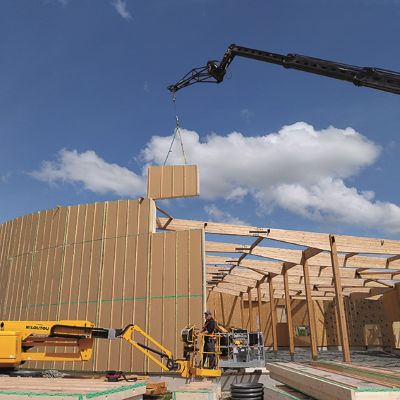
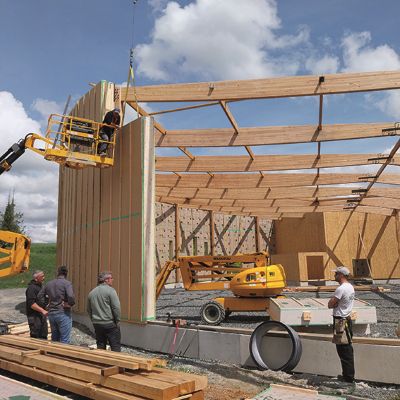
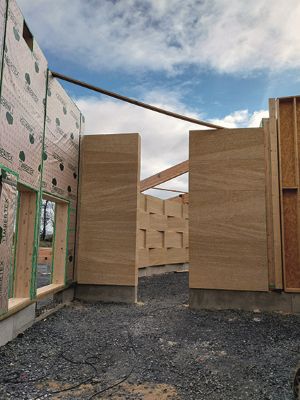
The variable height of the walls represented a second difficulty. Due to the roof slope, the facades reach between 7 and 8 meters high. In order to rationalize production, the lower part was standardized at 5.60 meters, i.e. the assembly of two 2.80 meter panels. In order to guarantee the stability of the whole in the face of wind forces and avoid any rotation phenomenon, a vertical element in glued laminated wood was integrated over the entire height of the facades in conjunction with the structural design office, a solution which ensures the mechanical continuity of the walls while accompanying the curvature of the building. © Spurgin-ActivHome
The constructive potential of wood-straw
Distributed by Activ’Home, now part of the Spurgin groupTHE wood-straw modules used on the project are based on the patented ECOSTRAUV® process. They simultaneously provide the structural and insulating functions of the building. Compliant with RE2020, these constructive elements display particularly high performances, with thermal resistances of up to R = 7.5 m2.K/W and a thermal phase shift of up to 17 hours, a parameter that has become strategic for summer comfort. Their low weight, around 100 kg/m2also facilitates their use on long-span wooden or metal structures.
For Charles Coulanjon, this operation demonstrates that these solutions can now move beyond the niche market with which they are still often associated. “This global construction process tends towards energy autonomy and is adaptable to any type of construction without exception, ranging from individual houses to industrial buildings.” he assures.
“We have just delivered this winery at around €1,000 per m2i.e. an additional cost of €200 per m2 compared to traditional concrete block and concrete construction, for unrivaled comfort. Straw wood is indeed a material of the future and I will do everything to be a player in its development” concludes the architect.
Spurgin-ActivHome