
Episodes of heatwaves are increasing: 9 out of 10 homes are not suitable for it, nor are public buildings. The government announces measures to remedy this: Green Fund, VAT and discussions with the ABF.

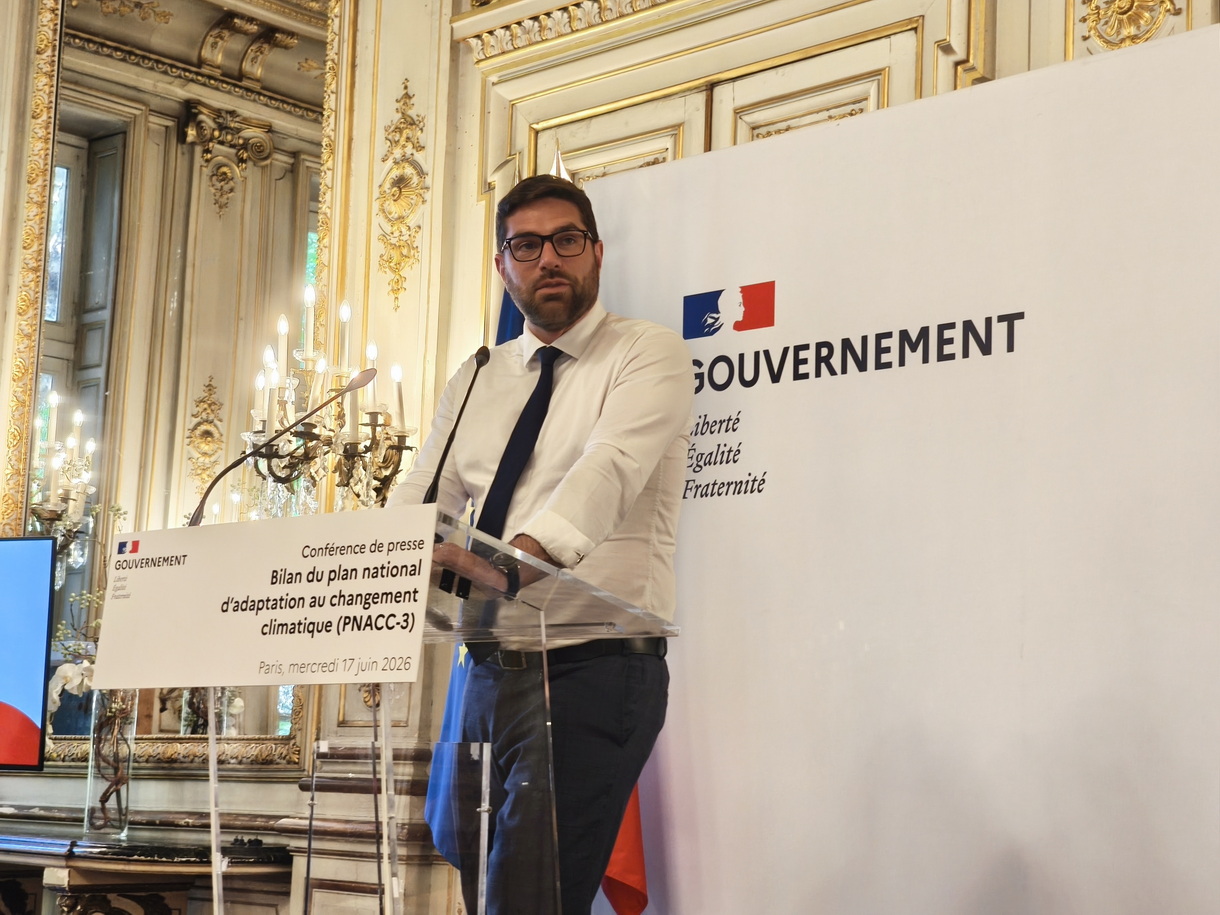
On June 17, under the abundant gilding of the Hôtel de Roquelaure, headquarters of the Ministry of Ecological Transition, Biodiversity and International Negotiations on Climate and Nature, the Minister Monique Barbut and her colleague Vincent JeanbrunMinister of Cities and Housing, presented both the first results of the application of the third National Plan for Adaptation to Climate Change (PNACC)launched in March 2025 and a short list of specific measures. Let’s start with the most juicy information.
Air conditioning returns to court
THE anti-climate speech held for years by the Public Authorities and ADEME is clearly changing. It is not, as pointed out, Monique Barbut and Vincent Jeanbrunto air-condition all buildings. But of air conditioning wisely : certain premises in schools, in EHPADs, … And, proof of this turnaround, Vincent Jeanbrun announces a reduction in the VAT rate on air/air heat pumps to 5.5%even if none are made in France. When will this rate be applicable? Very quickly. But still? Very quickly! Without further details. And will it be applicable to all air/air heat pumps in all circumstances? Only to the most efficient and as part of work in an existing building carried out by an RGE qualified company. How will the performance of the CAP be characterized? It’s too early to tell.
But the same reduction in VAT rates should take place on solar protection, on air mixers and on cold networks which the government wants to multiply by three by 2030.
In short, there is still a lot of information missing, and we do not know exactly when it will become available. Before getting to air conditioning, the two ministers emphasize, passive measures must be deployed:
– sun protection;
– Thermal insulation, rather from the outside;
– Ceiling ceiling fans;
– And nighttime overventilation.
In this case, will the Architects of Buildings of France (ABF) receive new instructions to no longer oppose ITE and exterior solar protection? Monique Barbut explained that a consultation had begun with the ABFs which report to the Ministry of Culture, but that it will take a long time. Vincent Jeanbrun, a little drier, predicts that the ABF doctrine will have to evolve, otherwise, instead of protecting heritage, they risk condemning it. The minister took the example of half-timbered houses for which external thermal insulation is the only solution to improve their DPE and make them accessible for rental again. Interior insulation reduces the living space so much that these accommodations lose the character of decent accommodation and can no longer be rented in any case. So, the ITE is the right technical response in this case, but certain PLUs and ABFs do not authorize it, at the risk of leaving these accommodations unoccupied. Which would guarantee their rapid deterioration. We need to evolve quickly.
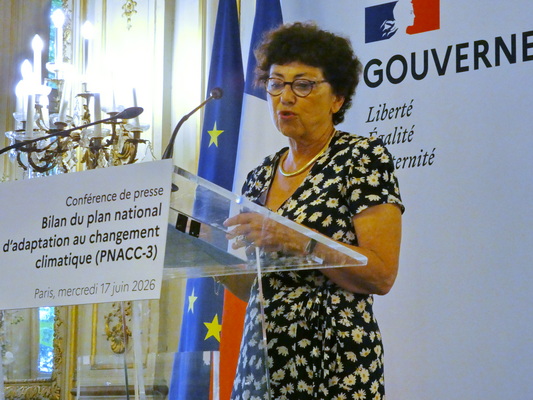
Monique Barbut, Minister of Ecological Transition, Biodiversity and International Negotiations on Climate and Nature, recalled that the Green Fund is allocated €870 million and that the State receives too few requests in this regard. © PP
Funding and training: the means are there
According to Vincent Jeanbrun, the financial means to support the adaptation of buildings exist, but are not well known enough. He recalled that the Green Fund, intended to accelerate the ecological transition in the territories, is allocated this year with €870 million, 50% of which is dedicated to adaptation to climate change. But, specifies Monique Barbut, the requests are not that numerous, while the Green Fund, as well as the Barnier Fund endowed with €300 million this year, can notably finance the adaptation of schools and public buildings, including solar protection and even cooling equipment. For housing, MaPrimeRénov’, as part of a large-scale renovation, finances the ITE, ventilation, cooling and management of technical installations. Not to mention that all France Rénov’ advisors and all “Mon Rénov’ Accompagnateur” will be trained in the fight against overheating.
In addition, slips Vincent Jeanbrun, theSummer Comfort indicator in RE2020, will be tightened from this year. Which means that he knows that this indicator exists and plays an important role in the RE2020 calculation method. A consultation should be launched this summer, for a decree before January 2027 and an application immediately. Finally, he concludes, studies show that 9 out of 10 homes in France have insufficient summer comfortthat moreone in three homes can be qualified as a climate kettle and that, in social housing, more than 6 million people live in housing without exterior solar protection. He therefore calls for acting quickly and changing software. According to him, all organizations, public and private, must now include climate change in the evaluation of their investments.
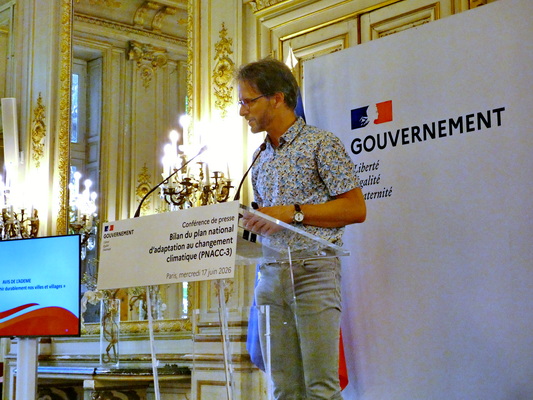
David Marchal, Executive Director of Expertise and Programs at ADEME, listed all of ADEME’s recent studies and publications on adaptation to climate change. © PP
52 measures in the third PNACC
Let’s not be afraid of new acronyms. The third PNACC (National Plan for Adaptation to Climate Change) now takes into account the TRACC (Reference Warming Trajectory for Adaptation to Climate Change), which was not the case for version two. The TRACC forecasts, on average in France and compared to the pre-industrial era, + 2°C in 2030, + 2.7°C in 2050 and + 4°C. David Marchal, the Executive Director of Expertise and Programs at ADEME, who spoke before the two ministers, explained that this was not the worst scenario, but the most probable. On June 18, “ADEME Opinion: Act to sustainably refresh our towns and villages” was published, which shows that the issue of overheating spills over from buildings and relates to the neighborhood or urban area.
The initial goal of the meeting called by the two ministers was the presentation of the first results of the 3rd PNACC. It includes 52 measures, including measures 5 – Protect populations from damage to buildings, linked to the shrinkage-swelling of clays (named RGA, new acronym), 9 – Adapt housing to the risks of high heat –, 10 – Deploy renewable cold technologies on a large scale – and 12 – Integrate the challenges of adapting to climate change in all renovations of the State’s building stock – directly concern the building.
It was not possible to discover what renewable cold technologies cover. But we continue to search.
These 52 measures are divided into 340 sub-actions, 80% of which have been launched since March 2025. In particular, since March 2026, the TRACC has been included in the environmental code and 14 regulatory texts have already been published this year. The main one concerns the reinforced obligation for employers to protect workers, particularly those in construction, in the event of high heat.