
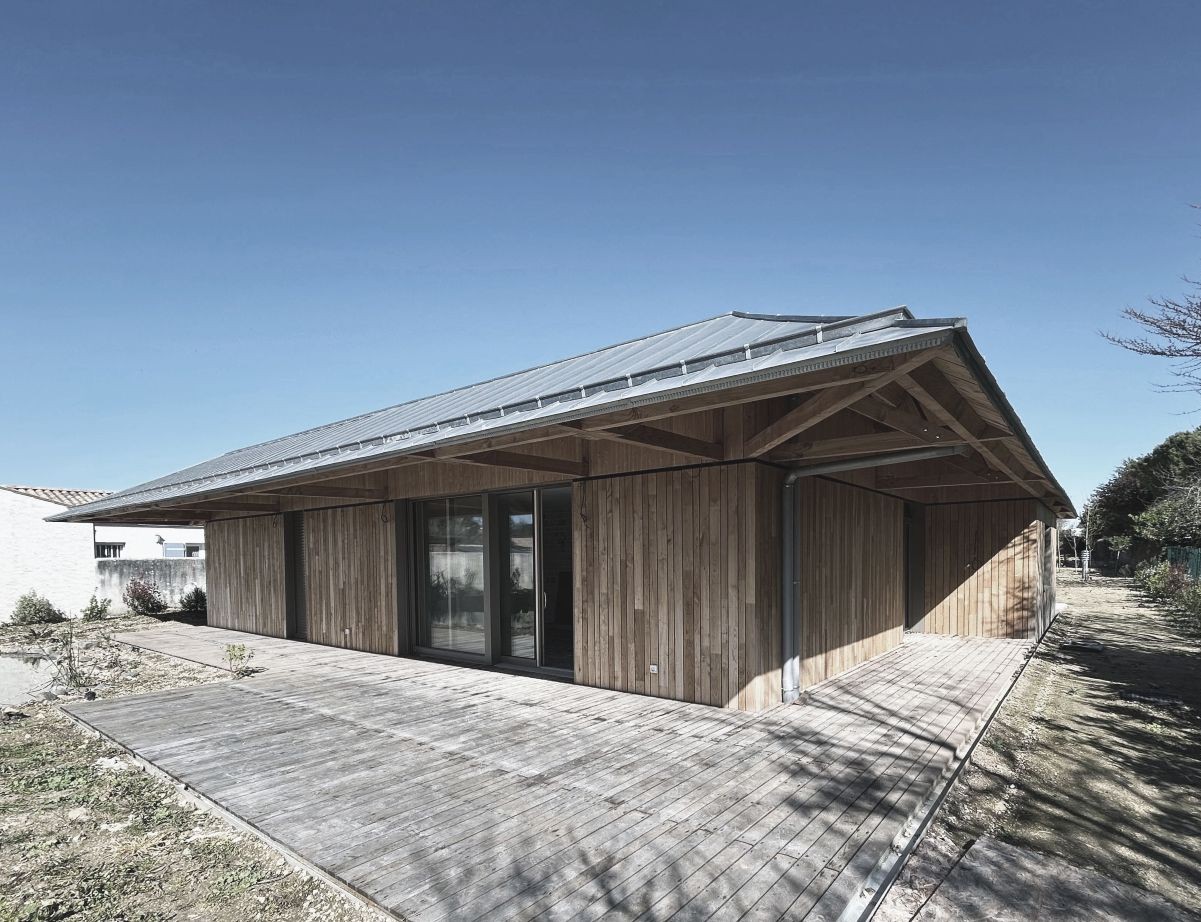
The timing is perfect: one week after the Passibat Festival in Pantin, which was affected by the historic heat wave of June 2026, the architectural agency delivered La maison Canicule in Aigrefeuille d’Aunis (17).

L’Karawitz agency certified PassivHaus as the first French house (Maison Bambou)a little after the heatwave of 2003, 20 years ago, and inaugurates what public opinion would benefit from discovering on the media sets instead of talking about air conditioning: the new architecture of climate change.
The passive house and everything else
Around Mischa Witzmann and Milena Karanesheva, the Karawitz agency remains particularly known and published internationally for its passive individual houses such as the Trilogis house in Fontainebleau, but develops a multifaceted activity not only in metropolitan construction, but also in Africa and the tropical zone, extends its creativity to new installations such as the Pan’Auditorium of the Forum International Bois Construction or the development of connections for the bamboo construction.
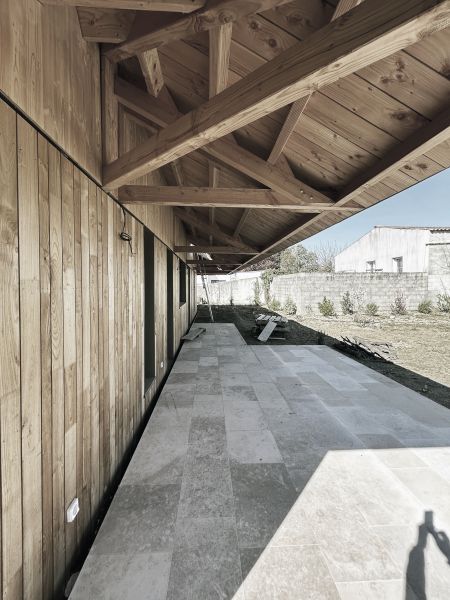
Terrace being installed. Delivery Friday June 26. We wish the project owners a nice cool summer. © Karawitz
Three decisive houses
In recent years, there have been at least three decisive works in the individual house. First, by Studio Lada, a house in the Vosges massif (Ban-sur-Meurthe, 2022) pushing the use of premises to its limits. Then, presented at the last Forum du Grand Palais, the minimalist house of Grands Moyens, 2023, in La Grande Paroisse (77). Now added the Karawitz Heatwave House, in Aigrefeuille d’Aunis in Charente-Maritime not far from La Rochelle, one of the epicenters of the June 2026 heatwave.
A project with a precise aim
Mischa Witzmann explains that “this project was designed with a clear objective: to guarantee a excellent summer comfort in the face of periods of high heat, while maintaining a very high level of energy performance“. The main measures implemented are:
– structure to wooden frame with straw insulation ;
– Passive sun protection thanks to a large cap offering almost 2 meters of overflow;
– Ventilated roof, whose photovoltaic panels also help limit solar gain;
– Double flow VMC associated with a Canadian well for the pretreatment of fresh air;
– Reversible heat pump for optimal comfort in all seasons.
The house is in the process of Passivhaus certification.
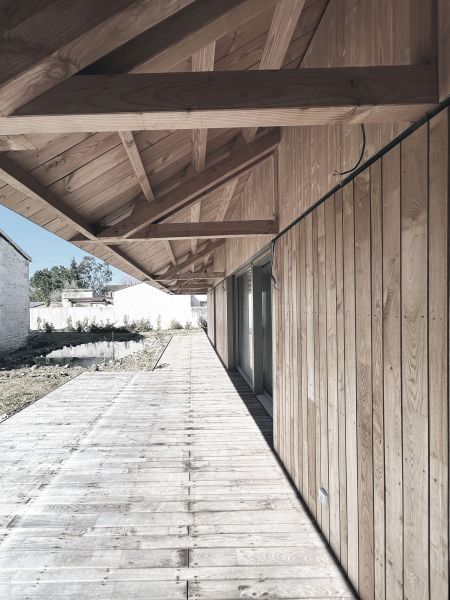
The Douglas (local, Limousin is not far away) goes well with the local chestnut cladding. © Karawitz
Twenty years of hindsight and twenty years of upheaval
With Karawitz, passive design evolved. Fifteen years ago, the agency delivered a renovation (La Rénopassive) which used, for over-insulation, vertical EPS walls, an option entirely accepted in PHPP calculations. Moreover, since then, the owner has checked and shared each year the validity of the passive approach deployed, noting that the indoor thermometer has never exceeded 26°C.
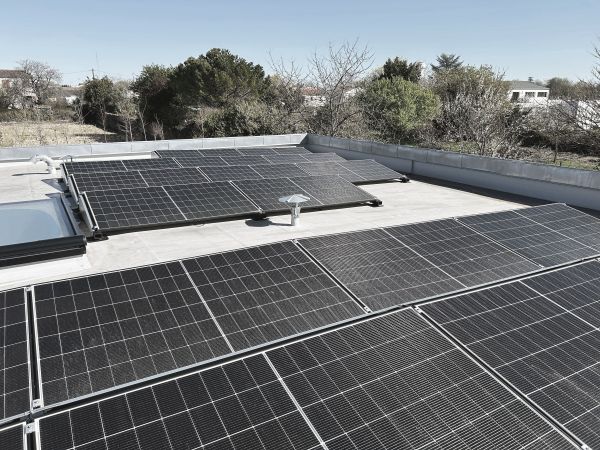
The roof is white and it becomes a real photovoltaic farm. © Karawitz
Twenty years later, the passive design remains closely linked to PHPP calculations which constitute the most reliable tool on the market. But priorities have changed towards summer comfort, carbon storage via use of biosourced materials such as strawand energy autonomy through photovoltaic panels.
The roof key work
A roof overhang of up to 2 m means that the roof has become the main structure and the sign of recognition of the house. The overhangs create wind resistance and require particular attention; it would also be possible to support them on exterior posts like Virginia verandas. But it also depends on the buildable surface area, and the architectural touch. With a large roof, large photovoltaic surface, great autonomy.
This is the Bois et Paille de Vausseroux scop (79), 88 m, who succeeded in designing this unusual Douglas framework, also took care of the local chestnut cladding, the triple-glazed joinery and thestraw insulation. It’s important! Within a radius of less than 100 km, regardless of major cities, there are fairly common builders capable of carrying out this type of work. You shouldn’t go looking for Mathis in Alsace or Pyrénées Charpente! The new biosourced manufacturers provide this group of services.
Triple-glazed windows are not everything
According to Milena Karanesheva, the heatwave liability, this is the PHPP calculationsupport from knowledgeable people and certification, but also dynamic thermal simulation, common sense and tact. The label launched in 1990 in Darmstadt in Germany relies on triple glazing because it corresponds to the German technological approach and offers a good ratio between lighting and performance in a German universe before climate collapse. Now, we no longer skimp on attenuation, use of local biosourced materialsshadow management.
To put an end to inertia
Nota bene : the question of inertia is resolved by the autonomy of the photovoltaic panels. Until now, it was still only a question of providing inertia in wooden construction, justifying concrete slabs or even the reduction of wood to just the envelope. Now, with the multiplication of heat domes, inertia becomes a trap and transforms constructions into ovens. The goal is not so much to absorb excess heat as to prevent it from entering the home.
The house is 130 m2 but as with Trilogis, Karawitz is a past master in enlarged surfaces, the terraces which extend the interior. Added to this is landscaping work in the garden, which goes in exactly the same direction of creating livable spaces in the hot season.
Open or close?
With this heat, isn’t tropical architecture preferable? We forget that apart from heat peaks, it is often quite cold in France. Milena Karanesheva explains: “there are also passive houses in the Tropics, particularly in Sri Lanka, which are effective and valued because of their ability to combat both humidity and insects“As for the bone of contention between double flow ventilation and natural ventilation, it is a somewhat vain but resurgent debate that Milena had to address as president of the ICEB before handing over to Emmanuelle Patte. She adds “I will not advance too much on the double flow VMC-natural ventilation debate. All our houses are designed to ensure natural cross ventilation. As president of the ICEB, I sought to ensure that this debate was conducted in a scientific and attentive manner, based on reliable tools and real results. Each project is unique and requires a tailored solution. The tools exist, the expertise exists, the techniques exist, you just have to seize them“.
In this spirit, the Karawitz Heatwave House does not present itself as definitive solution to the climate crisisbut as a response designed for time T of 2026 on the basis of architectural experience of more than twenty years. And what’s more, she’s pretty.
m / Jonas Tophoven / © Karawitz