
The engineering of the house today requires solutions capable of synthesizing structural rigor, thermodynamic efficiency and a precise visual identity. In the context of contemporary architecture, the dry ventilated façade presents itself as a very reliable construction system to guarantee the perimeter protection and hygrothermal comfort of buildings. The integration of large ceramic panels allows for the reduction of surface interruptions, enhancing the formal cleanliness of the volumes and at the same time guaranteeing unalterable mechanical performance.
Thermo-hygrometric principles and operation of the ventilation chamber
The ventilated wall technology bases its effectiveness on the creation of a physical separation between the load-bearing wall structure and the external ceramic curtain. Inside the cavity thus generated, appropriately sized according to the height of the building and its geographical exposure, a continuous air circulation develops triggered by the thermal gradient between the base and the top of the building.
During the summer period, the shielding offered by the sheets intercepts solar radiation before it reaches the masonry, activating an upward motion which constantly expels the overheated air upwards and avoids phenomena of heat accumulation by radiation. In the winter period, the same air chamber protects the insulating package from the beating action of atmospheric precipitation and promotes its constant drying, eliminating the risk of interstitial condensation and preserving the thermal resistance of the insulation intact over the years.
Anchoring systems and mechanical requirements for large slabs
The installation of porcelain stoneware slabs requires careful evaluation of the forces acting on the casing, primarily the depression due to the action of the wind and the differential thermal expansions between metal and ceramic.
The visible fixing systems use perimeter brackets and hooks in stainless steel or shaped aluminum which mechanically block the edges of the sheet, guaranteeing quick installation and impeccable static stability even in urban contexts exposed to strong gusts.
In creations that require a pure and continuous aesthetic, concealed fixing systems are used instead with expansion plugs or rear insertion profiles housed in special calibrated millings. This second methodology hides the supporting carpentry behind the ceramic facing, preserving the integrity of the architectural façade and allowing a coplanar structure without metallic interference on the visible surface.
Material expressiveness: the rigor of concrete and mineral authenticity
The definition of the architectural language of the facade finds a ductile and suggestive support in the large slabs. The material variations inspired by concrete or troweled industrial surfaces give the building a monolithic presence, ideal for executive contexts, public structures or residences with a markedly minimal character.
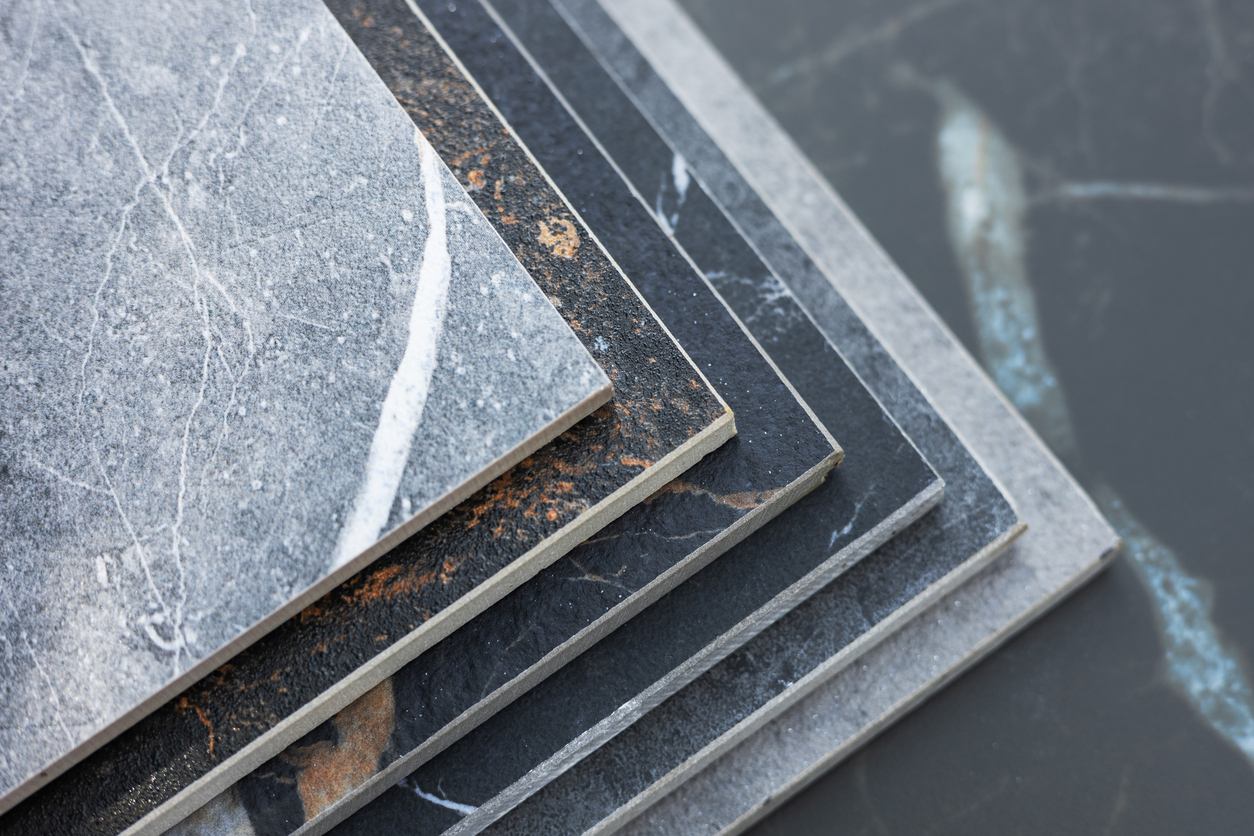
At the same time, the adoption of stone and concrete effect porcelain stoneware reinterprets the noblest varieties of the material, offering controlled veining, chromatic depth and micro-rough textures that interact with natural light without showing the intrinsic fragility of natural quarried stones. Unlike the original stone material, ceramic surfaces offer total uniformity of breaking load, absence of unverifiable internal cavities and almost zero water absorption, factors which avoid risks of frost cracking even in the harshest climate zones.
Photocatalytic treatments and self-cleaning for the preservation of the casing
An important technical aspect concerns some surface treatments that are applied by some specialized suppliers during the industrial sintering phase, aimed at enhancing the self-protection capabilities of the external casing.
One of these concerns the functionalization of stoneware using active ingredients based on titanium dioxide, which gives the surface advanced photocatalytic properties, capable of being activated in the presence of natural or artificial light. This chemical process decomposes the polluting particles deposited by urban smog and breaks down the nitrogen oxide molecules present in the air, transforming them into harmless salts that are easily washed away by rain.
The combination of photocatalysis and hydrophilicity prevents dirt from adhering tenaciously to the walls, guaranteeing that the large backgrounds keep the original brilliance intact without requiring expensive periodic washing interventions, preserving the real estate and architectural value of the work indefinitely.