
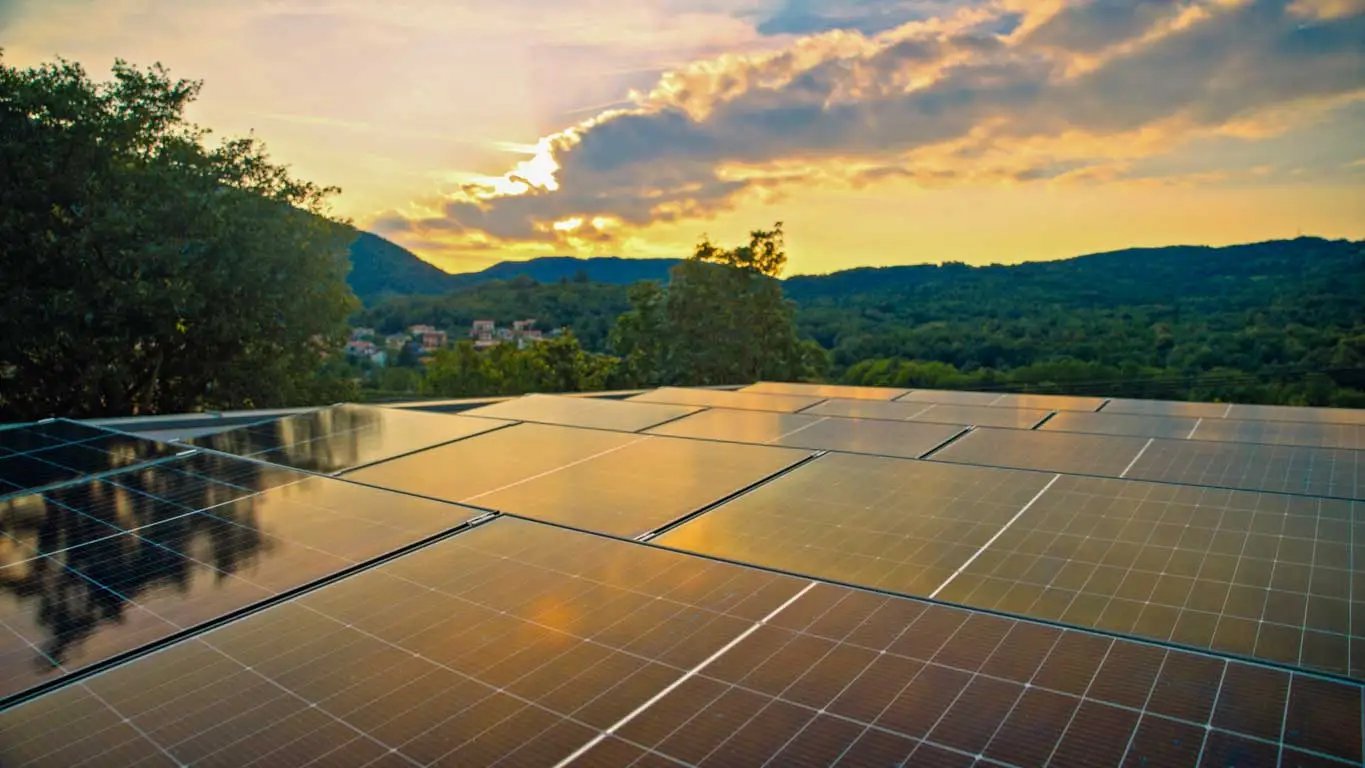
Panels and top view
The story originates from a demolition and reconstruction of a building located in an area subject to landscape restrictions for reasons of historical and naturalistic importance. When carrying out the works, the construction company had requested landscape authorization for the installation of photovoltaic panels on the roof of the building. However, he had received a negative opinion from the Municipality following that expressed by the Superintendence. Opinion contested, and with the first instance ruling the TAR for Lombardy had ordered the Superintendence to re-determine, contesting the fact that the ministerial body had expressed an a priori judgment based on visual perception alone, without evaluating the mitigation measures offered by the company.
In response to the request, the Superintendency had issued a new opinion confirming the ban: according to the body, the panels on the roof would have been highly perceptible from the hills behind and interfering, also due to the light reflection, with the overall vision of the ancient village, for which it suggested installing the system on the pergolas of the galleries of the internal courtyard, located downhill and therefore not visible from the hills. Hence the appeal before the Council of State.
No to the application of obsolete categories without analysis on the merits
In the appeal, the company and the condominium owner of the building contested the judges’ decisions with various reasons, both of substance and method. The Superintendence, in fact, had not really taken into consideration the proposed improvement design solutions (such as the use of panels with colors similar to the tiles or the movement on internal pitches), ignoring the favor of the jurisprudence towards the energy transition.
For its part, the alternative solution on internal pergolas, initially proposed by the Superintendence itself, would not have allowed the achievement of the minimum technical requirements for accessing state incentives for renewable energy. Furthermore, this same proposal was in turn rejected by the Municipal Landscape Commission, while the Superintendence, once again consulted on the matter, remained silent, thus generating a logical and procedural short circuit.
Panels now integrated into the construction style
The Council of State expressed itself in favor of the appeal, clearly rejecting any a priori assessment based on aesthetic standards that are no longer applicable, in light of the change in collective sensitivity and the pre-eminence of national energy transition objectives. According to the judges, in fact, photovoltaic panels can no longer be considered as “intrusions” or visual disturbance factors according to traditional aesthetic standards, but now represent an evolution of the construction style accepted by law.
Therefore the protection of the landscape (static interest in conservation) must necessarily compare and balance with the public and dynamic interest in the production of energy from renewable sources, as well as with the private interest in energy saving.
In this context, the Superintendency can impose the movement of the panels from the roof to other areas (such as pergolas) only if this alternative is aesthetically preferable but also technically and energetically acceptable. If, however, the move imposes a disproportionate sacrifice on the private individual, compromising access to public incentives or the energy efficiency of the property, the prescription becomes illegitimate due to lack of proportionality and unreasonableness.
Vice of unreasonableness if all factors are not taken into account
In particular, in the opinion of the judges, in this case the Superintendence fell into the vice of unreasonableness since it rejected the request by insisting on the mere perceptibility from the hills, instead completely ignoring the specific protections and mitigation interventions offered by the construction company, from the use of panels of a color similar to the Marseille tiles with aged finish, to the redistribution on the internal pitches oriented towards the valley, to the partial movement from the east pitch to the west.
In essence there was no examination of the merits, which is instead necessary in these situations. Furthermore, in the ruling, the judges of Palazzo Spada underlined that the recent reforms introduced by Legislative Decree 175/2025, which qualifies buildings and their appurtenances as areas suitable for photovoltaics and reduces the role of landscape authorities to a mandatory but non-binding opinion, confirm the irreversible direction undertaken by the legislator.
Thank you for subscribing to the newsletter.